The Paper Dog of the Traveling Circus
In a traveling circus, a painter meets a magician and a paper dog that alters fate. A romantic story about timing, love, and what feels real.
A Short Story by Mila Meraki
Ruby would come to learn that Parch had a talent for bringing people together.
The circus's arrival was announced first by the creak of wagon wheels. Excitement gathered in small towns when something extraordinary appeared to change their ordinary rhythm of life.
By the time the canvas tents rose against the horizon, stretching upward in arcs of striped color, anticipation settled into the lungs of those who came to watch and those who came to perform.
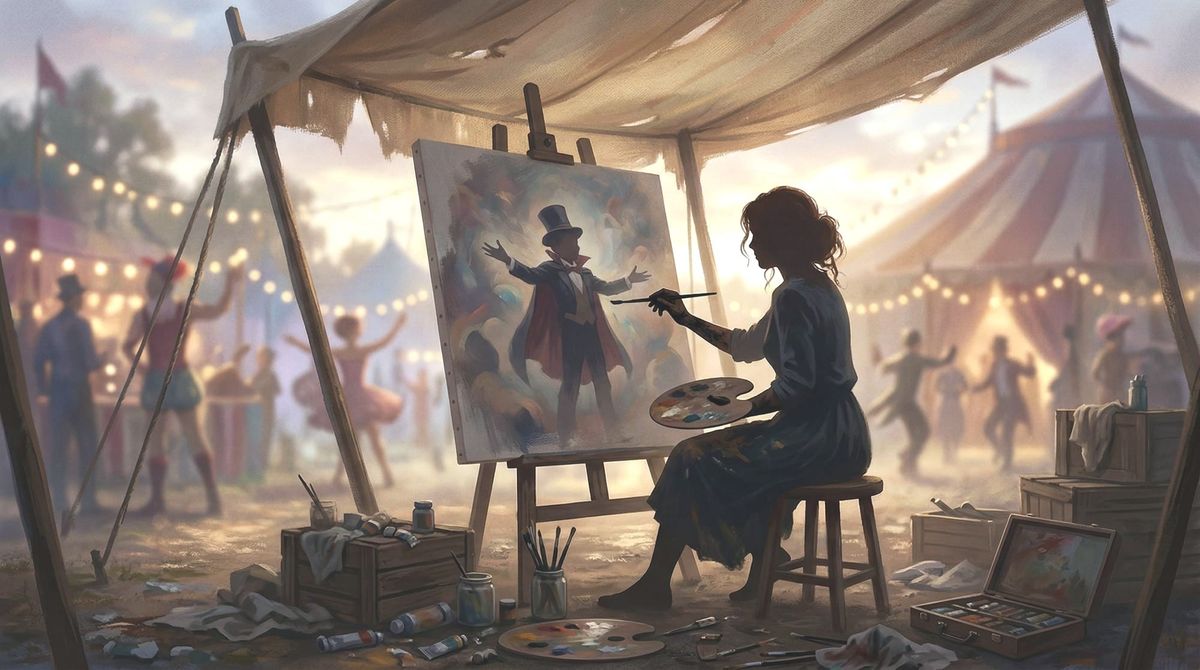
Ruby's job was to paint the performers of the circus as they existed in between performances.
She stood just beyond the main thoroughfare of the grounds. Her workspace was arranged with meticulous care beneath a slanted awning that shielded her canvases from dust and sudden weather.
Her hands were often stained faintly with pigments that never washed away completely.
An eclectic cast of performers moved past her in flashes of color and curated charisma, their laughter rehearsed, and their gestures modified for observation.
Their identities changed into palatable characters. They were more dazzling and more sellable this way, instead of highlighting the complicated truths that lay beneath.
Her brush moved across the canvas before her in practiced strokes, capturing the likeness of a trapeze artist whose public image suggested effortless grace, though Ruby had seen the tremor in her hands and the flicker of fear that no amount of applause could erase.
A low murmur of conversation drifted toward her, blending with the distant swell of music and the rustling of canvas, yet she remained focused until a shadow fell across her work, enough to draw her attention upward.
“Quite the observant flower you are,” a voice asked, smooth yet unpretentious,
“Noticing the persnickity details that others regretfully miss.”
Ruby looked up, and for the briefest moment, she forgot how to respond.
Then a soft, irregular sound drew her attention downward, and that was when she noticed the dog.
The Magician Arrives
The magician was undeniably magnetic in the way he occupied space.
His attire was nothing remarkable by circus standards, consisting of a fitted vest, rolled sleeves, and a loosened collar.
“I have been told,” he continued, “that you are difficult to work with.”
“Possibly,” Ruby replied, setting her brush aside, “Do you expect accuracy or flattery?”
“I expect both,” he said, a hint of playfulness touching his expression, “though I do lean towards flattery.”
Ruby studied him more carefully now, intrigued.
“You are the new magician,” she said.
“I am.”
“And you came to this tent to be painted.”
“Immortalized,” he corrected, “and to see how you would interpret me.”
The Paper Dog
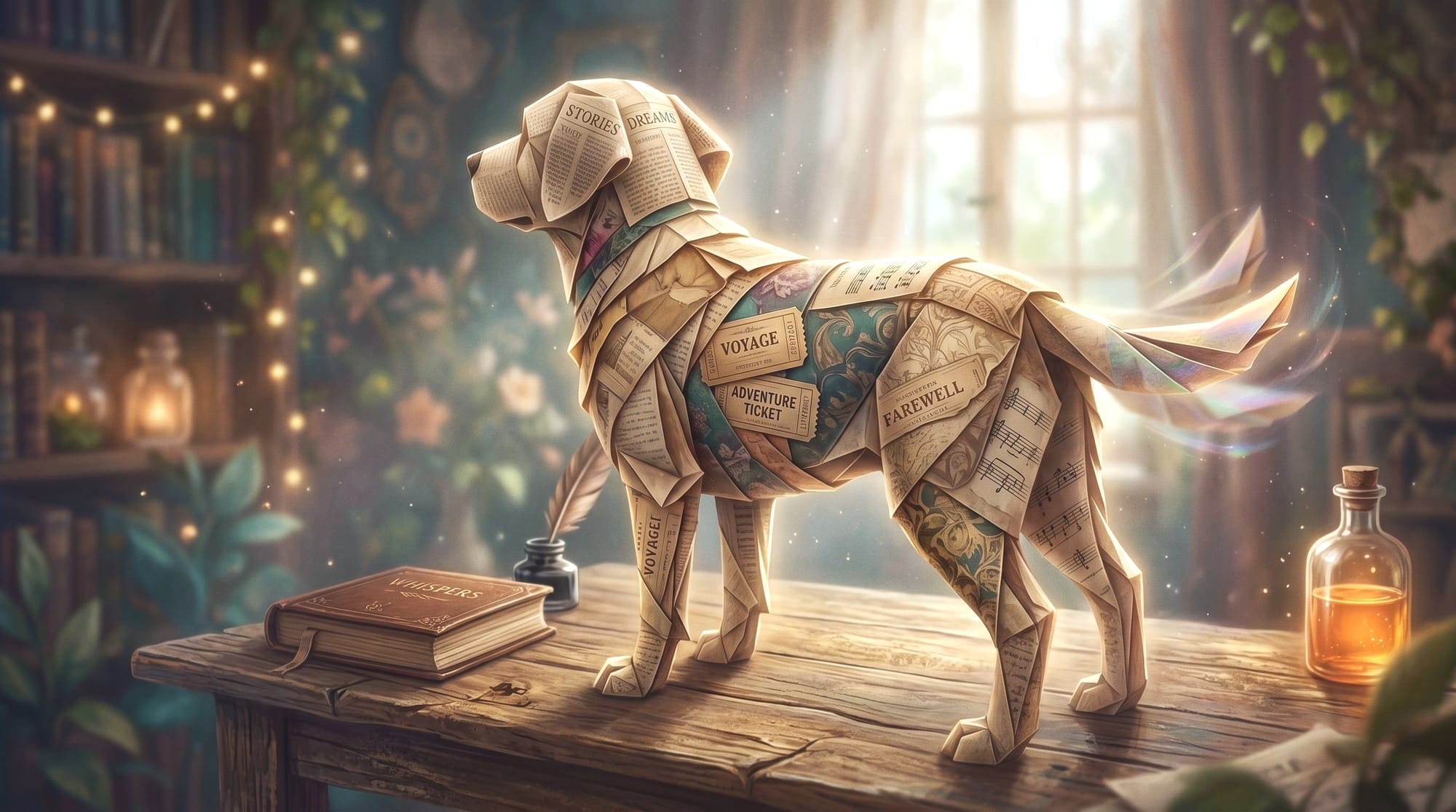
At first glance, the uncanny creature might have been mistaken for an elaborate decorative piece.
Its body was composed of layered brown paper, each segment folded and refolded with intricate detail, forming the recognizable silhouette of a chocolate labrador retriever.
Fragments of aged posters formed its torso, their muted browns and sepia tones blending seamlessly into a textured surface that imitated fur without replicating it, while ticket stubs and program scraps created subtle variations in color and pattern across its limbs.
Its ears—folded newspaper sheets that shifted when it moved—hung with convincing weight, and its tail, formed from a curling strip of cardboard paper, swayed with unmistakable enthusiasm.
The creature was clearly alive. It stepped forward with light taps, each motion accompanied by a rustle, a sound that might have been overlooked if not for its persistence.
“What,” she said finally, “is that?!”
The magician grinned.
“What is it,” she repeated.
He considered the question with apparent sincerity, though his answer came quickly.
“A wonderful companion.”
The gleeful dog reached her table, its head tilting with inquisitive charm, and then, with surprising care, it pressed its folded snout against her hand.
First Encounter
“Does it have a name?” Ruby asked, still watching the dog.
“It has had many,” the magician replied. “Though it does not seem particularly concerned with any of them.”
“Then I will call it Parch,” she said, as though the decision required no further discussion.
The dog’s ears lifted at the sound, and its tail gave a pleased flick.
“Parch it is,” the magician agreed.
The creature’s presence defied immediate categorization.
“Hmm,” the magician observed, “seems like it has taken an interest in its new identity.”
“It seems,” Ruby replied, though her voice carried an edge of uncertainty she did not appreciate, “to lack respect for boundaries.”
The dog nudged her again. She exhaled slowly, adjusting her grip on the brush.
“Fine, fine,” she murmured, more to herself than to either of them.
She resumed her work.
At first, everything proceeded as expected, her strokes controlled and her interpretation guided by the same principles she applied to all subjects.
When the dog approached, her hand moved more efficiently and her lines seemed to find their place without resistance.
Her perception became clearer, as though she were seeing not only what was in front of her, but what might be.
When she finished, she leaned back and studied the result.
She glanced up at him.
Then back at the drawing.
“No,” she said.
He tilted his head slightly. “No?”
“This is unlike the other paintings.”
“How?”
She turned the canvas around and the painting revealed the man not as he stood before her, but as he felt in that moment—his eyes fixed on her with an intensity that bordered on reverence.
There was something undeniably intimate in it.
“And what is your name?” she asked, more softly now.
“Orville,” he replied.
“You don’t look like this to anyone else, do you?”
The dog’s tail wagged at her response.
“May I,” he asked, stepping closer.
Ruby turned, changing her position slightly to explain the discrepancy she perceived, but he leaned in at the same time.
Their lips met gently and their eyes widened in shared recognition.
She could not name what had moved through her—only that it had come from a deep place. It frightened her slightly.
The dog’s tail flicked once as though pleased with its work.
The Dog that Nudges Fate
Orville began appearing in Ruby's workspace with a frequency that could no longer be attributed to coincidence, though neither of them acknowledged this outright, preferring instead to treat each encounter as though it were incidental.
“You have been avoiding finishing the painting,” he remarked one afternoon, leaning against a nearby crate.
“I have been working on it,” Ruby replied without looking up.
The paper dog, meanwhile, had made itself entirely at home.
It wandered through her space with endless curiosity, occasionally pausing to inspect a drying canvas or to rearrange a stack of sketches with its nose, its presence marked by the shuffling of paper and the soft, rhythmic tapping of folded paper paws.
More than once, Ruby had reached for a tool only to find it already within reach, positioned exactly where she needed it without recollection of placing it there herself.
More than once, Orville had caught supplies she had dropped before they struck the ground.
“You do that often,” she said once, giving a sly smile.
“Do what exactly?” He'd return the look.
“Arrive exactly when it's needed.”
He considered this, glancing briefly at the dog, which wagged its tail wildly.
Paper Meets Real
The town they passed through that week had streets lined with modest storefronts. Streets were shaded by large poplar trees, its inhabitants inquisitive as the circus set up along the outskirts.
Ruby found herself walking beside Orville in the late afternoon.
“This is unnecessary,” she said, though her tone lacked conviction.
“But, darling flower, you needed fresh air,” he replied.
“Surely those art supplies of yours are no good for the lungs.”
The paper dog trotted ahead of them, its tail swaying with uncontained delight as it explored unfamiliar territory, pausing occasionally to inspect a discarded scrap or to watch a passing figure.
Ruby followed its gaze.
A real dog—large, golden, and distinctly unimpressed by the world at large—stood tethered outside a shop, its posture relaxed, its attention only partially engaged with its surroundings.
The paper dog froze and with a sudden burst of energy, it leapt forward.
“Be nice, Marigold!” the owner called from the path, his voice half-amused, half-wary.
Parch circled it playfully, nudging gently at its nose, emitting soft crinkling sounds that mimicked a bark.
The golden dog leaned back slightly, uncertain, then tentatively extended its own nose and they touched.
A snicker escaped Ruby.
“It does not understand,” she said between soft breaths of laughter, “that it is not the same.”
“Parch does not need to understand,” Orville replied.
“Look how happy he is,” he added.
The golden dog, reciprocating, wagged its tail.
Ruby watched the interaction with a sense of wonder. She allowed herself to exist within a space that did not demand analysis.
And when she turned back toward Orville—he was already looking at her.
The Second Occurrence
“You should laugh more often,” he said, one evening as Ruby was washing her paintbrushes.
“Maybe things ought to be funnier,” she retorted.
“Perhaps, but one does not need a joke to enjoy the pleasure of laughter.”
Ruby set her brushes out to dry and when she moved closer to him, her azure eyes met his silver ones.
The paper dog sat in the middle.
His hand lifted, stopping for the briefest second before resting tenderly against her jaw, his touch careful, and delicate.
Then he kissed her again.
The Magic is Revealed
The realization emerged gradually, built from a series of observations that, when considered individually, might have been dismissed as coincidence.
She noticed during a trapeze act performance.
Ruby was camped at the corner of the tent, sketchbook in hand, her attention divided between the movement above and the scenario occurring below, her mind mapping the composition she would later commit to canvas.
One of the performers slipped and gasps rose from the audience.
And then—he recovered almost instantaneously. The safety net shifted just enough.
A second performer adjusted the position at exactly the right moment, she grinned nervously from the distance, sending a message that all was well.
Everything resolved seamlessly and Ruby's gaze traveled to the spot behind the second performer.
There the paper dog sat, watching it all happen.
The Truth
Ruby chose to confront Orville.
He stood near a table scattered with playing cards, his hands shuffling through a deck.
Parch lay at his feet, its form loosely folded, its tail giving occasional, absent flicks as though responding to stimuli only it could perceive.
“You knew,” Ruby said.
She did not look up immediately, though his hands paused briefly in their work before resuming.
“I suspected,” he corrected.
She stepped closer, her sketchbook held tightly in one hand.
“You have been allowing it,” she continued, her voice steady.
“Everything between us and every… alignment.”
He exhaled slowly, set the cards aside at last and gave her a glance.
“Yes.”
The simplicity of the answer annoyed her more than any evasion might have.
“But why?”
He considered the question with visible care, though when he spoke, his tone remained even, devoid of defensiveness.
“Because it brings favorable outcomes.”
The dog stirred, lifting its head cluelessly, its ears shifting as though responding to the change in atmosphere.
“I found it,” Orville continued, “years ago. It was… damaged. I repaired it, nursed it as best I could, and after that—”
“Things became easier.”
Ruby's jaw tightened slightly. “You mean luckier.”
“Exactly my darling. Better timing,” he clarified. “Better opportunities. Beautiful moments that aligned when they otherwise would not have.”
“And you did not question it.”
“I did,” he said. “Several times. I decided that the outcomes mattered more than the method.”
Parch was uncertain of its role in the current exchange.
Tension
“You should have told me,” Ruby said.
“I did not know how, or where to start,” Orville replied, “and because I did not know,” he said, his voice lower now, less composed, “whether you would still be here if you understood it fully.”
The frankness of the statement struck with more force than she expected.
“Tell me,” she said, her voice barely above a whisper now, “that this—” she gestured between them, “whatever this is—is real.”
He listened patiently and took a breath.
“I love you,” he said.
“Does that answer your question,” he added.
He closed the distance without conscious decision, driven by a force that transcended logic. This time the kiss was fuller.
“That,” Ruby said, her voice unsteady for the first time, “was very real.”
Final Act
The night of the final performance in that town arrived.
Backstage was a symphony of motion and sound. Performers pushed past one another in carefully orchestrated disorder. Assistants shouted last-minute instructions.
The tent was thick with anticipation and the metallic tang of nerves.
Ruby moved through it with practiced efficiency, her sketchbook tucked beneath her arm.
Orville stepped into the light as the music traveled, the low murmur of the crowd dissolving into a hushed congregation.
His act began simply.
A deck of cards appeared, vanished, reappeared in impossible places—behind his ears, beneath his shoes, and suspended in midair.
The audience responded as expected: delight, surprise, the soft ripple of applause.
But then the act underwent a transformation. The lighting dimmed, narrowing into a single golden beam.
Parch stepped forward.
At first, the audience laughed—uncertain if this was part of the illusion or something more whimsical than impressive.
It tilted its head and then impossible things began to occur.
A ring tossed from the crowd landed perfectly on Orville’s finger without him looking.
A dropped prop never hit the ground.
A gust of wind lifted the edge of the curtain at precisely the right moment to reveal what should have remained hidden.
Every movement, every beat, every transition unfolded with grace and perfection.
Ruby watched from her station. She could see it now, clearly as brushstroke on canvas.
The dog nudged the world so that everything unfolded at its most beautiful version of itself.
Applause thundered through the tent. The audience rose to their feet before the act even ended.
Orville looked past the crowd and straight at Ruby.
She no longer questioned what she felt.
The image she had tried to capture finally made sense.
Parch was a companion that followed the best possible outcome, and whatever came next was entirely their own.
You’ve reached the end of this story.
But not the end of the world it belongs to.
New stories appear regularly.
Stay curious.
✦ Related Reading & Themes
This story explored:
the unseen forces that shape timing, connection, and chance
how being truly seen can change the way we see others
the tension between coincidence and intention
the idea that some moments arrive exactly when they are ready to be felt
the soft unfolding of connection in spaces built for performance
Tags for similar stories:
magical realism, circus setting, whimsical fantasy, soft surrealism, romantic fantasy, quiet love story, slow burn connection, character driven fiction, introspective fiction, subtle supernatural, fate and timing, found connection, emotional growth, soft paranormal, atmospheric fiction, understated romance, cinematic storytelling, reflective fiction, comfort fiction, whimsical romance, poetic fiction
✦ If You Liked This Story
You might also enjoy:
Journals of Unlived Lives - Viva discovers a hidden bookstore filled with donated journals—each one alive with the echoes of a life once lived. As she grows closer to the shop’s reserved accountant, they fight to preserve a place where some stories continue long after they’ve ended.
If you want more stories like this, explore the full Petalstorm Press library → HERE
© Petalstorm Press — Original Fiction
This story is part of the Petalstorm Press library.
Redistribution or reproduction without permission is prohibited.