The Golden Invitation
Calligrapher Laelia Valentina discovers an illuminated manuscript that writes back. She finds herself drawn toward a golden invitation hidden inside its pages.
A Short Story by Mila Meraki
Laelia’s New Job
The job interview began beneath a ceiling painted the color of old parchment, in a municipal arts office whose windows overlooked the fairgrounds.
Bright tents were still being raised like flowers from the grass and colorful pennants snapped above the vendor lanes.
Laelia Valentina sat opposite three strangers at an oval table. She handed one of them a portfolio of lettering samples.
“Miss Valentina, your pieces are unusually expressive,” said Mrs. Perrine, the director of the town’s Heritage Fair, a woman with transparent glasses, lacquered nails, and the serene brutality of someone who had rejected hundreds of applications without losing sleep.
“What makes you believe you can handle demonstrations with visitors watching over your shoulder?”
Laelia folded her hands on her lap, since the nails of her right hand still held a crescent of India ink from a commission finished after midnight.
“People already watch artisans work online,” she replied, choosing composure over desperation.
“At least in person they can smell the ink, ask questions, and discover that beautiful things are usually made through repetition rather than enchantment.”
Beside Mrs. Perrine, a man named Arlo Beam leaned forward as though he had found a personal philosophy inside her sentence.
“Would you say you are patient with children and critics?”
“Children are curious and critics give good information,” Laelia said.
Arlo allowed a small smile to rearrange the severity of his face. He then asked Laelia to demonstrate a decorative capital.
Laelia uncapped her fountain pen, drew a lavish V whose stem unfurled into vines, then added a procession of small leaves that looked less invented than remembered.
When the interview ended, Mrs. Perrine offered a temporary position as a calligraphy demonstrator for the season, not grand employment but enough to pay a month of rent.
Laelia had spent years writing other people’s important words in beautiful script: wedding vows, anniversary menus, baptismal cards, memorial verses, and names that would be framed, gifted, photographed, or forgotten. Everyone admired the lettering. Few people asked about the person behind it. Skill, she had learned, was easiest to sell when it appeared obedient, anonymous, and useful.
She accepted with gratitude, left the office carrying a badge on a blue lanyard, and stepped into the fairgrounds with the peculiar sensation that a door had opened.
The Manuscript
The fair had become fragrant with kettle corn, rain-damp straw, beeswax polish, old paper, roasting nuts, and the mineral tang of metal warmed by sun. Laelia passed booths selling medieval-style brooches, botanical prints, embroidered linen, and tiny glass animals that made adults speak in childish voices.
Near the far edge of the grounds, between a stall of vintage maps and another of obsolete postcards, she found a narrow booth crowded with manuscripts, loose folios, and battered ledgers tied in ribbon. Behind the table stood a man with silver hair, russet gloves, and a face that held secrets.
“You have a good eye,” the man at the stall said as Laelia paused in front of a manuscript bound in mellowed leather.
“That one is different.”
The gilded edges caught the light, brightening when Laelia tilted the pages, shining in lines that seemed to follow the movement of her hands. Tucked between stacks of older books and loose prints, it stood out without trying.
“Different how?” Laelia asked, though the question carried its own reluctance.
The vendor shrugged lightly, but his gaze lingered on the book rather than on her face. “It tends to find the right person.”
Laelia laughed, because the sentence resembled a sales tactic.
“Or let me guess, the right person finds it.”
“Maybe,” he replied. “Just be mindful where you leave it.”
Laelia considered asking whether the warning referred to theft, humidity, jealous librarians, or ghosts with excellent taste. The vendor had already begun wrapping the manuscript in brown paper.
A Beautiful Thing
Laelia brought the manuscript home to the apartment she shared with Luz Moran.
The apartment occupied the second floor of a brick building above a laundromat with windows that rattled in windy weather and radiators that hissed like resentful kettles through the colder months.
Laelia’s room contained a thrifted desk, jars of nibs, a stack of half-finished sketches, pressed flowers between copy paper, and a corkboard covered with postcards from museums she had visited mostly through gift shops.
At first she set the manuscript on the desk, intending to look through it after dinner, dishes, and the small domestic obligations that always multiplied when ignored.
Eventually, after Luz had gone to her clinical shift and the neighborhood had settled into a nocturnal arrangement of passing tires, Laelia reached for the manuscript.
She pulled it closer, unfolded the paper, and opened the cover slowly.
The pages were thick and uneven and the illustrations were intricate without becoming excessive.
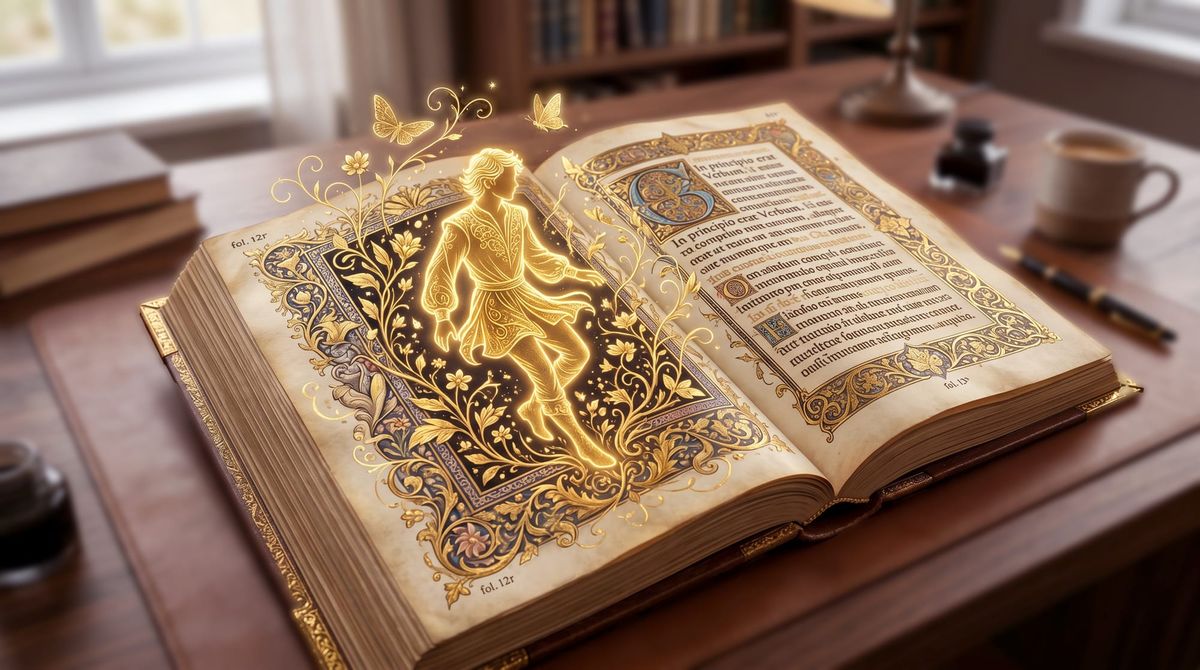
Vines curled into the margins, small animals tucked themselves into corners with an almost conspiratorial modesty, and organic figures appeared in the background of certain pages, their forms deliberate enough to unsettle any claim of accident.
Gold leaf threaded through the details, glistening and illuminating parts of the page in a manner that felt almost selective, as though the book were choosing what deserved to be seen.
“It’s so beautiful,” Laelia murmured, while the room listened without answering.
She turned page after page, finding no title, no author, no date, no colophon to anchor the object in an ordinary chain of maker and owner. The writing seemed to belong to several languages at once, with Latin ligatures and Greek-looking curves.
Every page carried a faint scent of violets and dust, an improbable combination that made Laelia think of old churches and rain on stone.
Weird Stationery
Laelia noticed the first odd instance three nights later, and even then she nearly convinced herself that exhaustion had altered her memory.
A flower rested in the lower margin of a page she was certain had been empty before, its petals thin and expertly shaped, the gold at its center radiating softly.
She stared at it longer than a reasonable person would have stared.
“That was not there at all,” Laelia said, closing the book halfway before opening it again.
After that, more began to appear.
A swash curved along the edge of a passage she had lingered on the night before, its shape following the exact path her fingers had traced without awareness. Leaves and branches filled the margin beside a page she had reread twice, their edges brightening faintly whenever she tilted the book to catch the lamp glow.
A moth emerged near the spine, all veined wings and patient antennae, and beside it bloomed a cluster of berries in a pigment so deep it seemed less red than remembered blood.
“You keep staring at that thing,” Luz said one evening, watching from the kitchen counter while chopping cilantro with the solemn aggression of a medical student who had memorized a library of symptoms.
“I feel like it’s special,” Laelia replied before prudence could intervene.
Luz raised an eyebrow, her expression moving from amusement toward concern.
“Please don’t be weird around stationery.”
“I mean it,” Laelia insisted, turning the book so the gold along the margins caught the light again. “Things keep appearing when nobody touches the pages.”
Luz stepped closer.
“This flourish was not here before,” Laelia said, opening to a page whose margin now bore a vine curling around a rabbit no larger than a fingernail.
Luz glanced down, and looked back with the compassionate firmness of someone preparing to recommend sleep and hydration.
“It looks old to me.”
Two Names
The first time Laelia saw her own name on a spread, she did not tell Luz. It was hidden within the page, woven through a trellis of vines so elegant that recognition arrived like a trespass. L curled into a stem, A doubled as leaves, E vanished among tendrils, and the rest revealed itself in pieces.
“Are you all right over there?” Luz asked from the couch, where anatomy flashcards lay across her lap.
“Yes, just tired,” Laelia answered, closing the book before Luz could see what held her gaze.
Luz contemplated her for a minute. “You have been strange since you bought that thing.”
After that, the changes became more noticeable. A small heart curled into the spiral of a vine. A human figure appeared like a silhouette rinsed in moonlight, unrecognizable but unmistakable.
When Laelia turned the page, the figure appeared again, clearer this time, its posture altered, one arm lifted as if in greeting or appeal. She flipped back, then forward, then back again.
The first words appeared the night after that.
your spirit is beautiful
Laelia stared for a long moment, her fingers hovering just above the page, unwilling to touch the letters in case contact made them vanish.
“Did you mean my spirit?” she whispered, though she was not certain who might answer.
The next page offered no explanation.
your hands make the margins bloom
Laelia pushed her chair back so swiftly that one leg knocked against the floorboards, waking the radiator into a clank of protest.
“I don’t understand any of this,” she said, her voice unsteady enough to embarrass her in the empty room.
His name appeared in fragments over the following days, scattered across pages in a way that forced her to search for it, each letter hidden within foliage, beasts, flourishes, and architectural borders as if never meant to be read all at once.
O was the ring of a halo, L the root of an illuminated tree, I a golden pillar, V a pair of swallows descending, I a reed beside painted water, E a curling wave, and R the tail of a fox. The surname came later, lodged among thorns and scrollwork.
The name was Olivier Refley.
When Laelia said the name aloud, the room was newly inhabited by an attention that had always been waiting for permission.
Olivier’s Privacy
The fair continued, because ordinary obligations have the discourtesy to persist.
Laelia demonstrated lettering beneath her assigned awning, drawing names for children, bookmarks for tourists, and a marriage certificate border for a couple who argued about font weight with devotional intensity.
Mrs. Perrine praised her composure, and Arlo returned daily with jokes that made nearby artisans groan with theatrical despair.
“Calligraphers always know how to draw the line,” Arlo announced, holding up a pretzel like a lecturer’s pointer.
At the end of each day, Laelia returned to the apartment and opened the manuscript.
The figure in the margins gained detail by increments. A shoulder emerged beneath a long coat. A defined throat showed above a cravat. Hair darkened in loose waves touched with gold. Hands appeared most distinctly, one palm often turned outward as though pressed against an invisible pane.
Then, one night after rain had lacquered the windows and Luz had fallen asleep during a documentary about surgical mistakes, the manuscript opened to a page Laelia had never seen before.
A painted room filled the margins, its walls lined with shelves, its ceiling crossed by beams, its hearth holding a low amber glow.
At the center stood the illustrated man, no longer only a silhouette, but a figure rendered with the precision of a miniature portrait.
His eyes were green with a ring of brown near the pupil, his mouth curved as if he had nearly remembered joy, and beneath his image bloomed a sentence in gold.
I was not always ink.
Luz found Laelia asleep beside the open manuscript the next morning, cheek resting on a sweater, fingers near the gilded edge. The margins were empty except for the original vines, no names and no figures. Laelia woke to Luz shaking her shoulder with exasperated affection.
“You need breakfast and possibly supervision,” Luz said.
Laelia sat upright and shut the book. “The pages were different last night.”
“The pages are still paper this morning,” Luz replied.
Laelia wanted to tell her everything: the name, the words, the figure, the sense that Olivier Refley was neither metaphor nor delusion. Yet the manuscript had already demonstrated a preference for privacy, and fear made Laelia possessive.
She hid the book after Luz left for class, sliding it into the back of the closet, where no visitor, roommate, or landlord would think to look.
Luz noticed the absence immediately that evening, because nothing interested a practical woman more than a missing source of impractical trouble.
“What happened to that weird book?” Luz asked, glancing at the empty space on Laelia’s desk.
“I put it away,” Laelia replied evenly.
“Why would you do that now?”
Laelia met her gaze, holding it long enough to make the boundary visible. “Because not everything needs to be shared.”
Luz’s expression softened, though hurt flickered behind it. “Just let me know if you need help with something. You’re my friend.”
She nodded, washed two mugs, and went to bed without allowing herself to look toward the closet.
Stepping Out of the Margins
That night, Laelia dreamed of the fairgrounds after closing, of manuscript pages fluttering from tent poles like pale moths. Somewhere beyond the vendor lanes, a man called her name with aching patience, but every path she followed led back to the stall where the silver-haired vendor wrapped nothing in brown paper and smiled at an empty table.
While Laelia dreamed, the room around her did not remain empty. Across from her bed, Olivier appeared.
His outline gleamed in golden brilliance, as though the moon had learned to draw a human form.
He was slender and insubstantial, leaning against her desk with careful poise, dressed in the long coat and cravat from the portrait, with sunlit hair falling beside a face more sorrowful than predatory.
He did not come closer, only watched Laelia turn in her sleep and pull the blanket higher around her shoulders.
Behind him, the closet door stood unopened, but the hidden book seemed aware of his presence. He leaned forward just enough to see Laelia clearly, and some expression passed through his translucent features, grief mingled with wonder, desire chastened by restraint.
Then, from the closet, the manuscript opened itself on its own.
Thin lines of gold began to return, glistening as they spread through the margins once more, illuminating the surface beneath folded scarves and lavender sachets.
Vines uncoiled. Olivier smiled with the exhausted certainty of someone who understood longing as both compass and prison. Then he returned to wherever he had come from, leaving behind the impression that he already knew Laelia would open it again.
The next morning, she sat on the edge of the bed for a long time, listening to Luz in the kitchen. The sensible world continued to make its claim, yet beneath it ran another script, one written in vines, vanished margins, and a name.
Laelia crossed the room, drew the closet door open, and removed the book.
The manuscript lay in her hands. When she lifted it, warmth moved through the leather, subtle and unmistakable, like a pulse disguising itself as memory.
From the kitchen, Luz called, “Want some eggs?”
“In a minute, Luz, I promise,” Laelia answered, holding the manuscript against her chest.
Then she opened the manuscript to the page where Olivier’s portrait had been and found an image of a room waiting, brighter than before. Beside the hearth, a chair had appeared, empty and angled toward him with the unmistakable intimacy of an invitation.
Beneath it, in gold, a new sentence bloomed.
come where you are seen
✦ Related Reading & Themes
This story explored:
how being seen can feel both tender and perilous
how a magical manuscript can blur the line between art, haunting, and desire
how the margins of a page can hold a hidden world
how an artist’s hands can awaken something forgotten
how tenderness can begin through restraint, attention, and mystery
how a room inside a book can become both refuge and warning
how the desire to be understood can open doors that should perhaps remain closed
Tags for similar stories:
romantic fantasy, magical realism, soft fantasy, atmospheric fantasy, emotional fantasy, cozy fantasy, literary fantasy, soft gothic romance, supernatural romance, haunted romance, romantic supernatural fiction, enchanted object, magical object, enchanted manuscript, magical manuscript, illuminated manuscript, living book, magical book, female artist, calligrapher protagonist, creative woman protagonist, enchanted art, romantic haunting, ghostly romance, spectral figure, man in the margins, magical invitation
✦ If You Liked This Story
You might also enjoy:
Porter's Restaurant in the Rain - A soft magical realism story about a woman who discovers a hidden restaurant that appears only in the rain—guiding her toward the life she never realized she wasn’t choosing. An introspective romance about autonomy, alignment, and becoming.
You’ve reached the end of this story.
But not the end of the world it belongs to.
New stories appear regularly.
Stay curious.
If you want more stories like this, explore the full Petalstorm Press library → HERE
© Petalstorm Press — Original Fiction
This story is part of the Petalstorm Press library.
Redistribution or reproduction without permission is prohibited.
All stories shared through Petalstorm Press—and the channels linked here—are the official home of this work. Any versions found elsewhere are not authorized unless clearly noted.