A Seascape of Living Layers
When a pirate steals a living seascape and traps his crew inside, a restoration artist must enter the painting and uncover the layered magic hidden beneath its tide.
A Short Story by Noiah Metta
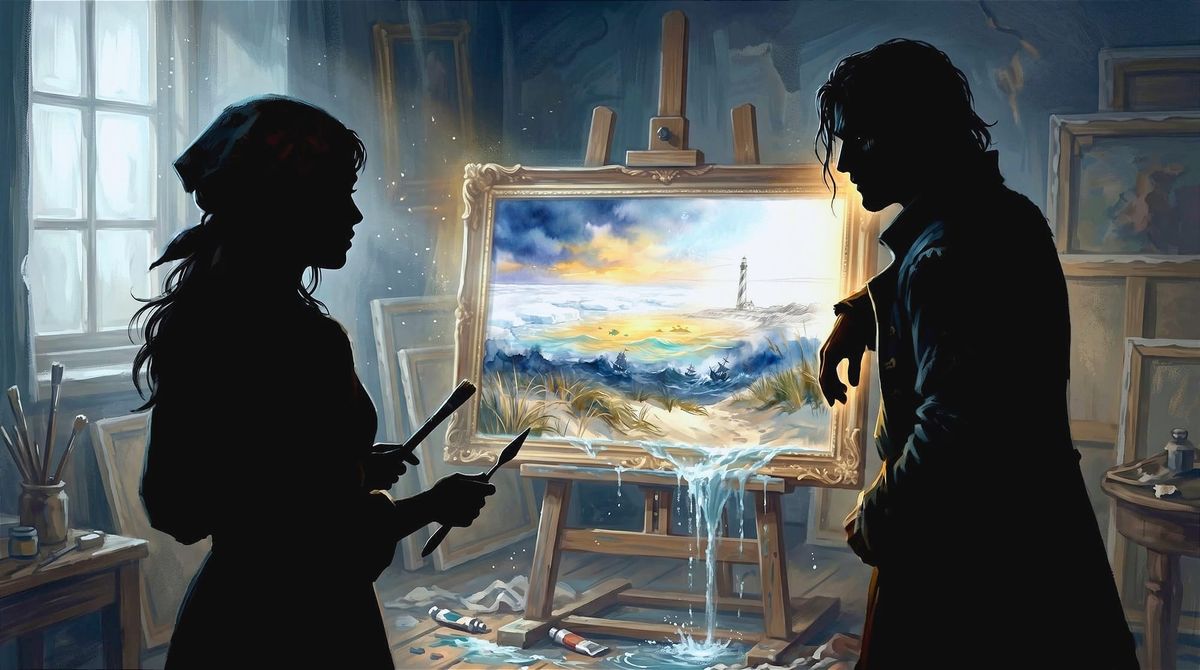
Atlas Delmare arrived at Tsula Sinclaire’s restoration studio with rainwater in his hair, blood darkening one sleeve, and a framed watercolor clutched beneath sailcloth as though it were a sleeping infant or a loaded pistol.
The storm outside had turned the street of bellmakers and framers into a narrow canal, its gutters frothing with paper petals, fishbones, and stray pigment from the workshops uphill.
Thunder rolled over the harbor with the weary irritation of some old god being asked to rise from bed.
Tsula opened the door with a glimmering lamp in one hand and a silver palette knife in the other. She had her black hair pinned beneath a scarf printed with faded butterflies.
“I’m in big trouble,” Atlas said, pointing at the framed seascape. “My crew is trapped in there.”
Tsula stared at him, then at the sailcloth, then at the trail of seawater making a glistening path across her floor.
Atlas gave her the smile that had once charmed customs officers, debt collectors, duchesses, and one unusually sentimental kraken, but Tsula only lifted the lamp higher. The otherworldly light revealed the painting beneath the damp cloth.
The watercolor showed a ship no larger than a beetle struggling upon an indigo sea. Its masts bent beneath violet weather, and its sails were rendered in translucent washes.
Then one tiny figure on the painted deck lifted both arms and struck the inside of the frame.
Tsula’s face changed.
“That is Sereia Aethel’s work,” she said.
The painting trembled. A bead of seawater swelled along the lower edge of the frame, fell onto Tsula’s floor, and spread into a blue stain that smelled of kelp and old varnish.
She stepped aside.
“Bring your disaster inside before it drowns my neighbors.”
The Rules of Living Art
Tsula’s studio was full of drying racks of canvases, cabinets of powdered lapis and malachite, sable brushes floating inside moon-charged water, and apprentices’ exercises pinned along one wall like captured butterflies.
She laid the watercolor upon a table, then studied its brushwork through a lens made from polished abalone.
His ship groaned within the image.
“Living paintings obey rules, whether thieves know them or not,” she said.
A sound like muffled shouting rose from the frame, and Atlas’s hands curled around the table’s edge.
“My boatswain is in there. Giles Dash. He has survived cannon fire, fever, and a card game against a priest. I refuse to lose him to decorative paper.”
“Living watercolor is never merely decorative when the binder contains moonstone powder, enchanted salt, and a willing memory.”
“Moonstone powder? That is much rarer than gold.”
“It is nearly priceless, which is why plunderers like you should educate themselves before developing ambition.”
Tsula pointed to the painted sky, where one wash of gray bent against the others in a contrary direction.
“First rule. Never touch the surface of a living painting with bare skin unless invited.”
Atlas leaned closer.
The ship inside the painting lurched, and a tiny sailor tumbled toward the rail. Atlas reached out without thought, without patience, without permission, and placed his fingertips against the painted sea.
The studio exploded into ocean.
Inside the Painting
They landed on wet planks beneath a bruised sky, with painted rain coming down in ribbons of diluted ultramarine and the deck of Atlas’s ship, the Gildhawke, bucking under them.
Crew members shouted and slipped across pigment-slick boards, staring at Tsula as though the storm had delivered her by mistake.
Giles Dash, broad-shouldered and bearded, pointed at Atlas with a fury that needed no translation.
“Captain, your rescue plan could use more flair.”
Rysen Nerin, who wore three earrings and an expression of permanent disbelief, spat blue seawater over the rail.
“At least the lady looks competent.”
Odell Conall, pale and shivering beneath a torn coat, clutched a canvas-wrapped box to his chest.
“Does anyone else taste the paint?”
Tsula rose from the deck with drenched dignity, her skirt clinging to her boots, her gaze already traveling across the storm.
“This ocean responds to conflict,” she said. “Every argument deepens the wash, every accusation thickens the weather, and every heroic impulse from your captain is likely to kill us faster.”
Atlas wiped rain from his brow.
The thunder cracked open above them, revealing a seam in the paper sky, and Tsula saw what the sailors could not: every wave was made of brushstrokes moving against each other, anger layered over panic, panic glazed over guilt.
She took Atlas by the wrist, turned his hand palm upward, and dragged one finger through the rainwater pooled there.
“Feel the current beneath the current.”
He looked at her hand upon his, then at the water trembling in his palm.
“It is moving west.”
Together they crossed the deck, his stride born of storms and hers of study, and when a mast split near the top, Atlas shouted orders that sent Giles and Rysen into motion while Tsula pressed both hands against the mainmast and read the pigment like a pulse.
“Your sea was painted in anger,” she said.
The waves faltered.
Atlas looked from the subdued water to her rain-bright face. Tsula Sinclaire was a woman who could stand inside a storm and translate its sorrow.
They found the first seam in the eye of the storm, a place where the painted clouds thinned to expose a pale membrane of unworked paper.
Tsula held her hands out to the seam.
“The passage will not open until someone confesses what brought them here.”
The crew looked at Atlas with blank expressions.
He climbed onto an overturned crate as rain fell around him in blue strings.
“I stole the seascape from the gallery ship,” Atlas said, his voice carrying over mast, rope, and restless water. “I told myself it was ransom money to buy Odell’s brother out of the glass mines, but that was not the whole truth. I enjoyed the theft. I ignored the warnings. Every soul aboard this ship is here because I mistook need for permission.”
No one spoke for a moment.
Then, the eye of the storm opened.
A passage of white light unfurled before the Gildhawke, and the ship sailed through with its sails full of rain, leaving the angry ocean behind like a page turned by a solemn hand.
Indigo bled into turquoise. Violet weather softened beneath a wash of gold, and the sea around the ship brightened as though Sereia’s brush had dragged clean water across the page.
Atlas saw turquoise water lapped against the hull, pink clouds lounged across a golden horizon, and floating islands trailed vines heavy with plump fruits. He stared in awe at large flowers growing from broken masts. The air smelled of mango, warm cedar, and coastal holidays.
Rysen began weeping because a table appeared on deck bearing roasted duck, sugared pears, and his grandmother’s blue teapot.
Odell saw a small rowboat carrying his missing brother and nearly climbed overboard.
Giles discovered a chest of coins, opened it, shut it, and muttered that temptation had become lazy since his youth.
Atlas looked toward Tsula.
“This place gives people what they want,” he said.
“Possibly,” Tsula answered.
“Sereia’s work explores desire, among other things,” she added as green vines crept up the rail, spelling his name in red blossoms.
“It is merely an illusion,” Tsula said, though she hesitated long enough for Atlas to notice.
Atlas saw the pink in her expression and looked to the horizon.
“Come, we must find her signature,” she said as she turned away from him.
Their search for Sereia’s hidden signature took them away from the crew and into a lagoon where violet water moved beneath stone arches painted with shells, eyes, and winged fish.
The world arranged itself around them with insolent extravagance. A hammock swung between two palms. A silver tray appeared with figs, wine, and two cups. Somewhere beyond the palms, unseen musicians began a melody too intimate for strangers.
Atlas looked offended.
They found Sereia’s mark carved into a stone arch beneath a thin skin of pigment.
“Sereia never signed living work in one place,” Tsula said. “She scattered herself through the underpainting.”
When Tsula reached to test the surface, Atlas’s hand closed around the same patch of stone.
Their fingers touched.
Tsula withdrew, though not fast enough to convince either of them.
With the stone in hand, they returned to the Gildhawke and found half the crew enchanted by gifts the tropical sea had placed before them.
When she placed the stone upon the deck, the scenery opened into a winter sky.
The Frozen Ocean
The frozen ocean waited with no interest in welcome.
White cliffs rose from blue-black water, silent ships stood locked in ice, and the sky hung low as unprimed canvas stained with ash.
“Here, lies become frost on the speaker’s skin,” Tsula said.
The Gildhawke ground against a floe and stopped.
Tsula and Atlas crossed the ice toward a cabin drawn in charcoal black lines and pale washes, its chimney releasing smoke that rose in perfect spirals before becoming birds.
Halfway there, Atlas said, “It is not that cold.”
Frost immediately climbed his throat.
Tsula gave him a sidelong glance.
“Try telling the truth before you become a statue with excellent cheekbones.”
“It is miserable, and I despise it.”
The frost retreated.
The cabin door opened when Tsula touched Sereia’s hidden signature beneath the latch, and they entered a room containing one iron stove, one blanket, and walls covered in unfinished sketches of hands reaching from water.
Atlas fed painted driftwood to the stove while Tsula studied the sketches, each one a variation on rescue interrupted.
“My father died following a map I forged as a boy. My first mate lost an eye taking a cannon meant for me. Odell’s brother entered the glass mines because I failed to pay a debt quickly enough.”
Tsula sat across from him, the blanket between them like an unfinished treaty.
“I painted a harbor once,” she said. “It was meant to comfort grief, but it trapped the grieving boy inside.”
For a while, only the stove spoke.
Then Atlas extended his hand, palm upward, asking without words but not presuming an answer.
Tsula placed her fingers in his.
Their words and the honesty of their joined hands caused the ice to melt along the cabin window, and beyond it, trapped ships began to creak awake.
At dawn, or whatever the frozen painting used in place of dawn, they found sailors from older ships suspended in ice along the shore.
Each figure wore a painted mark over the heart, the same sigil hidden beneath Sereia’s brushwork: a crowned eye encircled by a frame.
Tsula recognized it as the mark of Lord Leander, a collector whose private gallery was rumored to be entwined with royal courts, interspecies treaties, and contracts no honest magistrate had ever been allowed to read.
Atlas stood before a frozen captain whose hand rested forever upon a wheel.
The ice cracked.
Beyond the frozen fleet, a horizon of raw linen appeared, and pencil-line waves began sketching themselves into existence.
The Gildhawke lurched free, and the sea’s final layer drew them forward.
The unfinished sea was terrifying because it had not yet decided what terror should resemble.
Its sky was bare canvas stretching beyond sight. The waves were graphite arcs, some filled with color, others abandoned before completion. Sections of the world vanished into blankness.
Tsula ordered the crew to tear strips from the spare sailcloth and write their names using pigment scraped from the deck.
“Names are anchors here,” she told them. “Memory gives the line something to hold.”
Giles wrote his name in enormous letters.
“If reality forgets me, make certain it remembers my shoulders.”
Rysen wrote his beside a small drawing of the blue teapot.
Odell wrote his own, then his brother’s, and the letters glowed like banked embers.
After recording his name on the cloth, Atlas handed Tsula a strip.
“Write yours too,” he said.
She looked at him for a long moment, then wrote Tsula Sinclaire in black pigment, followed by one smaller word beneath it.
Painter.
The unfinished ocean shivered.
They found Sereia Aethel standing upon an island made from stacked sketchbooks, surrounded by brushes taller than trees and pools of color that reflected different skies.
She looked older than Tsula remembered, though not by years alone; she had the worn magnificence of someone who had been mistaken for dead and found the rumor useful.
“My beloved apprentice,” Sereia said.
“You're hiding here?” Tsula asked.
“I hid here because the final painting cannot be completed from outside,” Sereia said. “If Leander found the method, he would own every horizon that ever trusted paint.”
“This was never several oceans,” she added.
“It was one sea, painted in layers. The storm was the first wash. Desire was the second. Truth was the third. The unfinished water was beneath them all.”
Tsula looked toward the blank horizon, where pencil-line waves continued sketching and unsketching themselves.
“You made the painting defend itself.”
“I designed it to have a choice,” Sereia said. “Leander wanted a weapon that could swallow fleets on command. I gave him a sea that would only open for confession, longing, truth, and memory. He could steal the frame, but he could not command the tide.”
Atlas looked toward his crew.
“Then how do we leave?”
Sereia’s gaze moved to Tsula.
“She must finish the sea.”
The blank horizon brightened, hungry and patient.
“Whoever completes it may give it an anchor beyond the frame,” Sereia said. “A living heart is often the easiest signature for a world to remember.”
Tsula's Design
Tsula stood before the unfinished horizon with a brush in her hand for the first time in years, and every silence she had cultivated inside herself rose like an audience.
Atlas described the real sea while Tsula painted.
He spoke of wind arriving before dawn, smelling of iron, salt, and faraway rain. He described Giles laughing during mutiny threats he had no intention of honoring, Rysen singing vulgar ballads to terrified gulls, Odell polishing the same brass compass whenever hope became embarrassing.
In between tales, he mentioned the harbor bells of Tsula’s street, though he had heard them only once, and the magical lamplight in her studio, and the way her hands moved when she read pigment.
Tsula painted those things into the raw canvas horizon.
A lane of color opened through the unfinished sea, blue at its edges, gold at its center, carrying the smell of varnish, rain, and mortal mornings.
Sereia lifted one hand in farewell.
“Beautiful work. Now I will hold the back of the canvas,” she said. “You hold the world beyond it.”
“You are staying?” Tsula asked.
“For now.” Sereia’s smile was tired, but not defeated. “This is one of my strongest works. Leander knows it. Until he can no longer reach for it, someone must keep the tide from answering the wrong hand.”
“And after?”
Sereia’s gaze moved across the painted sea, where the new horizon had begun to breathe in blue and gold.
“After, my beloved apprentice, I intend to walk out of my own painting.”
The Gildhawke sailed.
Behind them, the unfinished ocean became a finished one at last.
The Return
The crew spilled out of the frame and onto Tsula’s studio floor in a heap of boots, elbows, curses, and miraculous breath.
Giles bore a silver wave around one wrist. Rysen carried a tiny blue teapot mark beneath his collarbone. Odell had a frost-colored scar shaped like a compass needle, and Atlas had a small brushstroke over his heart, dark as ink and warm as living skin.
The once-stolen seascape no longer writhed. It rested against the wall, its ocean sleeping behind glass like a dream granted honorable retirement.
Outside, morning washed the street in pearl light.
Atlas stood amid puddles and broken brass weights, looking at Tsula with an expression more vulnerable than any wound.
“I will return the painting,” he said. “After that, I will accept whatever consequences arrive with uniforms, warrants, or disappointed aristocrats.”
A Sky Left Open for Us
Months later, after Lord Leander's gallery had been opened by magistrates, after the rest of Sereia’s surviving works had been catalogued and placed under oathguard protection, after Atlas Delmare had traded piracy for legal salvage with only moderate grumbling from his crew, he returned to Tsula Sinclaire’s studio carrying no stolen object at all.
The apprentices whispered from the upper landing.
Giles waited outside with flowers he claimed were for the studio and not for the intimidating woman who had saved his life.
Atlas removed his hat.
“I would like to commission a painting.”
Tsula looked up from a canvas of her own, where a dawn sea had begun forming beneath her hand.
“Not a portrait, surely.”
“My vanity has matured.”
“That would be quite the historic development.”
“A seascape,” he said.
His gaze lowered to the movement of her hand, to the blue gathering beneath her brush, to the certainty with which she could make a horizon breathe.
“Two ships sailing side by side beneath a sky that remains a little unfinished.”
Tsula studied him across the bright, paint-scented room. Months had passed, but some things had not thinned with distance.
“And the title?”
Atlas’s smile came slower now, gentler than the one he had brought to her door with blood on his sleeve and trouble in his hands.
“A Sky Left Open for Us,” he said.
Tsula reached for a fresh canvas and set it between them, close enough that Atlas could see the faint tremor of diluted cerulean blue as it gathered on her brush.
“Us is an ambitious word, Captain.”
His eyes lifted to hers.
“So was returning.”
Tsula looked at him. Then she dipped her brush into the blue and began painting.
✦ Related Reading & Themes
This story explored:
how art can become a living vessel
how guilt, longing, and truth can exist as layers beneath the surface
how a magical object can defend itself from those who would use it as a weapon
how a painted world can hold both refuge and warning
how tenderness can begin through trust, restraint, and shared survival
how an artist’s work can become both a sanctuary and a rebellion
how the sea can remember what people try to hide
how love can begin inside a space between escape and return
Tags for similar stories:
romantic fantasy, magical realism, soft fantasy, atmospheric fantasy, emotional fantasy, painterly fantasy, nautical fantasy, ocean fantasy, sea fantasy, art fantasy, living art, living painting, magical painting, enchanted painting, sentient painting, magical seascape, living seascape, painter magic, magical object, enchanted object, stolen painting, artist in hiding, pirate fantasy, restoration artist, female artist, magical artist, magical sea, painted sea, sea inside a painting, world inside a painting, layered magic, living layers, magical tide, enchanted tide, memory and art, guilt and confession, desire and illusion, longing and memory, magical escape
✦ If You Liked This Story
You might also enjoy:
Will You Still Hold Me? - When Tallulah finds a strange labradorite stone, she slowly realizes it holds the consciousness of a man lost to ancient magic. A tender fantasy short story about connection, memory, and quiet wonder.
You’ve reached the end of this story.
But not the end of the world it belongs to.
New stories appear regularly.
Stay curious.
If you want more stories like this, explore the full Petalstorm Press library → HERE
© Petalstorm Press — Original Fiction
This story is part of the Petalstorm Press library.
Redistribution or reproduction without permission is prohibited.
All stories shared through Petalstorm Press—and the channels linked here—are the official home of this work. Any versions found elsewhere are not authorized unless clearly noted.