Porter's Restaurant in the Rain
A soft magical realism story about a woman who discovers a hidden restaurant that appears only in the rain—guiding her toward the life she never realized she wasn’t choosing. An introspective romance about autonomy, alignment, and becoming.

A Short Story by Mila Meraki
Paloma had always liked rain. What she didn’t like was how it made driving along frontage roads in Texas feel like navigating through a blur. In this weather, the headlights diffused, lanes indistinct, everything became disorienting.
The rain began without any warnings. No gray clouds or dimming of the sky—just a sudden, saturated downpour that covered the road ahead of them in a dense, silver curtain.
Joey exhaled loudly beside her.
“Of course,” he muttered, running a restless hand through his hair. “This is exactly what we needed tonight.”
Paloma—Polly, to him—adjusted her grip on the steering wheel, though she wasn’t sure why. The gesture was reflexive.
“I can pull over,” she offered, her voice gentle, conciliatory, already accommodating a frustration that wasn’t hers.
Joey sighed again, longer this time, as though the rain had personally offended him.
“Yeah. Yeah, just—somewhere. I can’t deal with your driving right now.”
She nodded, though there was nothing to agree with.
The road stretched forward in slick, reflective bands, and she slowed, scanning for somewhere to stop—a gas station, some parking lot, somewhere neutral where his mood might settle.
That was when she saw it.
A sign—half-obscured by the relentless rain.
PORTER’S
The letters glowed with a subdued, amber warmth. The building sat just off the frontage road, set back enough that it felt private, almost hidden.
“I’m going to pull in there,” she said.
Joey barely glanced up. “What is it?”
“Restaurant, I think.”
He made a vague, dismissive sound. “But I’m not hungry.”
“That’s okay,” she said automatically. “We can just wait it out.”
She turned into the gravel drive.
The Threshold
The rain intensified as she parked, each drop striking the windshield with a deliberate insistence, like fingers tapping on glass.
Joey leaned back, closing his eyes.
“Just… stop talking. Give me a minute,” he said. “I’ve had a day.”
Paloma nodded again, though he wasn’t looking.
She sat there for a moment, listening to the rain. It was a beautiful backdrop that did not immediately orient itself around him.
“I’m going to go inside,” she said after a moment.
Joey didn’t open his eyes. “Why?”
“Just to see if they have coffee or something.”
He shrugged. “Yeah. Sure. Bring me fries if they got them.”
Of course, she thought.
She reached for the door.
The moment she stepped out, the rain felt warmer than she expected—not cold, not biting, but almost temperate, as though it belonged to the air rather than interrupted it.
By the time she reached the entrance, her sleeves were damp, her hair clinging softly to her neck.
The door opened without resistance.
The Room That Didn’t Ask Anything of Her
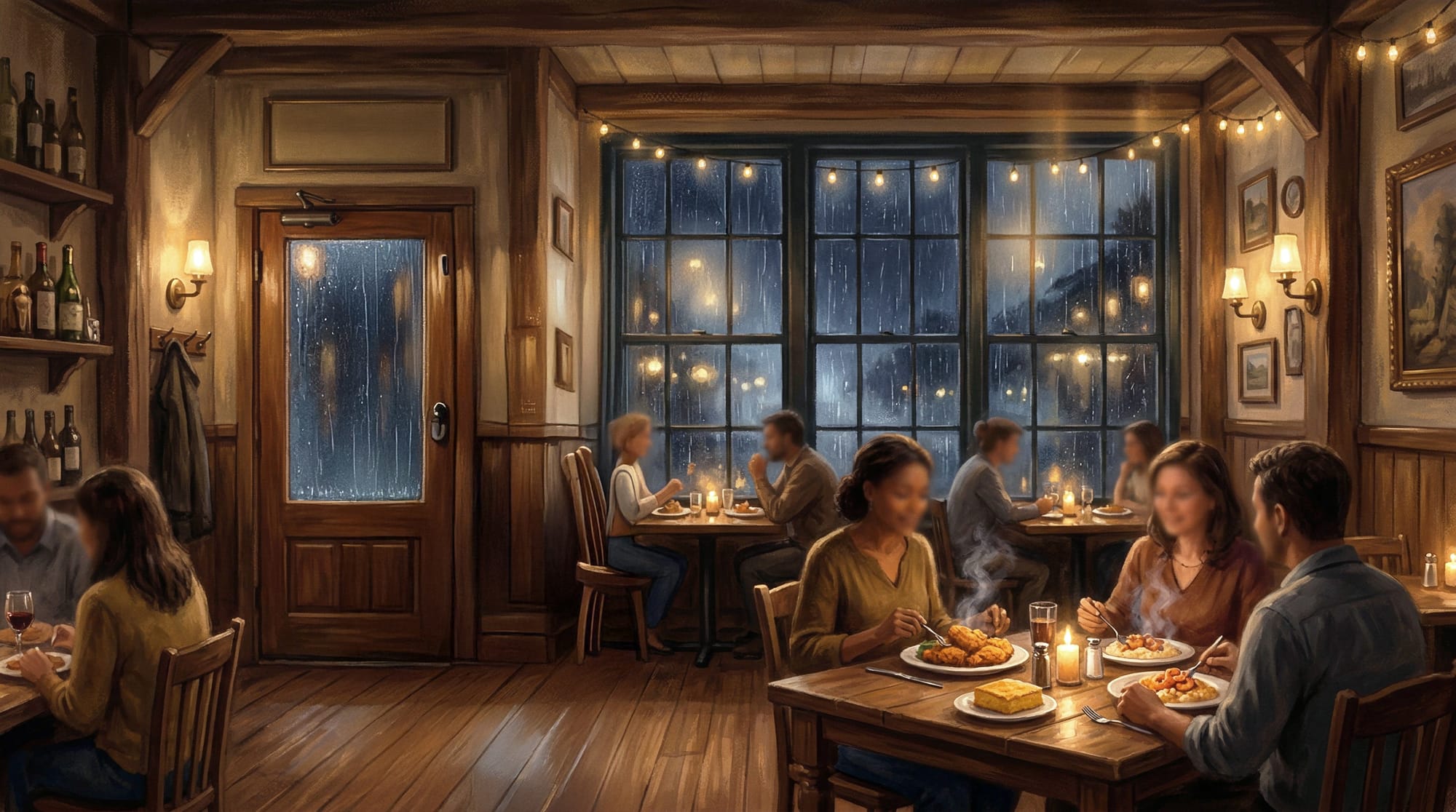
Inside the restaurant, the lights held a kind of illumination that made everything feel considered.
The sound of the stream outside dampened as soon as the door closed behind her, settling into the background.
There were a few scattered people, she realized after a moment.
A host stand stood near the entrance, though no one stood behind it.
“Hi,” Paloma said anyway, her voice softer now, as though the room itself required a different tone.
“You can sit wherever you like.”
She turned.
He stood a few steps away.
There was nothing ostentatious about him. No exaggerated charm, no immediate warmth. Just a steady, observant stillness, like someone who had no need to rush into being understood.
“Thanks,” she said, though the word felt oddly unnecessary.
She chose a table near the window.
Rain traced slow, deliberate paths down the glass, distorting the world outside into something abstract and indistinct.
He appeared again.
“Menu,” he said, placing it gently in front of her.
“Thank you.”
She opened it.
There were no prices.
That struck her first.
This didn't seem like a place that would have no prices on the menu. Then the descriptions—nothing extravagant. Southern comforts and casual foods that she had grown to love.
“What can I get you?” he asked.
She hesitated.
“Uh. I’m not really sure,” she admitted. “Do you have coffee?”
“Yes.”
“Alright. And a basket of fries I suppose. Something small for the road.”
He regarded her for a moment—attentive in a way that felt disconcertingly sincere.
“Of course,” he said.
He didn’t write a single word down or try to upsell her anything.
What Arrived Instead
One moment the table was empty, and the next it wasn't.
Roasted chicken, golden-skinned, resting beside a generous portion of mashed potatoes that still held the faint imprint of a spoon. A small dish of honeyed cornbread. Steam rising in soft, ephemeral curls.
A cup of coffee next to it in a porcelain cup. She brushed her finger on the cup to test it. Real porcelain.
The fries arrived in a small, well packaged box, carefully prepared for on the go.
Whatever this was, it was not small.
Paloma stared at it.
“I didn’t order any of this,” she said when he returned.
“I know,” he replied.
There was no defensiveness in his voice.
“You said something small.”
“I did.”
He gestured lightly toward the plate.
“That is small.”
She almost laughed—but didn’t.
Something about the way he said it made the contradiction feel less like a mistake and more like a perspective she hadn’t considered.
“Try it,” he said.
She did and the first bite was warm, enriching and filling. Paloma hadn’t realized how hungry she was to feel this warmth coursing her body.
“It's on the house,” he said.
When she was finished, she stepped back into the rain. It had begun to disperse.
The car looked the same and Joey looked the same.
She opened the door.
“You were gone forever,” he said, almost angrily—with that familiar, low-grade irritation that always seemed to imply she had miscalculated something.
“Sorry,” she said automatically. “I got you fries.”
She handed him the box.
He took it without looking at her.
“Yeah, thanks. Let's go home now.”
Joey began to munch on the fries while playing a game on his phone, now entranced.
She sat down, hands resting in her lap.
The rain had nearly stopped. She glanced back toward the restaurant as she drove out the lot and it was no longer there. Gone just as the rain had disappeared.
“Joey, it's gone.”
He continued his game, not bothering to look back.
The Second Rain
For the next several days, Paloma told herself she had imagined it.
That explanation lacked reason. How does a building just disappear in the blink of an eye? Just like that?
Austin in spring had a capricious temperament. The mornings could open bright and almost brazenly clear, pale blue sky, and by afternoon the air would thicken with humidity and expectancy until the clouds rolled in with theatrical abruptness.
Joey noticed none of it because he only noticed what entered the perimeter of his own inconvenience.
His car wouldn’t start on Thursday, so she drove across town after work to pick him up from his office park, where he stood with his tie loosened and his expression already sharpened into grievance.
On Saturday, he called her three times while she was in the grocery store because he couldn’t find the envelope with his insurance card.
On Sunday, he sprawled across her bed with one arm over his face and announced, in a tone that assumed compliance, that she was better at talking to people than he was and should call his landlord about the leak in the ceiling.
None of these requests were catastrophic. That was part of their efficacy. Joey rarely demanded anything dramatic enough to justify refusal.
Instead, he relied on the accumulative force of small dependencies, each one plausible on its own, each one difficult to object to without seeming ungenerous.
By the time Paloma realized how much of herself she had apportioned to the maintenance of his life, the pattern had already acquired the solidity of habit.
The second time she found the restaurant, she had not set out looking for it.
She had been driving home after leaving Joey’s apartment with a dull, familiar ache behind her eyes.
He had spent the evening lamenting his supervisor, his mother, his bank account, the friend who never called him back, the fact that she had seemed distracted. The accusation had arrived not as anger, but as injury, which somehow made it more difficult to contest.
Paloma had apologized, though she had not been certain what she was apologizing for.
The rain began as she crossed under an overpass—first a scatter, then a sheet.
Wipers flashed furiously across the windshield. The city blurred into streaks of wet sodium light and darkened trees.
She took the next turn almost without thinking, following a narrow road lined with live oaks and low commercial buildings whose signage glimmered through the storm.
Then she saw it.
This time the restaurant stood at the far end of a shallow lot behind a florist and an insurance office, tucked into a place that should have held dumpsters or delivery crates, not a house with a deep porch and illuminated windows.
Its painted siding gleamed darkly in the rain. Yellow light pooled from the windows in soft oblongs across the wet ground. The small sign near the porch steps bore the same name in the same amber lettering.
PORTER’S.
She parked before she had time to reconsider.
Inside, the room greeted her with the same unhurried warmth, but now that she had seen it once before, she noticed more.
A ceiling fan turned above her with stately slowness.
No one looked startled to see her.
A woman in a raincoat ate stew beside the window as though she had been sitting there long before the storm began and would remain long after it ended.
When their eyes met, she offered Paloma a small, knowing nod—
As though she had stood in the same place once.
A man near the far wall leaned over a plate, as though time had loosened its grip on him within these walls.
The scent of slow-cooked and rich foods filled the air—packed with rosemary, butter, and a faintly sweet aroma beneath it.
Paloma stood just inside the threshold..
“You found it again.”
Inside Porter's
The man's voice reached her without urgency.
She had learned his name was Porter, as in PORTER's.
He regarded her now—acknowledgment.
As though her return had been anticipated.
“I didn’t know I was looking for it,” she said, and immediately realized how strange that sounded.
He did not smile.
“Yeah that's how it works.”
There was no elaboration, no attempt to resolve the ambiguity of the statement. He simply stepped aside, giving her space to move further in.
She chose a different table this time, one closer to the center of the room. The checkered chair felt familiar beneath her in a way she could not quite justify.
When he placed the menu in front of her, she noticed a new array.
The structure remained—simple descriptions, grounded ingredients—but the offerings had shifted, as though the kitchen itself had reconsidered what it wanted to provide.
“You changed the menu?” she asked, running her fingers lightly along the edge of the page.
“It changes itself based on what you need,” he said.
The words blurred slightly as if the act of choosing here did not function the way it did elsewhere.
“What happens if I order something I don’t want?” she asked, not looking up.
“How does one order something they don't want?” He said, looking up at the ceiling.
She exhaled an involuntary laugh, though there was no humor in it.
“I think…” she began, then stopped. She had spent so long selecting her words based on how they would be received that the act of speaking without that consideration was difficult.
“I don’t know what I want,” she said.
Porter nodded once, as though confirming something rather than learning it.
“Excellent. That makes it easier.”
He left again.
The food arrived.
A shallow bowl of something fragrant and rich, steam curling upward in delicate ribbons. Braised meat, tender enough to yield at the edge of her fork without resistance. Vegetables softened into the broth, not dissolved but integrated. A slice of fresh bread rested beside it, crust crisp, interior still warm.
She took a bite.
The warmth settled deeper this time—as though whatever internal dissonance she carried had been wiped.
She ate even slower.
When Porter returned, he did not ask how it was.
Instead, he placed a glass of water beside her, though she had not realized she needed it.
“This is a place for those need clarity,” she said after a while, gesturing faintly around them.
She frowned slightly. “You think I need clarity?”
He considered the question, though not in a way that suggested hesitation.
“If you didn't,” he said. “You wouldn't have found us.”
The answer settled somewhere between explanation and evasion.
“It appears when you’re about to decide on something you don't want.”
She turned it over in her mind and looked back at her plate.
“Do other people find this place?” she asked.
“Yes.”
“Do they come back like I did?”
“Some do.”
“And the others?”
“They don’t need to anymore.”
There it was again—that quiet implication that the restaurant did not operate on convenience or preference, but on something far less negotiable.
No Need to Rush
Porter moved through the room. When he reached her table again, he did not speak immediately. He stood just within her peripheral awareness, close enough to be present, distant enough to allow her the choice of engaging.
“You don’t rush here,” she said finally.
“No,” he said.
She turned slightly in her chair, angling toward him.
“Why? Money's usually good when you're fast.”
The question carried more weight than it seemed to on the surface.
Why didn’t anyone here rush? Why did this place feel insulated from the urgency that dictated everything outside of it?
He considered her—not searching for an answer, but gauging whether she was ready to hear one.
“Because nothing here depends on you being faster than you are.”
The words settled into her with a peculiar precision.
She felt them land somewhere deeper than understanding—somewhere closer to recognition.
“I think everything in my life depends on that,” she said.
Porter pulled out the chair across from her and sat down—not intrusively but with the same quiet permission the rest of the restaurant seemed to operate under.
“Have you ever considered you make it depend on that,” he said.
There was no accusation in it.
She frowned slightly, her fingers curling loosely around the edge of the table.
“I don’t think I do.”
He didn’t argue.
Instead, he asked:
“When was the last time you didn’t?”
She opened her mouth, then paused.
Her thoughts moved quickly at first—scanning, searching, assembling examples—but each one collapsed under closer inspection.
Every moment she could think of carried the same underlying structure. Her mother's expectations, the marketing agency and their timelines, Joey's reactions to everything, anticipated and accommodated before it even arrived.
She let out a slow breath.
“I don’t know,” she said.
Paloma's phone vibrated in her bag.
The sound cut softly through the room.
Joey. Of course.
She already knew what the message would contain.
It would be a request. Maybe he couldn't find the remote again. Whatever it was, she knew it was a task that required her attention, her solution, her presence.
Her thumb hovered over the screen. She could respond quickly, efficiently, smoothing whatever inconvenience had arisen before it escalated into frustration.
The familiar pattern unfolded in her mind with practiced clarity.
But for the first time, she noticed the choice—the one where she picked herself first.
The phone remained in her hand for a moment longer before she set it down on the table.
Porter watched her with knowing eyes.
“That felt different,” she said.
She looked at him, something unsettled and steady at the same time.
“But I didn’t do anything.”
“You did.”
She frowned slightly.
Porter's Touch
The intimacy came later, unraveling the way everything in the restaurant seemed to—gradually, without pressure, without the need to force meaning onto it.
She stood near the window again, drawn by the rhythm of the rain, her reflection faintly visible against the glass. The room behind her blurred into warm shapes and muted movement.
She became aware of him beside her.
“You look like you’re waiting for something,” he said.
“I think I am,” she admitted.
“For what?”
She hesitated.
The old instinct—to provide the correct answer, the acceptable answer—rose automatically.
She let it pass.
“I don’t know how to stop waiting,” she said instead.
She turned toward him slowly and noticed the steadiness of him.
The way he did not lean in or close the distance for her, even though his eyes held pools of deep fondness.
The choice remained entirely hers.
When she touched him, her hand rested lightly against his arm, as though confirming something real.
He did not move to take more than she offered.
And that, more than anything, made the moment feel intimate in a way she had never quite experienced before.
No one had ever waited for her to decide before.
The realization assembled itself in a way that opened up doors.
Her mind replayed all the times that Joey asked her to make calls he didn’t want to make.
She thought of the night he had handed her his phone and said, “Can you just deal with this for me?”
The days where he framed dependence as affection.
He never even noticed when she stopped speaking.
The fact that he never asked what she wanted—because she had never required him to.
And her—answering through it all.
Accommodating, anticipating and shrinking for more than 5 years and not once in that span of time did she receive an act of service from him, unless he was socially pressured.
She stepped back slightly, her hand still resting against Porter’s arm, but her focus shifting inward.
“I’ve been… agreeing to things I never chose,” she said.
He nodded once.
“You see it now.”
When she stepped outside, the rain had softened into barely perceptible droplets.
Having walked out of the restaurant without thanking him, she tried to return but the parking lot was empty and the restaurant was gone.
Where She Found Her Clarity
Spring arrived fully this time and warmth settled into the city, coaxing everything into motion again.
Paloma walked more often now. The street she found herself on that afternoon was different, though not entirely. Austin had a way of repeating itself in fragments—similar storefronts, similar facades, subtle variations that made everything feel both new and remembered.
That was when she saw it.
The restaurant that helped her see the light. It wasn't hidden at all and made no effort to. It had a large parking lot and outdoor seating areas. The smell of steak and herbs tickled her nose.
The sign, in clean, modern lettering read:
PORTER’S
People moved inside, visible through clear glass, their conversations grounded, their presence anchored firmly in the ordinary.
She opened the door and a chime played overhead.
The interior felt different than she remembered. Brighter, with fluorescent lights instead of the soft yellow lights she had admired. Louder, with crowds of people and conversations that were coherent.
Silverware struck plates with a rhythm that belonged to people who had somewhere else to be afterward.
Real in a way the other had not needed to be.
He stood behind the counter and looked up when she approached.
His demeanor was polite, body language neutral and his eyes met her eyes.
“Hi,” he said. “Table for one?”
The absence of recognition struck a little harder than she expected. But it felt like confirmation that this moment truly existed.
She smiled.
“Yes,” she said.
And for the first time—it was entirely her own answer.
You’ve reached the end of this story.
But not the end of the world it belongs to.
New stories appear regularly.
Stay curious.
✦ Related Reading & Themes
This story explored:
- magical realism grounded in everyday life
- emotional misalignment and self-abandonment
- the psychology of people-pleasing and quiet resentment
- choice versus habit in intimate relationships
- liminal spaces as sites of internal transformation
- soft supernatural intervention without explicit explanation
- identity reclamation through small, deliberate decisions
- the contrast between being needed and being seen
- subtle romance rooted in autonomy and consent
- moments of stillness as catalysts for change
Tags for similar stories:
magical realism, soft supernatural fiction, emotional transformation, self-discovery story, people pleasing dynamics, quiet romance, subtle love story, introspective fiction, atmospheric storytelling, rain symbolism, liminal space fiction, personal awakening, feminine identity, relationship dynamics, slow emotional shift, grounded fantasy, cozy surrealism, internal conflict fiction, modern magical realism, soft introspective romance
✦ If You Liked This Story
You might also enjoy:
- The Secret in the Strange Garden - Kimi wasn’t supposed to enter the hidden section of the botanical garden. But when a flower blooms at her touch, she discovers someone bound to a living plant.
If you want more stories like this, explore the full Petalstorm Press library → HERE
© Petalstorm Press — Original Fiction
This story is part of the Petalstorm Press library.
Redistribution or reproduction without permission is prohibited.