Journals of Unlived Lives
Viva discovers a hidden bookstore filled with donated journals—each one alive with the echoes of a life once lived. As she grows closer to the shop’s reserved accountant, they fight to preserve a place where some stories continue long after they’ve ended.

A Short Story by Mila Meraki
“You look like someone who reads things all the way through,” Mrs. Savitri had said the first day Viva found the bookstore.
Viva arrived in the coastal town at the end of August, when the breeze still carried the weight of summer.
As she dragged her suitcase past salt-faded storefronts and wind-chimed porches, she reminded herself that this was temporary, that the visiting professorship would pass quickly.
She would return to her real life in the city soon, though she could not have said, if pressed, what exactly that real life was supposed to look like anymore. Most of the goals on her checklist were finally checked off.
When she graduated with her doctorate, the only person who came to see her was her mother—her sweet, loving mother, at least when she was not slipping passive little jabs into conversation about how quickly Viva ought to produce a child.
What she really wanted was for someone to share future accomplishments with, where she didn't have to feel so alone all the time. A child, maybe one day, but with no one around it wasn't even a thought.
She did not mind solitude. Most days, she even thrived in it. But thriving alone was not the same as wanting to remain untouched by companionship forever.
The university sat just far enough inland to escape the constant breath of the ocean. It was on one of her evening drives, after a long afternoon of lectures about narrative structure and unrealized endings, that she found the bookstore.
At first glance, it looked disheveled. Its wooden sign was bleached pale by the sun, and its front windows cluttered with uneven stacks of books and handwritten notes that had begun to curl at the edges.
There was a crystalline bell above the door that rang when she pushed it open, though the sound felt strangely delayed, as if it had needed a moment to remember how.
Inside, a voice called out from somewhere behind a leaning tower of paperback novels.
“Well, aren’t you a bright one,” the woman said, appearing as if she had simply unfolded herself from the space between shelves.
Her white hair was pinned up, wisps escaping a face that seemed permanently sculpted by kindness.
Viva smiled politely, adjusting the strap of her bag as she glanced around, noticing a small wooden box near the counter overflowing with loose bills and coins, entirely unattended, as a cat lounged beside it, batting lazily at a stack of bookmarks until they slipped onto the floor.
“I teach literature,” Viva said, and the woman’s eyes lit up with a kind of delighted recognition.
“Oh, goodness, that explains it,” she replied, clasping her hands together, “you must come see the back room, then, I always say educators are the only ones who really understand what’s worth keeping.”
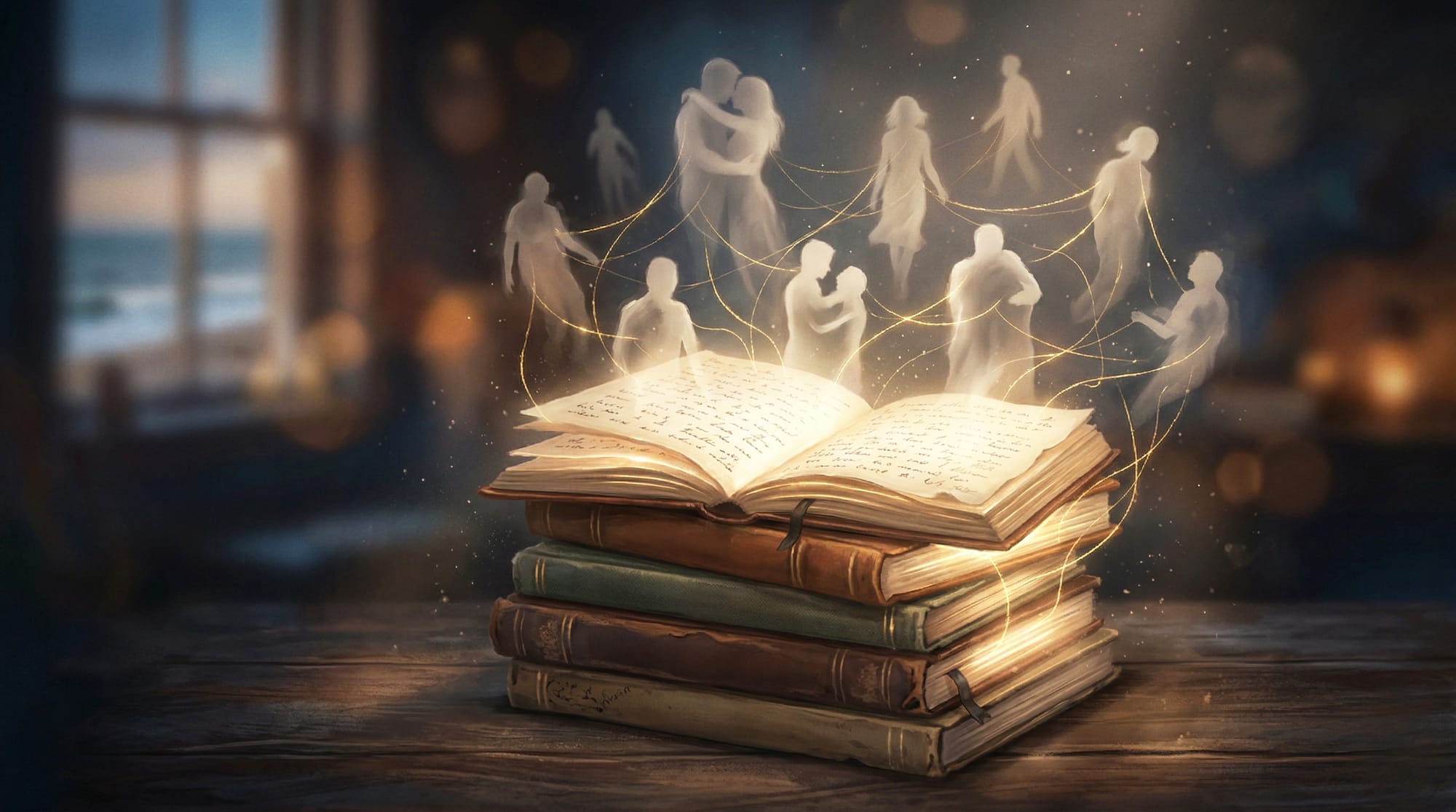
The room in the back was unlike the rest of the shop, and along the walls were shelves lined not with printed books but with journals, diaries, notebooks of every size and age, their covers worn soft by time.
“These,” the woman said, her voice lowering in reverence, “are lives people chose to leave behind.”
Viva turned slowly, taking it in, her fingers brushing the spine of a weathered leather journal, hesitant.
“They’re all donated,” the woman continued, stepping closer, “given willingly, with the understanding that someone else might one day read them, might carry a piece of them forward, which I think is a rather lovely idea, don’t you?”
Viva nodded, though something in her chest tightened as she picked up one of the journals, the pages thick and uneven, and when she opened it—
The room shifted as if someone had moved.
A teacup on a nearby table grew warm, though she had not touched it, and a thought that did not belong to her arrived.
Peppermint in the evening makes everything better.
Viva snapped the journal shut, her heartbeat quickening as she stepped back, and the warmth vanished, the room settling again into stillness.
“Oh,” the woman said gently, as if this reaction was expected, “yes, that happens sometimes.”
“What—what was that?” Viva asked, her voice more anxious than she intended, her gaze flicking toward the objects around her as if they might move again.
“Just memories,” the woman replied, smiling in a way that was both reassuring and slightly amused, “relics of the past, nothing to be afraid of, darling, they only stir when someone is paying attention.”
Viva swallowed, her grip tightening on the journal.
“They felt… alive.”
“They were once,” the woman said simply, “and perhaps, they still are.”
She picked up another journal, one that was leather bound, with a small anchor design on the bottom left. A glass bottle on the shelf spun when she opened it.
The sea is vast and I don't know when I will arrive home.
“They are all different,” the woman said simply, “some of them harbor deeper thoughts and others like to talk about their favorite colors.”
“That's frightening...and fascinating.” Viva exhaled.
“The best things in life usually are. Any other person would have run out that door and branded me a witch. But I'm not the one doing anything.” She shrugged.
Viva spent a few hours flipping through the journals, each one more intriguing than the next.
The Bookstore's Accountant
Elbis arrived that evening, stepping into the shop with a confident gait that suggested he had done so many times before, his presence reserved, and the woman behind the counter looked up immediately, her face brightening.
“Elby,” she called, as if the name had been waiting for him, “you’re late, and I’ve already lost track of the register again.”
He smiled, the expression soft and a little apologetic, as he moved behind the counter, gently reorganizing the scattered bills and coins with practiced ease.
“I told you to keep it closed, Mrs. Savitri,” he said, though there was no real reprimand in his tone, only a kind of fond resignation.
She turned to Viva, who lingered nearby, and said, “This is Elbis, though I’ve never once called him that in my life, and he pretends not to mind.”
Elbis glanced up then, his hazel eyes meeting Viva’s with curiosity but no intrusion.
“You’re a new customer here,” he said.
“She's in education,” the woman added, as if this explained everything.
“Ah,” he replied, nodding slightly, “that does explain it.”
Viva found herself smiling again, though her thoughts drifted back to the room, to the warmth of the teacup.
“You’ve been back there,” Elbis said, not as a question.
“Yes,” she admitted, studying him, “and I… don’t understand it.”
He paused, considering his words carefully, as if he had had this conversation many times before.
“I’m not sure anyone who ever experiences it does,” he said, “but I wouldn’t call it magic.”
“What would you call it?”
“A thing the brain does,” he replied, after a moment, “residual, maybe, something tied to the act of being read, like… like a cognitive pattern that reactivates under the right conditions. Possibly some behavior of wayward electricity and frequencies… among other things.”
Viva raised an eyebrow.
“That sounds like a very assured way of saying you don’t know.”
He smiled, a little sheepishly, his gaze moving from her lips to her eyes.
“You got me there.”
A Threat to the Bookstore
Norman Ozul did not belong in the bookstore. It was immediately obvious in the way he stepped inside, his polished snakeskin shoes out of place on the worn wooden floor, his gaze moving with assessment, as if everything he saw could be reduced to numbers.
He picked up a book on a shelf and three others fell when he did.
“I assume you’re the owner,” he said, addressing the woman directly, as she picked up the fallen books. His serpentine tone suggested contempt.
“I assume you’re about to say an unpleasant remark,” she replied, not unkindly, though her eyes twitched just enough to signal that she was not as scattered as she appeared.
He smiled thinly.
“The Ozul Company has acquired several properties in this area,” he began, gesturing vaguely toward the street, “and we’re highly interested in this location.”
“Are you now,” she said, tilting her head.
“We’re prepared to make a generous offer, of course.”
She laughed then, a light, almost musical sound that seemed to catch him off guard.
“Oh, no,” she said, waving a hand as if brushing away a particularly persistent fly.
“I’m afraid you misunderstand, this place isn’t for sale.”
“Everything is for sale with the right offer. And when that doesn't work, there are other ways.” he said with a veiled exhale.
Viva and Elbis
The weeks that followed unfolded with a flurry of action, the threat that Norman had verbalized no longer abstract but steadily advancing.
Mrs. Savitri found letters delivered, meetings scheduled, and the language of acquisition and inevitability pressing in from all sides.
Even though the town murmured its concern, it did not rise to meet it with enough force to stop what had already begun.
Viva found herself returning to the bookstore more often than she intended, drawn by both the journals and the strange, steady presence of Elbis, whose conversations with her moved easily between debate and understanding.
Conversations would soon turn into laughter, swimming and seafood dates.
She loved novels, romances, and literary devices. He loved nonfiction, historical accounts, and biographies.
Between fried calamari dinners and walks along the beach, she told him about the impact of storytelling, and he emphasized the importance of archiving information.
What brought them together was the eccentricity of the journal room.
There, the journals continued to stir when opened. A coat sleeve shifted when she lingered on a page describing a winter long past.
Always bundle up, even if you don't think you need it.
A pen rolled toward a paragraph that had been crossed out and rewritten three times.
The best ideas come after a few bad ones.
A chair creaked softly as if someone had just stood, though no one had.
Don't be stingy about buying a good chair.
And when Elbis opened a black weathered journal himself, he did not speak of it immediately.
The roses near the bookshelves spun slowly as if being held gently.
She's beautiful.
Later, as they stood near the front of the shop, he said, almost reluctantly, “I still can’t explain it.”
Viva looked at him, understanding passing between them.
Saving the Bookstore
The looming threat hovered above the building.
During the many weeks of Mrs. Savitri’s fight against the Ozul Company, Viva found herself giving less of herself to the visiting professorship and more of herself to the bookstore.
Elbis, who was naturally introverted and reserved, put all that behind him and rose up to the occasion. He spent several evenings coming up with various strategies to combat the acquisition.
Norman Ozul did not relent and had local politicians at his beck and call.
Viva and Elbis eventually learned what he planned to build.
“Think of how much money will flow in from the hotel. You could open up three of these places in the surrounding areas if you wanted to, Mrs. Salvi.” He exclaimed, never getting the woman's name right.
Against all odds, Viva and Elbis tried to save the bookstore.
They organized small gatherings, reading nights where locals were invited to share stories, to read passages aloud, and to remember why the place mattered.
“This is it, everyone. Let's do it for the community.” Elbis stood near a makeshift podium proudly, grinning towards Viva. She felt heat rise up to her cheeks from seeing him in such a position.
The last push was at the town meeting. The most dedicated customers, employees and sponsor showed up to defend their case.
But it wasn’t enough.
The businesses not connected with the bookstore wanted new developments, saying it would bring in more money.
On a bleak Monday, the decision came down quietly, formally, with signatures and timelines, with a finality that left no room for negotiation, and on the last day, the bookstore felt fuller than it ever had.
Mrs. Savitri handed over the final paperwork with a grimace. Norman Ozul flashed a satisfied smile.
“You know, I do have properties that would capture the potential of this place,” he said, pulling out a business card.
“I'd prefer you just leave now Mr. Ozul.” She stated calmly with a constrained frustration that Norman almost relished.
“Best wishes for you and your...paper stacks.”
Viva stood in the back room, a journal open in her hands, as the teacup warmed once more, the faintest echo brushing against her thoughts.
Thank you for remembering.
She closed the book gently, her throat tightening.
Elbis wrapped his arms around Viva as tears slowly crawled down her face.
A New Beginning
They never truly gave up the fight.
Even as Mrs. Savitri aged, and the journals sat for a time in a damp storage unit…and even when Viva chose not to return to the city.
They had not won against Norman, not in the way they had hoped, but they remained committed to finding a new home for every book, journal, and memory Mrs. Savitri had kept alive.
“Business partners, huh? I like the sound of that.” Elbis would say when she finally proposed the idea.
Looking for a new space was more difficult than they had anticipated.
Behind most of the listings in the area a name appeared often, OZUL Properties.
They fought tooth and nail. The end goal always being to lock in an agreement with a different company, even if it was a needle in a haystack.
Viva would shed a tear each time the owner of a location she loved was revealed to be Norman's and Elbis would always be there to comfort her distress.
Eventually, they found the one place Norman had not already touched.
The new space sat just a few blocks away, tucked between a trendy smoothie shop and a narrow art gallery, its floor to ceiling windows clear and bright, its white shelves carefully arranged.
It completely lacked the classic, rustic flair that the old bookstore had carried so effortlessly.
But that didn't matter.
With Mrs. Savitri's blessings, they transferred everything they could from her storage units. At some point, they even adopted the two cats, Mimi and Spot.
The journals were all carefully cleaned, preserved and named. Elbis and Viva spent weeks cataloguing them and displaying them with complete mindfulness.
And when the first one was opened—the white lights flashed once above them.
Good morning, it's a beautiful day.
Mrs. Savitri arrived one evening, later than expected, her steps slower but no less certain, and when she entered, the electronic bell rang clearly, as if it had been waiting for her.
“Well you two,” she said, looking around, her smile soft and full, “you’ve built something lovely here.”
Viva stepped forward.
“It’s always been yours,” she said.
The woman shook her head gently.
“No, darling,” she replied, “it never was. This old bag wasn't built for business anyway.”
She reached into her bag then, pulling out a single journal, its cover plain, unmarked, and held it out to them.
“I thought it might be time for you to have this,” she said. “To add it to the collection.”
Viva hesitated before taking it, her fingers brushing the edges, noticing how light it felt, how untouched.
“It's your—” she began.
“That's right,” the woman said, her voice softening.
There was a pause, a quiet understanding passing between them, before she added, almost as an afterthought, “I won’t have much use for it soon, I think.”
Elbis’s gaze flicked to hers.
“Mrs. Savitri, thank you,” he said.
She smiled.
Keeping the Memories Alive
Later, after she had left, after the shop had closed and the evening had settled into that liminal peace that belonged only to coastal towns, Viva stood near the shelves with a journal open in her hands, her attention caught somewhere between the past they had preserved and the present they had somehow built together.
The wind chime near the door rattled when she gave it her attention, and she heard the voice she had grown to admire.
What a quaint little town.
Elbis moved beside her without announcing himself, as he always did, his presence never abrupt. He leaned closer.
“We’ll keep them,” she said, her voice low, “all of them, no matter how many there are, no matter how many people forget what they are.”
“Absolutely we will,” he replied, just as quietly, though there was a courage in it now, something that had not been there when he first stood hovering around the old shop.
“It’s strange,” she said after a moment, her voice softening into thoughtfulness, “I used to think stories mattered because they ended, because they held meaning to the reader when they were finished with it, but now…” she hesitated, searching for the thought as it formed, “now I think they matter because someone is willing to pick them up again.”
Elbis considered that, his gaze following hers, though his expression remained quieter, more contained, as it always had been, even when something deeper stirred beneath it.
“I used to think they mattered because they were true accounts,” he said, “because they recorded experiences exactly as it happened, because they didn’t leave room for interpretation, but…” he paused, the faintest shift in his voice betraying the change, “I don’t think that was ever entirely right.”
Viva glanced at him then, a smile pulling at the corner of her lips.
There was a brief silence, though it did not feel empty.
She thought of their first evening as new owners.
The night where she had somehow ended up sitting beside him on the edge of the water, her shoes abandoned in the sand as the tide crept closer, their conversation drifting from books to lives to the quiet, unspoken things that neither of them had expected to share.
Another night they had stayed too long in the journal room, opening one after another. Most thoughts were sentimental or raw. Others would have them laughing out loud. Some of them scared them.
Thoughts like:
Doctor said the next month is my last.
This crossword puzzle is too hard.
Wouldn't be caught dead wearing polka dots.
They didn't suspect a thing.
I hate carrots so much.
Please come home.
Why can't I make friends?
The best pizzeria is Johnny's.
Above it all, the couple respected the understanding of many different lives, and their unique colors.
Elbis held her hand throughout every opening.
The small, ordinary moments that they shared had not seemed important at the time. But they had built a life as real as the shelves, as lasting as anything could be.
“We never figured it out,” Viva said after a while, her voice softer now, almost reflective, as she glanced down at another journal still open in her hands.
“No,” Elbis said, “we didn’t.”
“And you still don’t think it’s magic.”
“I still don’t know what it is,” he replied, though there was no resistance in it now, no need to define what had already proven itself beyond explanation, “but I don’t think it matters as much as I thought it did.”
Viva let that settle, her fingers tracing the margin of the page, her thoughts no longer caught on what the journals were, but on what they gave, what they carried, what they allowed.
“I stopped trying to explain it a while ago.”
“They knew someone would read them,” she said quietly, “that someone would care enough to open them again and just listen.”
Elbis nodded, his gaze shifting to her, something that no longer turned away when it reached its edge.
“And they were right.”
Viva closed the journal slowly, the soft sound of the pages settling echoing faintly in the stillness, and when she looked up, she found herself closer to him than she had realized.
“We fought hard,” she said, though she wasn’t entirely sure which moment she was referring to, the bookstore, the fight, the long weeks of uncertainty, or all of it at once.
“You didn't even have a reason to fight. You weren't even a local,” he replied.
She let out a small breath, like a laugh, though it carried more feeling than humor, and when her hand brushed against his, it was not accidental, not entirely, though neither of them pulled away.
“But I guess you are one now,” he added.
For a moment, they remained like that, the contact light but intentional, as if both of them understood that this, too, could be lost if left unacknowledged.
“We’ll move them again if we have to,” Viva said, her voice steadier now, though softer, as if the promise mattered more when spoken gently, “if this place goes, or our money thins. If absolutely anything changes, we’ll just… carry them somewhere else.”
Elbis’s hand shifted slightly beneath hers, his fingers curling just enough to hold, not tightly, not possessively, but with a quiet certainty that felt more lasting than anything she had expected.
“We will,” he said, and this time it was not just agreement, but a vow, something that extended beyond the journals.
Viva looked at him then, really looked, and whatever hesitation had once lived between them had thinned.
When he leaned in, it was slow, gentle, giving her every opportunity to step back, to turn away, to leave it unfinished, but she didn’t, and when their lips met, the shop remained still.
Years later, when they finally made the decision to open up Mrs. Savitri's journal, the books on the shelf danced when the pages split open.
I hope she takes care of Elby.
You’ve reached the end of this story.
But not the end of the world it belongs to.
New stories appear regularly.
Stay curious.
✦ Related Reading & Themes
This story explored:
- magical realism rooted in memory and preservation
- the quiet continuation of lives through storytelling
- loneliness and the longing to be witnessed
- the emotional weight of unlived or unfinished lives
- truth versus interpretation in how stories are remembered
- soft supernatural echoes tied to human experience
- the value of attention as a form of care
- community, loss, and what is worth protecting
- rebuilding meaning after inevitable change
- love that grows through shared purpose and understanding
- the contrast between recording a life and truly living one
- legacy, mortality, and the act of leaving something behind
Tags for similar stories:
magical realism, soft supernatural fiction, memory and legacy, quiet romance, slow burn connection, introspective fiction, atmospheric storytelling, bookstore setting, cozy surrealism, emotional transformation, modern magical realism, soft fantasy, literary romance, preservation of stories, small town fiction, reflective fiction, love through shared purpose, grounded fantasy, subtle magic, human connection fiction
✦ If You Liked This Story
You might also enjoy:
- Porter's Restaurant in the Rain - A soft magical realism story about a woman who discovers a hidden restaurant that appears only in the rain—guiding her toward the life she never realized she wasn’t choosing. An introspective romance about autonomy, alignment, and becoming.
If you want more stories like this, explore the full Petalstorm Press library → HERE
© Petalstorm Press — Original Fiction
This story is part of the Petalstorm Press library.
Redistribution or reproduction without permission is prohibited.