Honey for the Road
A couple stumbles upon a hidden forest town where everything feels perfect. The honey tasted great too.
We almost missed the turn.
Micah was driving, one hand loose on the wheel, the other tapping along to country music that kept fading in and out of signal.
I’d been half-distracted, folding the corners of a pamphlet we picked up at the last rest stop. There was a list of destinations.
One name kept catching my eye.
Melora Grove.
“Wait,” I said, leaning forward. “I think that’s here.”
The road bent, and there it was—half-hidden behind vines, a wooden sign. A smiley face and a mural full of people’s signatures read:
MELORA GROVE
WELCOME ALL
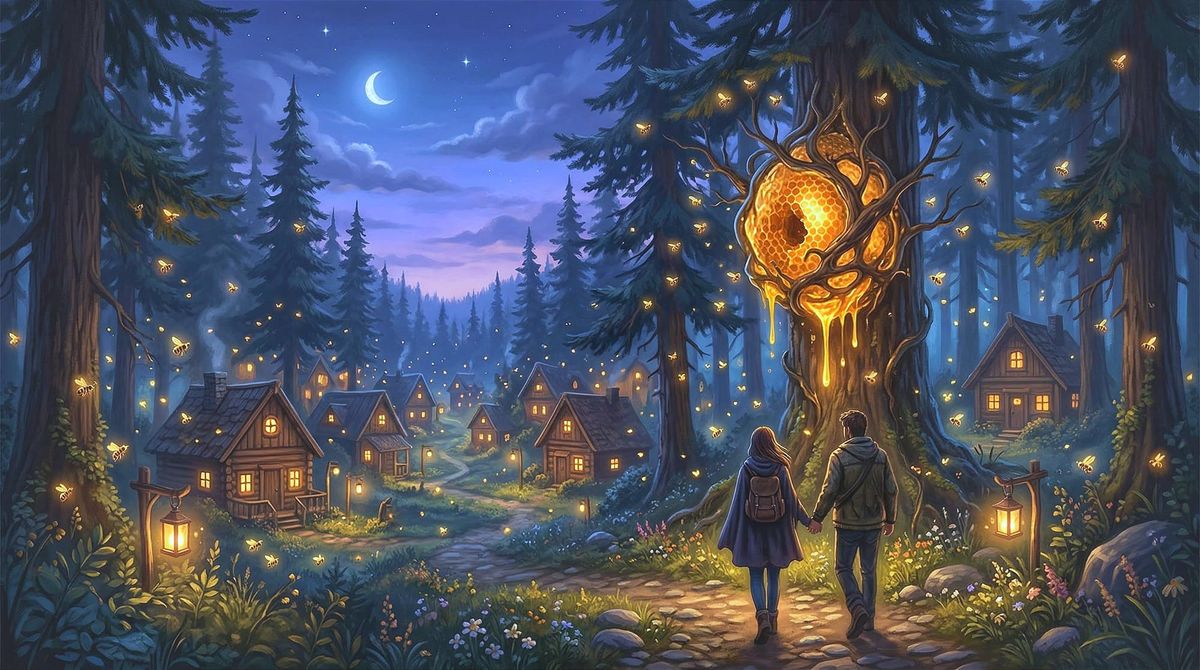
We passed pine trees, and then we saw the picturesque town up ahead.
People noticed us immediately.
A woman waved from a porch before we’d even parked. A man set down a crate of something golden in jars.
“You must be passing through,” the woman said when we stepped out.
“Yes. Is there a place to rest here?” Micah asked.
“Of course,” she said, like the question itself was unnecessary. “You must be tired.”
At the inn, the first thing they gave us was a jar of honey. Then we were served fresh bread with hot tea already poured into handcrafted mugs.
The jar of honey glowed faintly in the late afternoon light.
“It’s local,” someone in the inn said. “We make it here.”
Micah glanced at me I shrugged.
When we tried it, it was richer than the supermarket honey I had grown accustomed to.
They showed us a cabin and told us we could stay as long as we liked. No payment and no expectations.
“You’re welcome here,” the woman said again.
Micah found their kindness odd, I told him that there are still good people in the world.
There was a man named Corin who carved wood into cute animals. He laughed when Micah asked how long it took.
“Oh, time doesn’t feel quite the same here,” he said.
Then there was a girl—maybe sixteen—who braided flowers into my hair without asking, her fingers light and careful.
“You look like you belong here,” she told me.
The next morning, I knocked over an expensive looking lamp while trying to open a window. It slipped, hit the floor, and shattered into pieces.
I froze in embarrassment.
“I’m so sorry—”
The woman from the porch stepped in and looked at the broken glass.
“It’s alright,” she said gently, smiling.
She knelt and began picking up the pieces like nothing had happened.
Micah met my eyes.
Later that day, he accidentally backed the car into a low wooden fence.
We both winced at the sound and groaned in frustration. It was minor damage that could easily be fixed, but it was something that could irritate the wrong person.
A man nearby turned, looked at the damage and laughed.
“Don’t worry about it,” he called. “Things get fixed quickly here.”
Micah found it stranger than the broken lamp. The frustration we felt surprisingly faded with ease.
We stayed for a few more days. The views were beautiful, the people were kind and their honey was great.
One morning, we drove through the town.
Micah missed a turn and clipped a mailbox.
It tipped, snapped at the base, fell into the grass.
We stared at it. Then—we just laughed.
Someone across the street saw it all go down. They laughed too. Then another person approached with a smile.
The noise spread like wildfire, as if we’d all agreed it was funny.
I remember thinking:
Why is this funny?
And then not caring why.
That night, I couldn’t sleep.
Micah sat at the edge of the bed, elbows on his knees.
“You feel it?” he asked.
I nodded, my hands trembling slightly.
“Everything’s…” he searched for the word. “uncanny.”
I swallowed. “But its a good thing, right? I mean everyone is so happy, even when things go wrong.”
He looked at me then.
“That’s the problem, Bryn.”
We went for a walk that night to shake off the strange occurrences. The town was glowing softly, lit by fairy lights, and it held an aura I couldn’t name.
People were still out, talking and smiling.
“You shouldn’t be upset,” the flower girl said when we passed her.
“Try some honey,” she added. “It helps.”
Others echoed it.
“Have you eaten some?”
“You’ll feel better.”
“It brings you back.”
By the time we got back to the cabin, there were three jars waiting for us.
We hadn’t brought them.
Micah didn’t touch his.
“We need to go,” he said.
No hesitation this time.
I nodded in agreement, even though my chest felt tight.
I tried to push down the feeling that leaving didn’t make sense and that we were overreacting.
Everything here was beautiful.
We grabbed our things and packed the car anyway.
As we stepped outside, I heard a low, constant hum.
I looked up and the trees were full of bees drifting between branches.
Their bodies glowed softly in the dark.
Micah grabbed my hand.
“Don’t think about how it feels,” he said under his breath. “Just move.”
Behind us, a door opened.
“Leaving already?” A voice sang in the distance.
“Let me give you a few jars of honey for the road!” Another voice shouted.
We got in the car and drove off before that voice could reach us.
I glanced back once.
The town of Melora Grove gleamed like a place that only exists in fairy tales.
I wanted to stay.
Then Micah squeezed my hand hard, and I chose him instead.
You’ve reached the end of this story.
But not the end of the world it belongs to.
New stories appear regularly.
Stay curious.
If you want more stories like this, explore the full Petalstorm Press library → HERE
© Petalstorm Press — Original Fiction
This story is part of the Petalstorm Press library.
Redistribution or reproduction without permission is prohibited.
All stories shared through Petalstorm Press—and the channels linked here—are the official home of this work. Any versions found elsewhere are not authorized unless clearly noted.