The Axolotl Heist
A bakery, six glowing axolotls, and a man sent to take them back. This is a sci-fi romance about stolen creations, dangerous alliances, and choosing what to protect.

A Short Story by Avia Nevoir
The bell above the bakery door rattled in its bracket with a metallic complaint.
Laureline, who was standing behind the counter with apricot glaze up one wrist, did not immediately look up because she had reached that perilous stage of assembling dough.
“Before you say anything,” she called, wrestling a sheet pan away from the edge of the counter with her hip, “the pistachio braids are not ready, and if you ask how long on the braids, I will make up a number.”
There was no response.
A figure stood inside the doorway and set himself upright among the sugar jars and copper pans.
His hair was damp from the mist.
The city’s ultramarine glow, refracted through the rain-streaked front windows, which highlighted the lines of his dark coat.
His gaze had already taken in the glass case, the exits, the corridor beyond the counter, the floodlight over the sink, and finally landed on her with unnerving composure.
Laureline wiped her hands on her apron.
“We’re closed,” she said.
He glanced toward the window, where the blue neon sign still buzzed OPEN in pink script, though the P flickered with a neurotic inconsistency she had meant to fix for months.
“That's not what the sign says.”
“Did you hear me? We are closed.”
He took one step farther inside. The bell shivered again. “I won’t be long.”
“No,” she said, moving before she had quite decided to move, slipping from behind the counter and planting herself in the narrow space between him and the back hallway, “you absolutely will not.”
An amused expression crossed his face.
“Ms. Radia,” he said.
That stopped her for a fraction of a second. She had not used that surname in nearly three years.
“You’ve got the wrong bakery,” she said lightly. “I’m Ms. Try Me, actually. Radia retired.”
His eyes did not leave hers, entertained and frustrated simultaneously. “You have something that belongs to my family.”
A blade slid cleanly from his sheath.
Laureline crossed her arms, though she kept her weight balanced on the balls of her feet.
“People say that a lot in this city. Usually they mean ex-lovers or proprietary recipes.”
Axolotls in the Bakery
A soft, almost dainty splash sounded from the back room.
The man's gaze moved, almost imperceptibly, toward the hallway.
Laureline’s heart beat fast inside her chest.
When he took another step, she grabbed the nearest object from the prep table, and found her pastry knife settling into her palm. By the time he realized she had armed herself, the blade was pressed flat to the back of his coat.
“Do not move,” she said.
He stopped with the knowledge of a man who had learned very young how much power there was in economy.
“I doubt you’re going to use that,” he said, his grip on his own blade, ready to strike if needed.
“You have mistaken me for someone more orderly,” she responded.
Slowly, he turned his head enough to look at her over his shoulder. Up close, his eyes were not black, as she had first thought, but a smoky gray.
“Sylvester Argen,” he said. “Most people call me Sylv.”
“You,” she said, recognizing the last name.
“I have been sent by House Argen,” he said with a small smile.
The splash came again, followed by a faint luminescent shimmer slipping beneath the crack of the back-room door.
Sylv’s gaze focused on the glow from the door.
“You’re here for the salamanders,” she said.
His attention returned to her. “Yes, those wonderful Axolotls.”
That time he smiled a fraction more, only with one corner of his mouth, and it was worse somehow than if he had never done at all.
“You know exactly what they are, Ms. Radia.”
“Of course I do.” She lifted her chin. “I'm the one who made them.”
The smile vanished.
“I need to see them,” he said.
Laureline looked him over for another beat, searching his face for triumph, greed, contempt, any of the expected signatures of men connected to old money and regulated violence.
“Alright,” she said. “But if you lunge, I stab or worse.”
“You’ve made that policy quite clear.”
She withdrew the blade, nudged him forward with it anyway out of principle, and with her free hand pushed open the door to the back room.
The chamber beyond had once been a pantry. It used to be narrow and tiled, with shelving on three walls and a sink at the far end. Now, the shelves held nutrient canisters, filtration cartridges, tangled wiring, and bakery supplies that had colonized every surface.
At the center stood the tank.
It glowed with an underwater radiance that turned the white tile blue-green and cast wavering reflections over the ceiling.
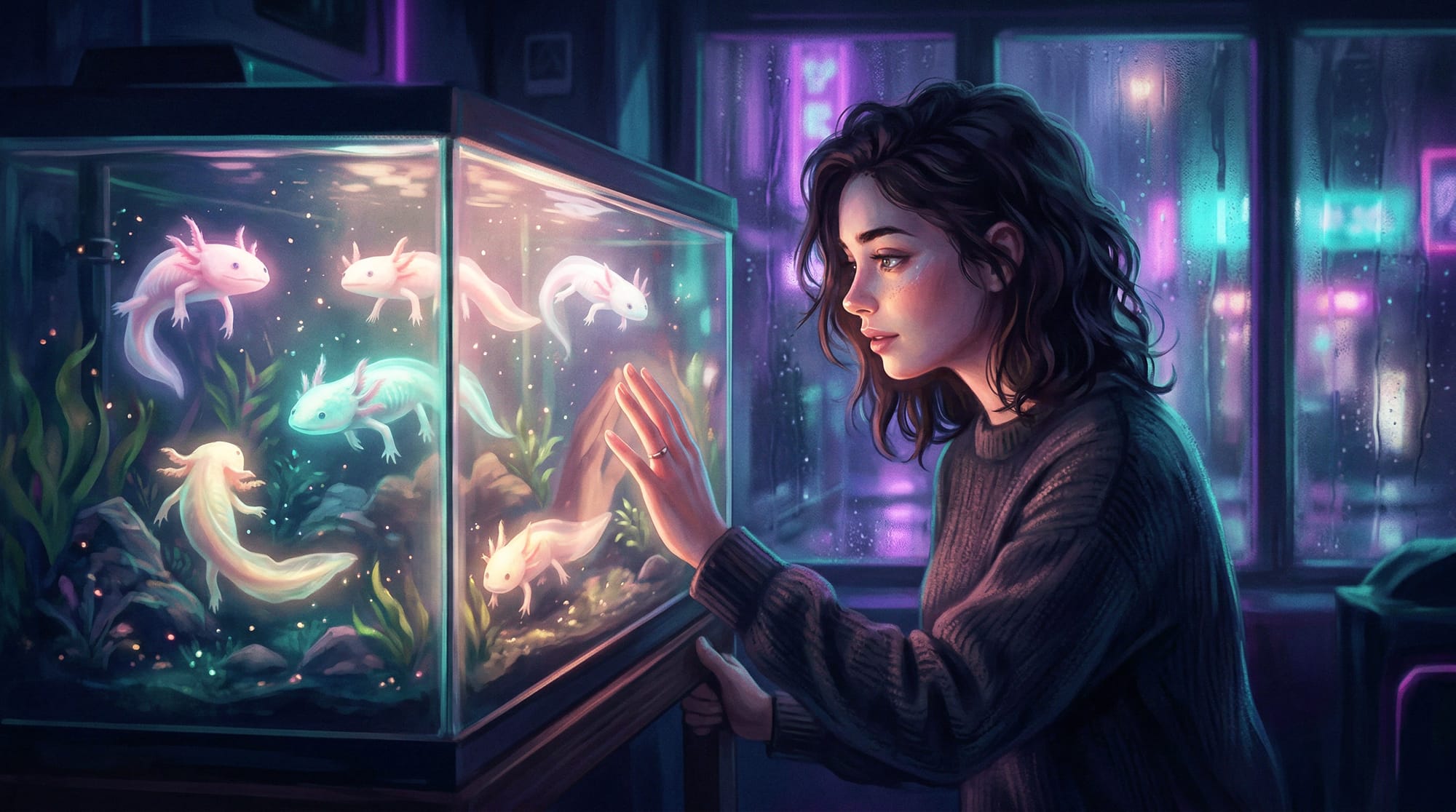
Inside, among the water plants and black volcanic stone, moved six axolotls no longer than a forearm, their skin translucent in places, their branch-like gills feathered with soft bioluminescence.
Tiny pulses of light drifted along their spines. One rose from the bottom with dreamlike motion and pressed its broad, foolishly gentle face against the glass, watching them both.
Sylv exhaled through his nose. The mask had cracked.
“You kept all six alive,” he murmured.
Laureline lowered the knife. Not because she trusted him. The axolotls had begun to stir more rapidly in response to his presence, and she did not want them distressed.
“I kept them alive because your family intended to kill them.”
His gaze moved over the setup: the adaptive filters, the improvised light regulators, the algae beds and the handwritten notes fixed to the wall with pastry magnets shaped like stars.
One of the axolotls drifted upward toward her hand and turned lazily in the water.
Its light brightened until her fingers seemed haloed.
Sylv looked at that, and his face became unreadable once more. “A bond.”
She nodded.
A short knock sounded at the front of the bakery, followed by the scrape of the letter slot and the dry, cheerful voice of Mrs. Ibanez from next door.
“Laureline, darling, your delivery drone bullied my basil again.”
She closed her eyes briefly.
“One moment,” she called, pointing the knife at Sylv.
“Do not touch anything.”
She left him there with the tank and went to the front, where Mrs. Ibanez stood in her shawl beneath the glow of her florist sign, holding a half-crushed bundle of sweet herbs.
“I see you have visitors after closing,” the older woman observed, peering past Laureline’s shoulder with unabashed interest.
Laureline dislodged the delivery drone from the edge of her garden. “Yeah, what of it?”
“It is impolite to show up with no respect for the hour.”
“You're as wise as ever, Mrs. Ibanez.” She patted her on the back.
Mrs. Ibanez leaned closer. “Do you need me to call my nephew?”
Her nephew, Timo, had once broken a man’s wrist with a bouquet stand over an unpaid orchid invoice and regarded it as one of his more civic accomplishments.
“I'll have to get back to you on that,” Laureline said.
Mrs. Ibanez patted her cheek with a cool, damp hand. “Then I shall continue pretending not to watch from my window.”
When Laureline returned to the back room, Sylv had not moved from the tank, though his attention had shifted to one of her pinned notes, a stained page of calculations she had scrawled at four in the morning between batches of brioche.
“They were commissioned as a product,” he said as she entered.
“That's correct.”
He turned then, leaning one shoulder against the shelves, immaculate and out of place among sacks of rye flour and spare pump tubing.
“Do you have any idea what House Argen paid to develop this line?”
“An appalling amount, I presume.”
He frowned and nodded.
“Do you know what the Vivarium Syndicate would pay to acquire it?”
“Enough to make everyone involved even uglier than they already are.”
His mouth tightened. “Then you understand the scale of what you hold.”
Laureline slid the knife onto the shelf within easy reach, and folded her arms again.
“I reclaimed six living organisms that your family intended to strip for regenerative matrices and neural adaptation compounds. You can call that theft if it helps your conscience stand upright.”
For the first time something flashed in his expression, not anger exactly but the sudden emergence of a wound. “You think I agreed with it.”
“I think you came here to retrieve them.”
“You're mistaken. I came here before someone worse did.”
Vivarium's Interference
Inside the room, the tank cast wavering motes over Sylv’s face, giving him a reflection that was aquatic in nature.
“Who else knows?” she asked.
Sylv answered immediately, which made the answer more frightening. “Too many people.”
He pushed away from the shelves. “Your extraction from the lab went unnoticed for thirty-six hours. After that, there were rumors. After that, bribes.”
Laureline swore under her breath.
“Vivarium intercepted one of our transport manifests and cross-referenced old personnel records. This address surfaced yesterday.
“House Argen believes I came to retrieve the lost property.” His tone flattened at the word property.
“Then you should leave,” she said. “You can tell your family you didn’t find anything.”
“They would know I lied.”
She blinked. There was enough iron in that sentence to tell a larger story than he meant to offer.
The axolotl nearest the glass pulsed brighter. Two others drifted in slow orbit beside it.
Laureline reached down absentmindedly and rested two fingers against the tank.
“They can’t travel tonight,” she said. “Their circadian rhythm is still unstable after the last filtration adjustment. If I move with them now, they’ll shock.”
Sylv’s gaze followed the gesture. “How long?”
“Twelve hours, if nothing goes wrong.”
“Then I stay.”
Laureline stared. “That was not one of the options. You cannot simply decide. I should kick you out now for your audacity.”
His expression did not change. “You can’t hold this place alone against Vivarium. You know that.”
Infuriatingly, she did know it.
Sylvester's Protection
So the arrangement began.
The bakery had always been all warmth and amber bulbs. Its front window crowded with loaves and tarts and hand-painted menu cards where Laureline had drawn little moons beside the night specials.
It was a room built for appetite and gossip and the slight delirium of sugar at odd hours.
Sylv stood where sight lines were clearest. He noticed locks, weak hinges, the blind spot near the fridge. When dawn began its slow dilution of the neon outside, he had already inspected the alley, the roof access, and the side entrance shared with Mrs. Ibanez’s florist.
Laureline disliked being observed and discovered, to her annoyance, that she disliked it more when the observer was occasionally useful.
“The backdoor latch is misaligned,” he said, returning from the alley while she whisked cardamom into cream.
“So is my life.”
“I see. Well, I fixed one of those.”
She glanced over and found, to her great irritation, that he had indeed repaired the latch.
Morning regulars arrived.
Laureline sold saffron buns and coffee dense enough to alarm a cardiologist.
She introduced Sylv to no one. The neighborhood invented explanations anyway.
Mrs. Ibanez came in for tea and spent an extravagant amount of time selecting one madeleines tin while studying Sylv over the rim of her glasses.
“Debt collector?” she asked Laureline.
“Nope.”
“Boyfriend?”
“Absolutely not.”
Mrs. Ibanez smiled into her tea.
Sylv, seated at the corner table with a cup of espresso untouched before him, looked as if he might have preferred a firefight to the conversation.
Later, Timo from the florist’s arrived with a crate of blood oranges and the proprietary concern of a man who loved neighborhood drama because it allowed him to exercise his forearms.
“Laureline,” he said, hoisting the crate onto the counter, “your sign nearly electrocuted a courier.”
“I'll get that fixed... eventually.”
He nodded toward Sylv, who was tightening a screw beneath the pastry case with an efficiency that suggested he had once repaired more expensive things under worse conditions.
“You hiring now?”
“Don’t be ridiculous,” Laureline said.
Timo squinted. “He does look expensive.”
Sylv straightened. “I’m told that often.”
Laureline snorted despite herself.
The day unspooled in a rhythm neither natural nor wholly unwelcome.
He ended up holding bowls while she reached for jars on high shelves, stabilizing sheet pans when she swung around too fast, and at one point catching a falling tray with one hand before it could take out an entire row of candied pear tarts.
Laureline looked at the rescued tray, then at him. “You may keep one tart as thanks.”
His brows lifted. “One?”
“Do not overplay your role.”
He accepted the tart with all the solemnity of a diplomatic treaty, bit into it, and closed his eyes in delight for a fraction too long.
“Aha,” she said triumphantly. “You have a soul.”
Under the slow accumulation of these absurd domestic skirmishes, attraction ceased being hypothetical and became a low, inconvenient current.
It lived in the way Sylv rolled his sleeves exactly twice when he washed up, exposing forearms scored with thin white scars.
Glances lasted a heartbeat too long and were then redirected with exaggerated concentration toward entirely irrelevant matters like lemon zest or window locks.
That evening, after the last customer had gone and the district outside shifted into its nocturnal brilliance, Laureline finally told him the rest.
She was scrubbing caramel from a saucepan with unnecessary violence when Sylv asked, “Why baking?”
The question was so disarming in its simplicity that she set the pan down.
The bakery glowed around them in honeyed pools of light. Rain tapped at the windows. In the back room the tank pulsed.
“I was good at biodesign,” she said at last. “Too good, apparently. House Argen recruited me young, promised meaningful work, gave me beautiful machines and endless budgets and praise that turns ambition into religion.”
Sylv leaned against the prep table, listening without interruption.
“At first it was tissue regeneration for catastrophic injuries. That changed into stabilization of black-market augmentations, so men with more money than ethics could taste longevity. They wanted something that could regenerate almost indefinitely if cultivated right.”
She smiled without humor.
“The axolotl was the obvious choice.”
“You stayed even knowing what was to come.”
“I did.” Her fingers tightened around the edge of the sink. “Because every bad thing arrives disguised as a compromise. I told myself I was there to keep worse people from taking over the work. I told myself I could guide it.”
The rain thickened, silvering the window glass.
“When the first viable line survived,” she continued, “they celebrated. I thought that meant we had done something extraordinary. Then I read the procurement orders.”
She looked back over the tank.
“Extraction schedules and profit projections. They never intended to let them live long enough to become themselves.”
Sylv’s jaw shifted, the only sign he was affected.
“So I took them,” she said. “I deleted what data I could, fried one server room by overloading the humidity regulators, stole six specimens in pastry transport crates because irony delights me, and disappeared into the only life I could imagine that involved making things with my hands.”
“Why this neighborhood?”
“Because rent was low, everyone minds everyone else’s business while pretending not to, and Mrs. Ibanez frightened away anyone who would ask intrusive questions.”
At that, the ghost of a smile touched his mouth.
Laureline looked down at the pan, then away. “And because baking is one of the only things I know how to do that doesn’t hurt anyone.”
Sylv spoke after a long moment. “You think I don’t know what my family is.”
Laureline met his gaze. “I think you know exactly what your family is. I just don’t know what you are.”
He absorbed that without flinching.
It was close to midnight when the message arrived.
Sylv’s wrist terminal, which he had silenced but not disabled, lit once against the dim kitchen.
He looked at it, and the set of his shoulders changed with such minute precision that Laureline would have missed it if she were not already watching him too much.
“What?” she asked.
He hesitated, which told her enough before he answered.
“My brother.”
He glanced at the screen again. “We need to hide them. Now.”
Laureline wiped her hands.
“And he informed me that Vivarium has assets moving through the lower district.”
Laureline’s heartbeat had begun to pick up again.
“I can delay one side,” Sylv said. “Not both.”
“Then we move them,” she said.
“You should have told me the moment he contacted you,” Laureline said.
“I just told you within seconds. And I needed to know if it was leverage or warning.”
“So which was it?”
“Both.”
She laughed harshly and turned away, shoving cooling racks aside with more force than necessary. “Of course it was.”
From outside came the slow growl of engines in the alley, followed by a brief wash of white light across the rear window.
Both of them froze.
Sylv moved first, crossing the room in three strides and killing the front sign. The bakery dropped into dimmer amber. Laureline was already in the back room, checking the tank seals, her hands steady through sheer force.
“How many?” she asked.
“I don’t know yet.”
He went to the alley door, peered through the reinforced slit he had installed that morning, and cursed softly.
She came back with the transport canisters, six matte cylinders lined with adaptive gel and soft blue indicators. Their readiness lights were still amber.
“Not enough time,” she said.
“We make time.”
He looked around the bakery once, and she saw calculation settle over him like armor. Then he removed a slim communicator from inside his coat.
Laureline saw it and went cold.
“No.”
He ignored her and keyed a channel.
“Sylv,” she said.
He spoke before she could cross the room. “Rooftop access, east side. Three minutes. No uniforms.”
Laureline stopped dead.
He ended the call. Then she understood, or thought she did, and fury hit her with such clarity it was almost cleansing.
“You called them.”
His expression hardened. “I called one person.”
“You were never going to let me keep them.”
“And you were never going to survive this alone.”
Protecting the Axolotls
Outside, a fist slammed once against the alley door.
Laureline snatched up the pastry knife. “Get the hell away from me.”
“Please listen.”
“No.” Her voice shook, which enraged her further. “No, you do not get to stand in my bakery after two days of fixing hinges and eating my tarts and looking at me like that, and then summon your family to tidy up the mess.”
“It’s not my family.”
“Why should I believe you?”
Another blow hit the alley door, heavier this time. Glass rattled.
Sylv took one step toward her and stopped when she raised the knife. “Because if it were my family,” he said, and now the control in his voice had gone razor-thin, “they would be here already.”
She stared at him. The canisters hummed on the counter. Behind the wall, the axolotls moved faster in the water, responding to the pressure in the air.
A crash sounded from the roof access hatch.
Vivarium had not waited for doors.
Sylv moved toward the storage shelves, yanking down the emergency shutter controls Laureline had never bothered to install properly.
He slammed the override. Metal grates began to descend over the front windows with a shriek.
“Knife or not,” he said, tossing her a compact shock baton from inside his coat,
“you need to decide whether you’re angry or alive.”
That, infuriatingly, was persuasive.
The rear door gave way with a concussive crack.
Three figures in matte polymer armor poured into the alley threshold, visors dim, insignia scrubbed.
The lead operative carried a stun carbine.
Another held a capture net pod.
The third had a case large enough for specimen extraction.
Laureline’s fear vanished beneath a hotter thing.
“No,” she said softly.
The first man crossed the threshold and stepped on a slick patch of butter she had dropped hours ago and forgotten.
His footing vanished spectacularly and he slammed shoulder-first into the counter, discharging the carbine into a tray of meringue shells, which exploded in a sugary white detonation.
For one glorious second even Sylv looked surprised.
“You have got to be kidding me,” he said.
Then the bakery became a battleground.
Sylv met the second operative halfway across the floor, taking the man’s arm, pivoting, and driving him into the espresso machine hard enough to shatter steam valves.
Laureline slammed the shutter control again, trapping the third operative half under the descending grate. Hot sugar went everywhere.
Another figure dropped from the roof hatch.
Timo, of all people, appeared behind him swinging the florist’s iron display hook like a medieval weapon and caught the intruder across the back.
“I saw shadows,” Timo said breathlessly, as though this explained everything.
“Also your sign went dark.”
One operative broke toward the back room. Laureline intercepted him with the shock baton, jamming it against the seam of his armor under the shoulder plate.
He convulsed and hit the tile.
Sylv disabled the man at the espresso machine, then caught Laureline by the wrist as she lunged toward the roof hatch.
“Canisters,” he said. “Now.”
Together they ran to the back room.
The axolotls were incandescent with stress, little lantern souls circling the tank in frantic loops.
Laureline’s chest clenched. “It's okay,” she whispered, though she did not know whether she meant them or herself.
The canister lights had shifted from amber to blue.
“Ready,” Sylv said.
They worked in a feverish, precise tandem that would have seemed intimate under any other conditions and therefore seemed almost unbearable under these.
Laureline guided each axolotl into the transfer sleeves, speaking to them in the nonsense-soft syllables she had developed over months.
Sylv sealed the canisters and calibrated the temperature differentials with hands so steady they made her want to either kiss him or strike him.
“Who did you call?” she asked between the fourth and fifth specimen.
He did not look up. “My sister.”
As if summoned by the line itself, a woman in a charcoal coat stood framed by the back hall, dark hair braided tight, cheekbone split by an old crescent scar. She held a suppressed pistol in one hand and looked at the wrecked bakery with a distinct lack of sentiment.
“Sylv,” she said.
“Laureline,” he said, still sealing the final canister, “this is Giada.”
Giada took in the glowing cylinders, Laureline’s flour-streaked face, and the prone operatives on the kitchen floor.
Laureline straightened, clutching two canisters to her chest.
“Argen security is two blocks out. Father sent them after your signal piggybacked through the private relay.”
Sylv swore.
“So,” Giada continued, “we have approximately ninety seconds before this becomes a much uglier reunion.”
Sylv took three canisters, Laureline the other three. “Vehicle?”
“Not exactly,” Giada said. “Come.”
They moved through the bakery’s side corridor.
Above them, the city rose in tiers of fluorescent chrome and algae-lit concrete, balconies dripping with bioluminescent vines, transit rails threading the mist.
A hover cart no larger than a food stall waited under the awning, its cargo bed lined with thermal shielding and, to Laureline’s astonishment, fitted with collapsible display shelves.
Giada followed her stare. “I had to improvise. It belonged to a noodle vendor I owe a favor.”
Laureline looked from the shelves to the shielded compartment to the surviving crate of pastries Timo had somehow thrust into the cart while no one was looking.
“You turned my escape into a mobile bakery.”
Giada considered. “I thought it might improve morale.”
Behind them, the bakery door shuddered under another impact.
Sylv climbed into the cart and held out his hand. Rain jeweled in his hair. Blood, probably not all his, darkened one cuff. He looked less composed than he had all day, and somehow more himself.
“Laureline.”
In that single word lived the whole narrowing of the world. The bakery behind her, wrecked and beloved. The axolotls hummed in their canisters, blissfully unaware.
The city that had hidden her and would no longer keep her.
Trust him, said one part of her.
Run, said another.
Laureline took his hand.
They hauled themselves into the cart just as the alley gate burst inward and men in Argen black flooded the lane. Giada hit the throttle.
The cart lurched upward on whining repulsors, skimmed over stacked produce crates, and shot into the rain-silvered arteries of the night.
Below them, the district receded in shards of color: the florist’s green sign, the bakery’s pink script half crushed behind shutters, the market lamps glowing like embers in water.
The sea beyond the city was a sheet of obsidian, and farther still the offshore turbines blinked red in intervals.
For several minutes none of them spoke. The canisters glowed softly in their mounts.
Giada drove with cool violence. Sylv sat opposite Laureline in the swaying cargo bay, one hand braced above her shoulder, close enough that she could feel the heat of him whenever the cart pitched.
Finally Laureline looked at the pastry crate between them and laughed, the sound cracking at the edges from exhaustion and adrenaline.
“We brought the blood orange brioche.”
Timo, who had somehow wedged himself onto the rear step without anyone noticing until now, leaned in through the side rail, drenched and radiant with vindication.
“I thought ahead.”
Giada did not turn. “Why are you here?”
Timo looked offended. “Community.”
For the first time since the fighting began, Sylv laughed properly, a low, incredulous sound that transformed his whole face and left Laureline briefly incapable of language.
That settled it, absurdly enough.
The cart shot over the harbor causeway and down toward the freight district.
At the far end of Pier Nine was a decommissioned transit trailer Giada had arranged under false registry, its sides painted a cheerful cream and its service window fitted with polished brass.
“A new location,” Giada said. “Temporary, but discreet.”
Laureline stared.
The trailer smelled faintly of cedar and machine oil.
There were built-in shelves, a water hookup, and enough room in the rear compartment for the tank rig Giada’s contacts had smuggled in ahead of them.
Through the side hatch, the ocean breathed in dark, salt-heavy gusts.
They transferred the axolotls first.
Laureline’s hands shook only once, when the smallest one flicked its glowing tail against her wrist as though to reassure her.
In the new tank, under fresh filtration and the low murmur of pumps, the six creatures settled among the sea grass and volcanic stone and began, gradually, to pulse in a calmer rhythm.
Safe, for now.
Only then did the enormity of everything else arrive.
Her bakery was behind her. Her anonymity was gone. Argen security would be searching the district by dawn. Vivarium would also not abandon a prize like this.
Laureline stood with flour still on her collar and stared at the axolotls.
Behind her, someone set a cup on the counter.
Sylv had made tea, which seemed odd, in light of all the other things, strangely fitting.
She took it. “I thought men like you emerged fully formed with no practical domestic skills.”
Timo had fallen asleep on a sack of flour in the corner with an empty brioche tin on his chest. Giada stood outside under the awning taking a call in a voice too low to carry. The sea struck the pilings in slow, resonant thuds.
“What now?” Laureline asked.
Sylv leaned beside her, shoulder brushing hers with a tentativeness more intimate than boldness would have been. “Now,” he said, “we disappear more creatively.”
She turned to look at him. The harbor lights moved in his eyes. Without the relentless vigilance of the last twenty-four hours, he looked tired enough to be human and dangerous enough to remain interesting.
“You destroyed your life for six glowing salamanders and one extremely temperamental baker.”
“Axolotls,” he said automatically.
She smiled despite herself. “You see? This is why I almost stabbed you.”
“Laureline,” he said after a while, her name quieter than before, “when you thought I’d called my family, you looked at me like I’d broken something I didn’t know how to name.”
She swallowed.
“Maybe you had.”
His hand, resting on the counter beside hers, turned until their fingers touched.
“And now?” he asked.
She looked through the trailer window at the sea, at the city beyond it with all its merciless lights, at the reflection of the tank where six squishy creatures drifted like living starlight. Then she looked back at him.
“Now,” she said, “You're... useful.”
His mouth curved, that near-smile she had noticed in the bakery door and learned, against her will, to treasure.
“I can do useful.”
“I thought you’d say that.” She leaned closer, close enough to feel the warmth of his breath.
“Will you stay?”
The words slipped out.
Sylv’s expression changed in that devastating way honest expressions do when they stop being managed. “I intend to.”
Laureline set down the tea and kissed him.
The kiss tasted faintly of bergamot and smoke.
One of his hands came up to cradle the side of her neck with such unexpected gentleness that her knees nearly betrayed her out of sheer indignation.
When they drew apart, the harbor still rocked beyond the window and the axolotls still pulsed in their tank and nothing external had changed, yet the world seemed reconfigured around the fact of it.
From the awning outside, Giada knocked once on the trailer wall. “I am pretending discretion,” she called. “Do not make it arduous.”
Laureline laughed into Sylv’s shoulder.
Saltwater Bakery
Dawn came pale and marine over the freight district, drawing silver across the city in opalescent bands.
By then they had cleaned the trailer, arranged the counter, hung a hand-painted sign that read SALTWATER BAKERY in Laureline’s hurried script, and stacked the shelves with whatever pastries had survived the night.
Timo, revived by coffee and self-importance, had decorated the service window with blood orange peels and stolen florist ribbon.
Giada vanished before sunrise, leaving behind a packet of forged permits and the number of a woman who owed her three favors and a refrigeration unit.
When the first dockworkers wandered over, drawn by the scent of cardamom and browned butter carrying over the harbor, Laureline served them from the new window.
Sylv adjusted the awning supports and pretended not to notice that everyone kept assuming he worked there.
One man bit into a still-warm brioche, looked at the glowing tank behind the counter, and said, “You folks new?”
Laureline glanced at Sylv.
He met her gaze across the little moving bakery they had not planned and somehow made.
“Yes,” she said, smiling.
Behind her, the axolotls drifted through green-shadowed water, safe for another day.
Outside, the city stretched its bright and treacherous limbs into morning.
Beside her stood a man who had chosen a different life over inheritance and stayed anyway.
The engine under the trailer hummed with possibility.
Laureline handed over the pastry, tucked stray hair behind one ear with flour on her knuckles, and began again.
You’ve reached the end of this story.
But not the end of the world it belongs to.
New stories appear regularly.
Stay curious.
✦ Related Reading & Themes
This story explored:
the cost of choosing compassion in systems built for extraction
what it means to protect something fragile in a world that profits from harm
the tension between inheritance and identity
how defiance becomes a form of survival
the intimacy of being understood without permission
the way ordinary spaces can become sanctuaries under pressure
trust as something built in moments, not promises
Tags for similar stories:
cozy sci-fi, soft sci-fi romance, biotech fiction, underground syndicates, black market experimentation, found family, slow burn romance, character driven fiction, atmospheric fiction, urban sci-fi, morally gray characters, subtle romance, quiet tension, high stakes low noise, hidden worlds, emotional restraint, cinematic storytelling, sanctuary spaces, chosen life, soft resistance, near-future fiction, immersive atmosphere
✦ If You Liked This Story
You might also enjoy:
Alignment in Aerodrift - In an eco-futurist world, a disciplined player and a former competitor connect through the exciting sport of Aerodrift. A story about trust, and learning to move with what cannot be held.
If you want more stories like this, explore the full Petalstorm Press library → HERE
© Petalstorm Press — Original Fiction
This story is part of the Petalstorm Press library.
Redistribution or reproduction without permission is prohibited.