Alignment in Aerodrift
In an eco-futurist world, a disciplined player and a former competitor connect through the exciting sport of Aerodrift. A story about trust, and learning to move with what cannot be held.

A Short Story by Avia Nevoir
Ana had always felt a moment of recalibration and jittery awareness in her body before she set foot inside the court.
By the time the first line of morning light broke across the low mountain ridges that bordered Avenlight, the Aerodrift courts had already begun to hum to life.
Avenlight was built on the idea that nature needed to be redesigned to live alongside the newest developments in technology, including gravity-powered sports.
The aerial courts were all built on the same principle—gravity-responsive fields—but each one developed its own identity over time, earning names like Resonance or Exodrift depending on how the drift behaved.
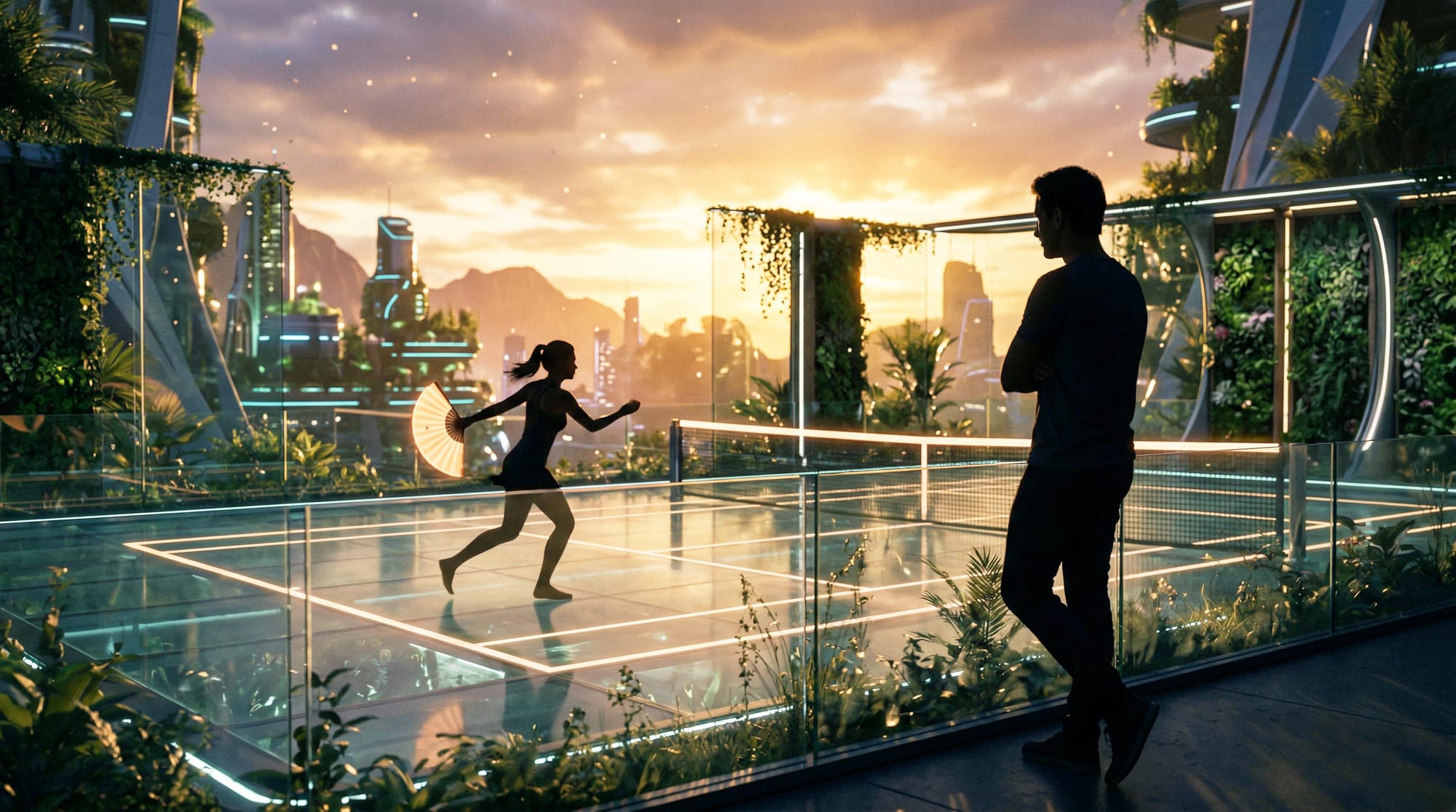
The Resonance Court was beautiful, made of translucent smart glass and surrounded by foliage of every shape and size.
Ana stood at the boundary line of the court with her Lumen Fan resting loosely against her shoulder, her fingers tapping once against the grip in a rhythm she did not consciously think about, and waited until that internal alignment settled into trust before stepping forward.
“You’re early,” Riggs said from somewhere above her, his voice carrying easily through the open air with the kind of relaxed confidence that suggested he had been watching long enough to know exactly when she would arrive.
Ana did not look up immediately, though she was aware of the soft hum of his hover bike shifting position overhead, the sound blending into the layered morning noise.
She heard the low mechanical whirr of generators stabilizing and the faint chatter of voices beginning to populate the edges of the courts as early spectators filtered in.
“You’re hovering again,” she replied, adjusting the stabilizing band around her wrist with a small, precise motion before finally lifting her gaze toward him.
He angled slightly lower, just enough that she could see him clearly without having to tilt her head too far back.
His posture was loose against the frame of the hover bike, one hand resting casually against the control board.
“I like the vantage point,” he said.
“You like being nosy,” she corrected.
“Ah, you keep saying that,” he said, “yet you never tell me to leave.”
She stepped forward.
Ana's Training Session
Right as she crossed into the court, the shift happened. The ground did not move beneath her, but it no longer felt entirely anchored either, and the space above the surface carried a sense of invitation, as though it was willing—if she chose—to let her move through it differently.
Today’s configuration leaned toward a vertical drift, though not aggressively. The field encouraged lift, extended hang time, and rewarded players who committed fully to upward movement, but it did so without offering any guarantees about how or when that lift would stabilize again.
The training courts projected adaptive AI opponents—responsive enough to simulate real matches.
It was, in other words, the kind of court that required trust.
“You’re tight again,” Riggs said, his tone shifting almost imperceptibly from teasing to observational.
“I’m focused,” she replied, bouncing once on the balls of her feet to test the drift.
“You’re bracing and anticipating failure,” he said.
“That’s not focus.”
She rolled her shoulder once, then lifted the Lumen Fan in her hand.
“And what would you call it?” she asked.
“Hesitation,” he said.
She served before she could acknowledge the word.
The motion was clean, the kind of strike that came from years of repetition, but the moment the ball lifted into the drift, she felt it—the slight delay in her movement as she recalibrated for the altered trajectory.
Her fingers clamped around the fan as she moved, but the hesitation cost her. The ball clipped the edge of the field and dropped short.
“Still negotiating,” Riggs said.
Ana closed her eyes briefly, then opened them again with a controlled focus.
“Shut up,” she said.
“I think it’s getting through though,” he said.
She glanced up at him, irritation flickering across her expression before settling into something more neutral.
“You’ve decided that, have you?”
“I’ve noticed it.”
“And what exactly have you noticed?”
“That you’re very good at Aerodrift,” he said, “but you're still playing like you don’t believe that.”
She held his eyes for a moment, then looked away.
“I’ve been winning,” she said. “And why are you even here You don’t play, you don’t coach, you don’t compete—you just watch,” she added.
“Observation is a vital skill,” he answered.
Training Day 2
The town of Avenlight was not built for spectacle, but it had become one anyway.
The sport sat at the center of it. It was the thing everything else oriented itself around, whether it meant to or not.
Structures had grown up around them over time, not according to any centralized plan, but through a series of adaptations—workshops leaning into open space, market stalls appearing where foot traffic gathered, eco-futuristic housing constructed in ways that allowed for both proximity and distance from the shifting fields.
It was a town that had learned to coexist with lightning-fast tech developments and a collective obsession with Aerodrift, and in doing so, had made the sport part of its identity.
By midmorning, Ana stepped into Resonance Court for her next training session.
Mara appeared near the electro railing.
“You’re arguing with him again,” she said.
“I’m ignoring him,” Ana replied.
“I'm still here, Anaktoria,” Riggs said, teasingly, using the full name printed on tournament rosters and nowhere else if she could help it.
“Don't call me that.”
“You're lucky to have someone cheering you on,” Mara said.
“Don't start. He's a thorn in my side.”
“I can hear you,” Riggs said.
“We don’t care,” Mara added.
Ana exhaled.
“I have a match on Friday,” she said.
“Hard work is gonna pay off,” Riggs added.
She turned back to the court.
“Stop talking.”
“I dare you to play one point without thinking about how it looks,” Riggs said.
“I don’t think about that.”
“You do,” he said. “You just don’t call it that.”
She served again.
This time, when the ball rose into the drift and the court subtly shifted beneath her, she felt the hesitation begin before it fully formed, the instinct to correct, to control, to ensure—and she jumped.
She hit the ball and it went wide. The artificial intelligence on the opposite side of the court failed to respond in time.
“Good,” Riggs said.
She stared at him.
“Your hair is falling from your bun,” he added.
Training Day 3
The training stretched longer than she intended, each repetition peeling back another layer of habit she had not realized she had built, each mistake revealing not a lack of skill, but a pattern of restraint.
Riggs stayed, as usual. Not always speaking and rarely intervening. He was present in a way that made it difficult for her to retreat into the polished version of herself she had relied on for so long.
“Show me,” she said eventually.
He stilled.
“You’ve seen enough.”
“I want to see it again,” she said.
“Why?”
“Because I still don’t believe it,” she said.
He studied her for a long moment.
Then, without another word, he stepped forward and crossed into the Resonance Court.
The shift was immediate and undeniable.
Ana felt it in the way the field seemed to adjust around him, responding to the way he entered it—without hesitation, negotiation, or the subtle tension she carried into every movement.
He pulled out a black Lumen Fan, battered at the edges.
“For the record,” he said, “this is still a bad idea.”
“Then don’t do it.”
He smiled slightly.
“You know I could never give up a chance.”
He served.
And this time, Ana watched not just what he did, but how he did it—the absence of that fractional pause she couldn't overcome, the lack of internal conflict and the way his body aligned with the aerial drift instead of correcting against it.
The adaptive opponent buzzed low as he landed cleanly.
“That’s it,” he said.
“I don't know how the hell you do that,” she replied.
“You just don’t trust the drift yet.”
She didn’t answer him right away.
The court shifted subtly beneath her feet, the drift tilting just enough that her weight redistributed again, forcing her to adjust without thinking, and she realized, with a quiet and unsettling clarity, that the adjustment itself had become easier in the last hour.
It was the result of the moment she had stopped trying to force it into something it wasn’t.
“I don’t like that you’re always right,” she said finally.
Riggs shrugged lightly.
“You’ll get used to it.”
“Just in Aerodrift-related matters, anyway,” she retorted.
“How do you know?” he said. “Maybe I’m a walking library of impressive skills.”
She rolled her eyes, letting out something closer to a laugh than she intended, and stepped back into position.
“Let me go again,” she said.
He nodded once, stepping back out of the field, returning to the edge without ceremony, as if crossing that boundary meant nothing to him and everything to her.
She served. This time, when the ball lifted into the drift, she followed it intuitively.
Her hand flexed once around the Lumen Fan, brief and instinctive, before she released the need to control it and committed fully to the motion.
She jumped, the space giving way beneath her, and struck a clean hit.
When she landed a second later, her balance was slightly off and her footing uneven, but her momentum carried her through instead of stopping her short.
She stood there for a moment, breathing, feeling the aftereffect of the movement settle through her body in a way that felt unfamiliar and strangely right.
Riggs watched her, something fonder in his expression now.
“Graceful landing, Anaktoria,” he said.
She glanced at him.
“Ana.”
“You’re gonna do great on Friday,” he said.
She shook her head, but the edge had softened.
Prematch Anxiety
The night before the big match, Avenlight felt different.
It always did before a match that mattered. The town transformed in an obvious way each time—banners, announcements, booths—and the awareness that existed within the courts had spread outward into the spaces around them.
Conversations lingered a little longer, team colors were displayed more often, and lights stayed on a little later.
Ana sat on the low concrete barrier near the Grand Court, her Lumen Fan resting beside her, the band still wrapped around her wrist, and watched the faint shimmer of the inactive field before its day of worship.
“You’re here,” Riggs said, his voice closer now.
“So are you.”
He stepped up beside her, leaning lightly against the barrier.
“For someone who doesn’t play,” she said, “you spend a lot of time at the courts.”
“For someone who says she doesn’t listen,” he replied, “you remember everything I say.”
She huffed quietly and glanced at him.
“…Why did you stop?” she asked.
The question lingered longer this time.
Riggs leaned back slightly, resting his weight against the edge of the electro barrier, his gaze drifting out across the court.
“I didn’t stop because I couldn’t play,” he said finally, his voice dimmer now, less performative, less playful in the way it usually was.
“That’s what people assume when they see me out here and not in it, like something broke and I just never fixed it.”
Ana tilted her head slightly. “Did something break?”
He let out a small exhale, not quite a laugh.
“Yeah,” he said. “Just not in the way they think.”
He shifted his weight, one hand absentmindedly pressing into the side of his knee.
“It was a high-lift configuration of the court,” he continued, his eyes still on the court.
Ana watched him more closely now.
“We were deep into the match,” he said. “Everything was fast, unstable, reactive.
The kind of game where you stop thinking about form and start trusting instinct because there isn’t time for anything else.”
He paused, then added, with a grin:
“I was good at that.”
She didn’t interrupt.
“The drift opened up,” he said. “I felt it before I saw it, the way you do when the court is about to give you something it hasn’t the entire match, and I didn’t question it.” He glanced at her briefly. “I just went with it.”
Ana’s grip tightened slightly around her wristband.
“How high was it?” she asked.
He smiled faintly, but there was no humor in it.
“High enough that I stopped thinking about the landing,” he said. “High enough that for a second, it didn’t feel like I was in the court anymore, like the gravity had thinned out.”
He looked down then, at the ground beneath his feet.
“That’s the part people don’t understand,” he continued. “These aerial courts don’t just respond to your movement—they answer to your certainty and stability. And in that moment, I was completely certain.”
Ana swallowed.
“And then?”
“The drift dropped faster than it should have,” he went on. “Or maybe I stayed up longer than I should have. Probably the latter.”
He shifted again, his hand pressing more firmly into his knee now, in acknowledgment.
“I hit the shot,” he said. “Exactly where it needed to go. And then I came down into a field that had already moved on from me.”
Ana felt the impact of it before she knew what to say.
“What happened then?” she asked, quieter now.
“My timing was off by less than a second,” he said. “But in the Resonance Court, that’s enough.”
He glanced at her, holding her gaze this time.
“The gravity reset before I did.”
She didn’t speak.
“I landed wrong,” he said. “Not catastrophically. But enough to shift something in the way my body trusted the court.”
He flexed his hand slightly, as if testing the memory of it.
“I could’ve recovered,” he added. “And I did, technically. The damage healed. Most of my strength came back. I even stepped onto the court again for you.”
Ana frowned.
“Why didn’t you keep playing?”
Riggs held her gaze for a moment, then looked back out at the field.
“Because the next time I jumped,” he said, “I thought about the landing.”
The words settled between them, heavier than anything he’d said before.
“And once that happens,” he continued, his voice steady but quieter now, “you can’t undo it. You can train around it, adjust your timing, your form, your risk threshold. You can even become a smarter player, a safer player.”
He let out a small breath.
“But you’re never the same player again.”
Ana looked down at her hands again.
“That’s incredibly dramatic,” she said.
He huffed a soft laugh.
“I’ve been told.”
“And also,” she added, “wise somehow.”
“Also been told that.”
That made her smile, just a little.
“Careful,” he said. “You’re starting to actually like my presence.”
“Tolerating it is more accurate,” she replied.
They sat there for a moment longer, the Grand Court stretching out in front of them, holding a promise of movement that neither of them could quite ignore anymore.
Then Riggs reached into the side compartment of his bike, though this time the motion was slower, less casual, as if he had already decided he was going to do this and was only now committing to it.
He held it out to her.
Ana took it, turning it over in her hands.
It was small—no larger than a coin—but thinner, irregular at the edges. The surface caught the bright lights of the court.
“…What is it?” she asked.
Riggs leaned back against the barrier, watching her rather than the object.
“Piece of an old court,” he said. “One they retired a few years back. The Exodrift Court. The field started behaving… strangely.”
Ana glanced up at him.
“Strangely how?”
He shrugged lightly.
“More reactive than usual, less predictable. Gravity went bonkers, and people didn’t like it.”
She looked back down at the fragment, tilting it slightly between her fingers, watching the way it seemed to hold onto the light for just a second longer than it should.
“And you kept a piece of it,” she said.
“I found it,” he corrected. “After they broke it down.”
Ana ran her thumb lightly along the edge of the fragment.
“It doesn’t do anything,” she said.
“No,” Riggs said. “It doesn’t.”
She glanced up at him again, a hint of suspicion returning.
“Then why are you giving it to me?”
He considered that for a second, then pushed off the barrier, stepping just slightly closer—not into her space, but near enough that the distance between them felt intentional.
“You thought I’d like it because it’s shiny.”
He didn’t answer immediately, just laughed.
She turned it once more between her fingers, slower now.
“And this is supposed to help me how?”
“It’s a reminder,” he said. “That the court doesn’t owe you stability. Trusting yourself anyway is what gives you a chance tomorrow.”
Ana looked back down at the fragment, her grip softening slightly without her realizing it.
“…That’s incredibly unhelpful,” she said after a moment.
Riggs huffed a quiet laugh.
She turned it over once more, then closed her fingers around it, not tightly, but enough to feel its shape.
“…It is kind of shimmery,” she admitted.
“Yeah,” he said.
She slipped it into the pocket of her jacket, the motion small, almost absentminded.
“Don’t think this means I’m taking your advice,” she added.
The Match at the Grand Court
The next morning, the Grand Court was packed. People gathered along the edges, leaning against electro railings, perched on hovering rigs, standing just outside the boundary lines with the practiced awareness of those who understood exactly how close was too close.
The air carried that familiar mix of anticipation.
Hilda Crestline stood across from her.
The Aerodrifter looked exactly as Riggs had described: perfect, toned, and synchronized.
Controlled to the point of rigidity, her movements had an almost mechanical precision that would have been impressive if it hadn’t been so predictable.
Riggs stood at the edge, arms crossed, watching them with open amusement.
“Hilda still hasn’t learned,” he said quietly as Ana stepped up beside him.
“She looks like a shark,” she replied.
“Always about looks with you,” he said.
“Focus. Remember the court is the biggest factor here.”
She adjusted the band on her wrist.
“I'm nervous.”
“You'll win,” he said.
She glanced at him.
“You’re very confident.”
“I’ve seen you play,” he said.
She exhaled slowly and stepped onto the court.
The match configuration was more complex than the training sessions—a layered drift that combined vertical lift with intermittent lateral pull, creating a field that rewarded fluid movement and punished rigid patterns.
Hilda adjusted instantly.
Ana did not at first. The opening points went to Hilda.
She felt the pressure quickly as the band around her wrist tightened, trying to correct what she had not yet trusted.
She didn’t. She moved anyway and struck.
“Good,” Riggs called from the edge.
She almost smiled.
The next point—closer.
The next—even better.
Hilda recalibrated, her movements synchronizing with mechanical precision, but as the court shifted unpredictably beneath her, that very control began to work against her.
Ana saw it and this time—she trusted herself enough to act.
The match stretched, points dinged and the crowd leaned in.
And then, the final point.
The name she had avoided for so long sitting somewhere just beneath the surface of that motion, not spoken, not claimed, but present.
Then it popped up on the glowing screen.
MATCH: Anaktoria Paisley
Ana dropped back down, her breath catching slightly as the gravity reasserted itself, her balance uneven but intact, the band on her wrist loosening as though it had nothing left to correct.
At the edge of the court, Riggs smiled.
“Told you,” he said.
She turned toward him.
“So,” he said lightly, as she approached. “Anaktoria.”
She met his gaze.
And this time—
She didn’t flinch.
“…Yeah. What do you want?”
Riggs tilted his head slightly, studying her.
“Feels good, doesn’t it?” he said.
She sighed, something softer in it now.
“It does,” she admitted.
She glanced back at the court, at the space where the final point had landed, at the subtle shimmer of the field as it settled, less reactive now that the match had ended.
“You’re still going to hover around me, aren’t you?” she said.
“Don't think of it that way.”
“It's definitely a midlife crisis,” she muttered.
“A support system actually,” he corrected.
She smiled as he held out his hand and the both walked out the Grand Court.
Epilogue
The courts in Avenlight never stayed the same, but after a while, you stopped expecting them to, and Ana—moving more as Anaktoria now, in every way that mattered—stood at the baseline of the newest court, the Avenis Court, under lights bright enough to feel unfinished.
With her brand-new Lumen Fan resting lightly in her hand, she stalled and read the layered drift, the kind of gravity configuration she used to resist.
“You’re thinking too much again,” Riggs said from across the court, not on the sidelines anymore, but already in position on the opposite side of the court.
He still did not play the way he used to, not with the reckless faith that had once made the courts love him, but he had stepped back inside them anyway.
“I’m assessing,” she replied, though there was less resistance in it now, and when she looked at him, he was watching her the same way he always had, only this time without distance.
They started without counting, the ball lifting into the drift as she moved with it instinctively, no longer negotiating with the space or correcting mid-motion, just responding, the rhythm building between them without structure, without score, the kind of play that only existed when neither of them was trying to control the outcome.
She jumped, struck cleanly, and the ball landed just behind him, but he didn’t move to return it, which was enough to make her pause.
“…You missed.”
“Did I?” he said, already stepping toward her, the court adjusting subtly around him as he crossed the space between them with the same certainty he used to reserve only for play.
She narrowed her eyes slightly. “You’re being weird.”
“I’m being intentional,” he said, stopping just close enough in front of her, his expression more serious than usual.
Before she could respond, he reached into his pocket and pulled something out, holding it toward her without explanation, and when she took it, she recognized the material immediately—Resonance glass, refined, this time shaped into a thin, smooth band that caught the light the same way the courts did, subtly, responsively, without trying to.
“Seriously?” she asked, drawing a nervous breath.
“Yeah,” he said. “Figured it was time I stopped pretending this was temporary.”
She looked at him, then at the band, then back again, something softer settling in her expression as she slipped it onto her finger without ceremony.
“…You’re terrible at this.”
“I know.”
“You didn’t even ask properly.”
“I can,” he said. “If you want.”
She shook her head slightly. “You already ruined it, thanks.”
He smiled at that, just a little, and for a moment neither of them moved.
“Obviously I’m saying yes,” she said, closing her fingers around the band.
Then she stepped back into position, lifting her Lumen Fan, and when the ball rose between them, neither of them held back.
You’ve reached the end of this story.
But not the end of the world it belongs to.
New stories appear regularly.
Stay curious.
✦ Related Reading & Themes
This story explored:
eco-futurist sci-fi short story
gravity-responsive sport and emotional resonance
control vs surrender in competitive environments
observer to participant character arc
slow burn connection through shared movement
trust, hesitation, and learning to let go
nature-integrated technology and designed environments
atmospheric aerial court setting
subtle romance through tension and presence
Tags for similar stories:
eco futurism, soft sci-fi, atmospheric fiction, futuristic sport, gravity-based mechanics, aerial courts, resonance systems, character driven sci-fi, slow burn romance, emotional growth, control vs surrender, speculative fiction, nature and technology, glass architecture, cinematic storytelling, subtle romance
✦ If You Liked This Story
You might also enjoy:
- A Signal for Grace - In a 1950s small town, a lonely woman begins hearing a voice through her radio—one no one else can hear. As their connection deepens, she must choose between the life she’s expected to live… and a love that exists beyond her world.
If you want more stories like this, explore the full Petalstorm Press library → HERE
© Petalstorm Press — Original Fiction
This story is part of the Petalstorm Press library.
Redistribution or reproduction without permission is prohibited.