Seafoam and Sugar
A coastal fantasy romance about a woman bound to the sea and the man who asks her to choose him anyway.
The first thing Calico Mercier ever said to me was, “Do you ever look at the sea like it’s the only thing that understands you?”
I had been standing at the edge of the dunes with a basket of cardamom rolls looped over my arm, and the wind pushing brine into my face.
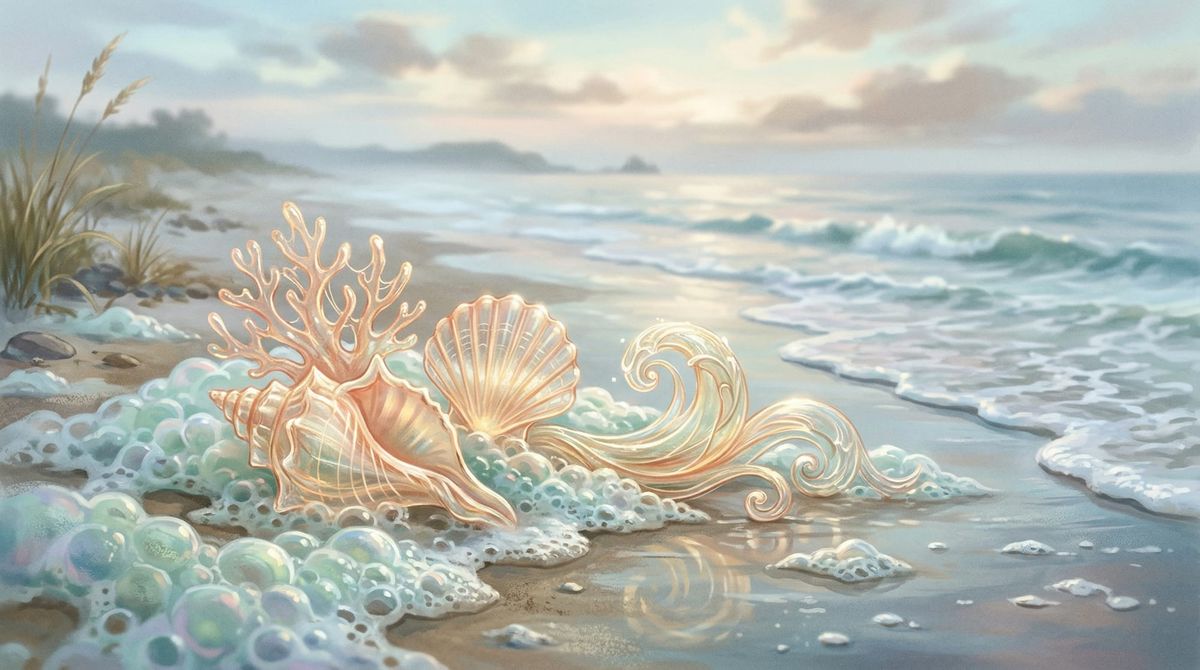
The evening tide had turned slate beneath the lowering sun. Beyond the shoals, a row of black rocks rose from the water.
I had been staring at them far too long.
I turned and found him leaning against the crooked fence that marked the end of our lane.
He wore a linen shirt unbuttoned at the throat and dark trousers dusted with sand.
His mouth had the shape of mischief.
“No,” I said. “I look at it like it knows something I don’t.”
That made him grin.
“Perhaps you should not ask serious questions to people you do not know.”
He pressed a hand to his chest in theatrical injury.
“Calico Mercier. I rent the weather-beaten cottage near the harbor. I have already been warned about your pies, your silence, and your tendency to make people curious.”
I should have left then, because I knew his name.
Everyone in town knew it, even those who pretended not to.
He had once filled arenas with songs that made girls faint and men decide to buy motorcycles.
Now he had come to our coast to disappear.
Instead, I adjusted my spectacles and said, “Those are outrageous warnings.”
He tilted his head. “Are they wrong?”
“Yes,” I said. “My rolls are much better than my pies.”
He laughed so suddenly that I startled.
The sea hissed over the sand behind me.
Through the thick lenses balanced on my nose, the water looked ordinary enough: gray-green flecked with seafoam.
Without them, the coast became a treacherous blur.
“I heard you bake for the town market,” Calico said. “Would it offend you if I bought one?”
“Why would it offend me?”
His grin widened. “Just making sure.”
I handed him one of the rolls. His fingers brushed mine, warm and dry, and somewhere beyond the rocks a low tone trembled through the water, as if a submerged bell had been struck.
“You heard that?” he asked.
I lied. “Heard what?”
He took a bite, chewing slowly. The expression that crossed his face was almost reverent. “That,” he said, pointing at the roll, “is so good it should be illegal.”
“I do not believe in laws against cinnamon.”
“There should be laws against making ordinary men feel this much from baked goods.”
Before I could answer, the bell-like note shivered again beneath the surf. It seemed to move through my bones rather than my ears.
Calico glanced toward the water. “There. It's that sound again.”
The basket handle dug into my palm. “You should go home before dark.”
His gaze came back to me, curious now rather than playful. “And do you always dismiss people when the sun goes down?”
“Only the ones who ask too many questions.”
He swallowed the last of the roll and wiped sugar from his thumb. “I will come back tomorrow and ask fewer.”
He said it as if he had already been invited.
To my own vexation, I wanted him to return. Maybe musicians heard what others missed.
The Bakery
Our bakery sat behind my aunt Miriam’s house, a white building fragrant with yeast, nutmeg, and singed sugar.
Calico began arriving just before noon, when the market crowd had thinned and my aunt was out bartering eggs for preserves. He always brought some excuse.
Once he claimed he needed currant buns. Another time he wanted coffee. Once he admitted, with disarming plainness, “I was bored, and you seem less tedious than most people.”
On a particularly warm day, he sat on the flour bin and watched me pull spun sugar into translucent ribbons.
“You make it look like glassblowing,” he said.
I stretched the sugar into a curling crest and fixed it atop a lemon tart. It caught the light like amber surf.
He studied me through the steam.
I kept my eyes on the tart.
The bells above the door stirred as the wind changed. I could smell the harbor from here.
Beneath it lurked something older, an aroma I had known since infancy: salt struck with sweetness, like honey dissolved into seawater.
Whenever that scent arrived, the visions came afterward.
Calico reached for one of the sugar shells cooling beside me. “May I?”
He laughed and picked it up before I could answer. The shell flashed between his fingers, iridescent and thin.
“You know what these look like?”
“Sugar shells,” I said frankly.
“They look like songs feel,” he replied.
He held the sugar shell against the window. Sunlight streamed through it in watery bands and skated over his face. He looked younger than the photographs in the magazines.
“My father made violins,” he said quietly. “Before he died, he used to say certain objects keep echoes inside them. Wood and glass mostly. Maybe sugar too, if somebody loves it enough.”
Outside, gulls cried over the harbor. The knife glided through fruit. Calico tapped the sugar shell against his knuckle.
“Why do you wear those glasses even in the kitchen?” he asked.
The question entered my chest like a pin.
I said, too briskly, “Because I need them.”
“Right, sorry if that came out rude.”
I looked at him then. A person can go a long while believing herself inscrutable, only to meet one infuriating man who notices the hidden hinges.
“Everything around me tends to be perilous. My mother said they help keep the world in focus,” I replied.
He nodded, but I could tell he did not believe me.
The air in the room changed. It always did just before the sea called.
Calico heard it this time too, that submerged music threading through the walls.
“What is that?” he asked.
I whispered before I could stop myself. “Home.”
His brows drew together. “This is your home.”
I glanced toward the window, beyond which the sky had gone nacreous and strange. “Not entirely.”
The Shoreline
Three nights later, he found me where the dunes sloped down to the cove.
Mist had come in early, laying a luminous veil over the beach.
I had slipped from the house with my spectacles in my pocket instead of on my face.
When I looked without the lenses, the water no longer appeared merely tidal. It shone from within. Veins of silver fire ran beneath the surface. Vast forms turned beneath the swells, elegant and monstrous.
“Eliza.”
Calico's voice came from behind me, rough with breath. I turned, startled, and his outline swam in the fog.
“You should not be here,” I said.
“I was about to tell you the same.” He came closer, sandals sinking into wet sand.
“Your aunt said you went walking. She looked worried.” He added.
I heard it then, the true call rising from the sea. Several notes braided together, so resonant that my ribs seemed to answer. The foam ran farther up the beach, cold over my shoes.
Calico stopped. “That sound again.”
The water brightened. Bright figures gathered beyond the break, tall as masts. I knew their shape from childhood stories. The nameless kin who took daughters and returned legends.
I backed away.
“Eliza,” Calico said.
His hands found my shoulders. Even blurred, his face steadied me. “Tell me what is happening.”
The truth broke out of me with humiliating ease. “The women in my family belong partly to the sea. One in each generation. The glasses were made to keep me here. My mother wore them and her mother too. They dull the call and they make being human easier.”
He said nothing for a long moment.
“And without them?” he asked softly.
“I am able to see what wants me.”
He drew in a slow breath. “Do you want it back?”
“I do not know,” I said. “Sometimes when I bake, I shape the bread into creatures I have never met, and they are waiting for me in the tide. I hear songs in shells before anyone sings them. A loud voice calls me back to the sea.”
Calico's thumbs moved once against my sleeves.
The nearest wave surged and did not fall back. A figure rose within it, woman-shaped and terrible, her hair unspooling into foam. No face, only shimmering radiance where features should be.
I flinched. Calico turned toward the sea, but without my sight he saw only darkness and weather. Still, he stepped in front of me as if his body might bargain with whatever ancient thing had come ashore.
“You cannot protect me from the ocean,” I said.
“Watch me try.”
Even then, absurdity nearly made me smile.
The chord sounded again. This time I understood it. Come back and finish the bargain. Be what you were made to be.
Calico spoke without taking his eyes from the waves. “You told me once that everything around you is perilous.”
He turned then, and though I could not see him sharply, I felt the intensity of him like heat from a kiln.
“Everything around me is perilous too, Eliza. Fame and leaving it. Loving anyone. Writing anything that matters. None of it has ever been safe. So I am asking you something idiotic.”
The sea climbed and wind lashed my hair across my mouth.
He took both my hands. “Choose me anyway.”
I stared at him. “Against the sea?”
“Yes.”
“You have no idea what you are defying.”
“Then explain it to me while we are surviving it.”
That should not have been romantic but it was the most romantic thing anyone had ever said to me.
The wave-woman lifted an arm. Behind her, the water convulsed with light.
My spectacles lay in my pocket, waiting for something.
I drew them out and looked at them one final time. Then I placed them gently in Calico's hand.
His voice went hoarse. “Eliza.”
I stepped toward the surf.
The sea opened up like a curtain. Towers of coral glimmered below. Hundreds of luminous figures turned their faces toward me. The night became baroque with color. I swayed beneath the immensity of it.
The wave-woman extended her radiant hand. She was not coming to seize me. She was coming to welcome me.
Calico's voice cut through the pull. “Eliza, listen to me.”
He held my spectacles in one hand. In the other was the silver pendant he always wore onstage in photographs, a guitar pick hammered into a charm. He pulled the chain over his head and pressed it into my palm.
“Take this,” he said.
He closed my fingers around the pendant. “If the sea wants a claim, let it fight me for one. I am not surrendering you because of a promise made before you could speak.”
The chord in the water changed.
I lifted the pendant toward the sea, and with my free hand I broke the spectacles against a rock.
Light burst across the cove in a tremendous arc and the radiant figures recoiled.
Then the sea halted.
I heard not one song but two: the old claim of the deep and the new defiance of a human heart offered freely instead of by bargain.
The wave-woman lowered her arm.
A final meaning moved through me, clear as dawn.
The water dropped away.
I stumbled backward into Calico, drenched and shaking. He caught me against him, laughing with pure disbelief.
I was crying and laughing too. “I have destroyed several family traditions.”
The sea calmed. Yet I still felt it inside me as kinship.
Calico tipped my chin up. “Are you here?”
“I am.”
“Entirely?”
“More than before.”
He kissed me then, with the tide around our boots and the mist silvering the world.
Behind us, the sea whispered but did not call me away.
By autumn, he wrote songs in the bakery while I spun sugar into shells.
In the winter, my aunt would stop pretending not to notice the way he looked at me over the kneaded dough.
When spring arrived, the town would accept that love sometimes arrived barefoot, notorious, and carrying flowers stolen from the harbor hotel garden.
As for me, I had not chosen the sea over love, nor love over the sea.
I had chosen myself—and found that Calico was waiting there.
You’ve reached the end of this story.
But not the end of the world it belongs to.
New stories appear regularly.
Stay curious.
If you want more stories like this, explore the full Petalstorm Press library → HERE
© Petalstorm Press — Original Fiction
This story is part of the Petalstorm Press library.
Redistribution or reproduction without permission is prohibited.
All stories shared through Petalstorm Press—and the channels linked here—are the official home of this work. Any versions found elsewhere are not authorized unless clearly noted.