Chip Milan Missed the Light
A gritty, nostalgic micro story set at a 2009 alternative music festival, where a photographer captures the one moment a famous singer stops performing.
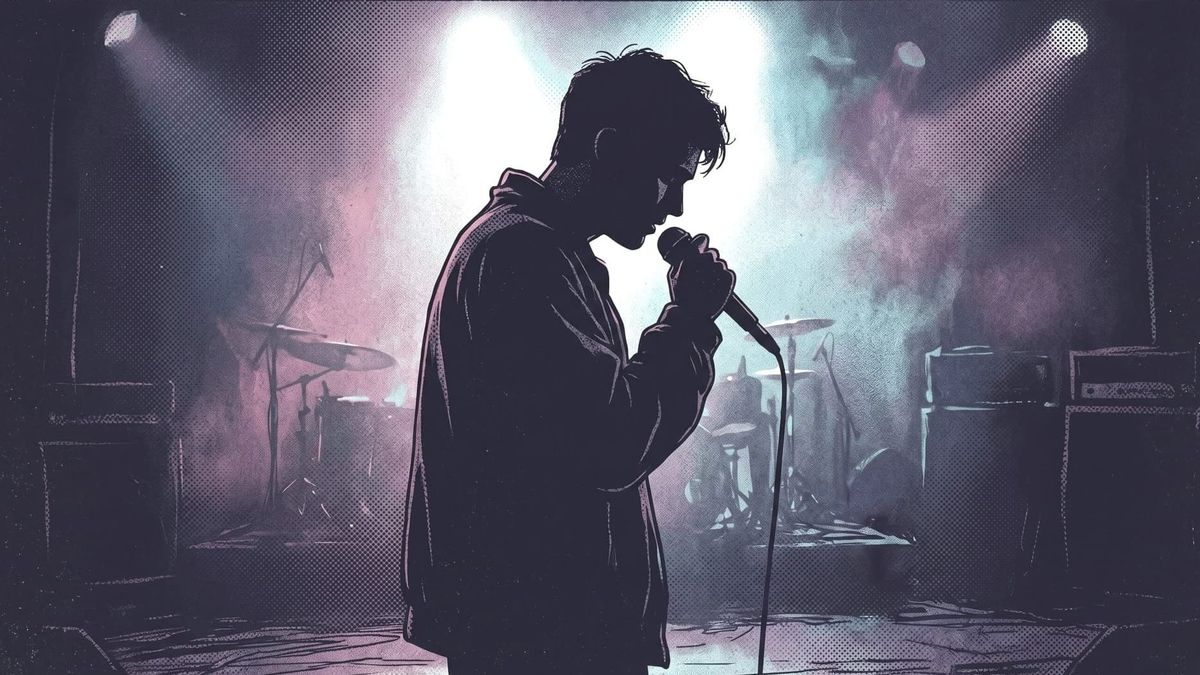
I kept my camera braced against my face, ready to capture the real energy of the Static Summer Music Festival.
By the time Chip Milan stalked onto the stage, the pit had already gone granular with dust and overpriced beer spills.
Bass thudded through my sternum with persistence.
Security guards in black polos barked at the front row to stop crushing the barricade.
Neon wristbands flashed in the dark like tropical fish scales. Above us, the lighting rig hummed.
I captured three frames of the drummer. Two of the guitarist mid-vault onto an amp.
One of a girl in the front row screaming at the top of her lungs.
“Luella, you alive down there?” Marco shouted from farther down the pit, his festival laminate smacking against his chest as he crouched for a low angle.
“Barely functional,” I called back, without looking away from the stage.
“That’s your best state.”
He was probably right. I did my cleanest work when I was half-annoyed and wholly concentrated.
Chip hit the stage in a burst of cultivated pandemonium.
I noticed the rips on his skinny black jeans, the torn tank, and layers of silver chains like fishhooks.
His gestures had been storyboarded to appear spontaneous: the mic stand swing, the bent-kneed lurch toward the crowd, the practiced rake of his fingers through damp hair.
Hands reached up as though they could pull him down from the platform and divide him among themselves.
He was very good at what he did. I noticed that immediately.
I also noticed the seams.
Even his smirk seemed timed to the half-second after a chorus landed, as if somebody behind the curtain had whispered now.
The fourth song began with a wash of blue and white from the overhead rig. Chip paced backward toward center stage, shoulders loose, mouth curled around the first line like he was chewing it apart for effect.
In front of him, the crowd shouted every word before he could. He lifted one hand, palm out, conducting them with the easy tyranny of somebody accustomed to being obeyed.
Then the spotlight slipped.
The beam moved where he was supposed to be and kept going. It floated past his shoulder and stranded itself on the crowd behind him, gilding the first few rows in a stark accidental halo. He stepped forward, expecting the light to gather him up, but it didn’t.
For one abrupt second he stood in a wash of partial shadow while the audience behind him glowed like saints in a medieval painting.
The expression that crossed his face was not dramatic enough to be called panic, but it was different from the loud persona he carried.
He looked unsure and clueless.
I took the picture.
Then the lighting operator corrected the error. Illumination rushed back over him, and Chip recovered with almost insulting speed.
He laughed into the mic, kicked a monitor, and flung himself into the chorus as though nothing had happened.
The front row never noticed. Marco certainly didn’t. A trio of girls beside the barricade were too busy crying into each other’s hair extensions.
I lowered the camera for half a breath and checked the frame.
It would never end up on a poster or a fan collage. His face looked open in a way famous people probably considered indecent.
He was neither alluring nor feral nor untouchable. Actually, it brought out his worst features, which I still thought were charming.
I should have deleted it then.
I walked over to the media tent after the set. Laptops clicked and external drives blinked. Publicists fluttered through the aisles with the brittle urgency of women trying to hold together a cardboard kingdom during a rainstorm.
I uploaded the approved set to the festival server first. Chip in full command. Chip with sweat on his throat and fire in his eyes. Chip with one knee on a monitor while the crowd convulsed below him. Exactly the sort of images Static Summer paid me to provide.
Then I opened a folder nested three levels deep in my hard drive.
REAL_ARCHIVE
The title was embarrassingly literal, but nobody else ever saw it.
Inside were years of things I had not published. A bassist crying behind a merch table while pretending to tie his shoe. A beautiful woman sleeping face-down on a picnic bench with glitter across her shoulders like frost. I even held the picture of a famous singer sitting alone by a loading dock, eating cold fries out of a paper tray with a look of almost aristocratic misery.
I dragged Chip’s photo into the folder.
As I was packing my supplies up for the day, Chip found me behind the second stage near the stacked road cases.
“You keep everything you shoot?” he asked.
His voice surprised me. Onstage it had that shredded, insolent quality guys taught themselves when they wanted to sound older than they were. Here, it sounded cold and annoying.
I hitched the camera strap higher on my shoulder. “Mostly.”
“Delete that one.”
I leaned against a metal railing and folded my arms. “You’ll need to be less vague. I’m carrying several hundred photos.”
“The one where the light missed.”
He said it flatly, but something in his jaw gave him away.
“No,” I said.
For a moment I thought he might escalate, which would have been easier to manage. Fury was common backstage.
“You planning to sell it?” he asked.
“No way. I’m planning to keep it.”
“You're serious.”
“Yeah,” I said.
“There were a lot of cameras out there that I'm sure got a similar shot. What's the big deal? Think I'm gonna cave because you're Chip Milan?”
I rolled my eyes. For years I had dealt with the entitlement of certain musicians.
He looked deeply offended by my honesty. Then somebody shouted his name from farther down the corridor, and the moment fissured.
“This isn’t over,” he said.
“I'm terrified,” I said, blinking my eyes slowly.
On the second day of the festival, his band worked the merch tents. I noticed he began materializing with suspicious frequency. He always had some flimsy excuse for being there.
“Just checking you haven’t auctioned my humiliation yet.”
“Just making sure you understand stalking is bad optics.”
“Just curious whether you ever consider taking a flattering picture instead.”
Our conversations acquired a spiky rhythm. He was wry when cornered, combative when bored, and difficult to impress. I found that perversely refreshing.
Most artists either flirted with photographers or ignored them. Chip seemed to consider me an adversarial opponent.
One evening, while a lesser-known band droned through a set on the side stage, I showed him a few of the images in my private archive. I do not know why.
Perhaps because he kept circling the question of what I wanted from the photo, and I had grown tired of answering in abstractions.
He stood beside me in the shadow of a merch tent while I scrolled.
“You like people at their worst,” he said.
“No,” I replied. “I like them when they stop pretending.”
Our story as adversaries took a sour turn.
The hack happened overnight.
I woke in my motel room with my flip phone vibrating itself toward the edge of the nightstand. Seven missed calls. Eleven text messages. One from Marco that read, in all caps, CALL ME BEFORE YOU OPEN ECHOPAGE OR THROW YOUR LAPTOP OUT THE WINDOW.
That was how I knew it was bad.
My EchoPage profile had been breached. The person who got in had selected only one gallery to dump: Chip’s set from the night before. Every approved image. And tucked in the middle like a shard of stained glass, was the one from my archive.
The reposts were already multiplying across blogs and fan pages. Grainy edits and oversharpened versions. Captions alternating between mockery and morbid concern.
when the dissociation hits
boy looks like he saw the face of god
this is the realest he’s ever looked
i bet he is high
is this a breakdown
The internet smelled blood and theatricalized it.
On the final day of the festival, publicists moved faster and assistants whispered. Two bloggers loitered outside the artist compound with the grubby patience of gulls.
Lena intercepted me near the press tent. “Tell me you didn’t do this.”
“Of course I didn’t!”
She searched my face and seemed to believe me, which made one person.
Chip found me an hour later.
He was furious now, laced with injury.
“You said you don’t post the real ones,” he said.
We stood behind the main stage.
“I didn’t post it.”
“Sure you didn't.”
“My page was hacked.”
He gave a short, ugly laugh. “Right.”
“It’s true!”
He stepped closer.
“You still kept the picture. So this is all your fault.”
That landed because it was true.
“I'm sorry...”
I had preserved a moment he did not mean to give. I had kept it because it fascinated me. Whatever happened afterward, that part belonged to me.
I could have defended myself. I could have said every photographer takes things people wish they hadn’t revealed. I could have argued that his whole career was built on letting strangers consume him in installments. None of it would have mattered.
“Yeah,” he murmured. “That’s what I thought.”
Then he walked away.
Static Summer carried on around me.
I began to dislike my own camera.
After the last encore had bled into amplifier hum and the crowd had begun its slow migration toward exits and parking fields, he found me by the darkened side stage.
He looked exhausted in a manner that could not be accessorized.
“Can I see it?” he asked.
I took out my camera and pulled up the original file. Not the jagged, compressed thing people had been chewing on for sport.
The real image, full-sized and quiet.
He looked at it for a long time.
There he was in partial shadow, crowd illuminated behind him, expression briefly emptied of all the things he had practiced.
He exhaled through his nose. “I hate that I look lost.”
“You look real,” I said.
He grinned goofy.
After the festival ended, the grounds looked ransacked. Paper cups cartwheeled across the dirt. Stages stood mute and skeletal. The ferris wheel had gone dark.
Chip and I sat on the edge of a barricade. At some point, his arms settled over my shoulders.
“You still have it?” he asked.
I nodded.
He looked out across the vacant grounds, jaw lit faintly by a distant work light.
“Don’t delete it.”
I waited. We sat there for a long time.
The kiss, when it came, had none of the pyrotechnics his audience would have expected.
He leaned in slowly, as though giving me every possible chance to retreat, and I met him halfway.
Later, he posted the photo to EchoPage.
you’re allowed to be real
The internet didn't relinquish cruelty. Some people still mocked him. But he gained others who defended him with startling ferocity.
Back home, I printed the photograph and I kept it.
You’ve reached the end of this story.
But not the end of the world it belongs to.
New stories appear regularly.
Stay curious.
If you want more stories like this, explore the full Petalstorm Press library → HERE
© Petalstorm Press — Original Fiction
This story is part of the Petalstorm Press library.
Redistribution or reproduction without permission is prohibited.
All stories shared through Petalstorm Press—and the channels linked here—are the official home of this work. Any versions found elsewhere are not authorized unless clearly noted.