The Assassin and the Marble Garden
An assassin enters a cursed greenhouse of marble statues, only to find a chained angel, a wrongly blamed Medusa, and a vain basilisk hiding behind the legend.
A Short Story by Noiah Metta
Every entrance had objected with supernatural commitment, so Violinne Romina climbed Erevan House and settled on the roof during a thunderstorm.
Her job, according to the vellum contract folded inside her boot, was clear: retrieve the antique mirror, avoid unnecessary bloodshed, deliver the object by dawn, and accept the lavish payment from her client.
She found a half-open window and had almost made a graceful descent when the roof shook. The pane beneath her boot convulsed, and Violinne missed the opening. She landed in a lemon tree that appeared to have awaited this humiliation for generations.
The tree shook, lemons fell, thunder smote the house, and Violinne hung upside down by an ankle while a marble cat beneath her stared with eternal disapproval.
“Well, this keeps improving fabulously,” she said to the cat.
The petrified creature did not answer, though its mouth was open around a hiss that had lasted, according to the dates carved into the adjacent greenhouse arch, for approximately one hundred and thirty-two years.
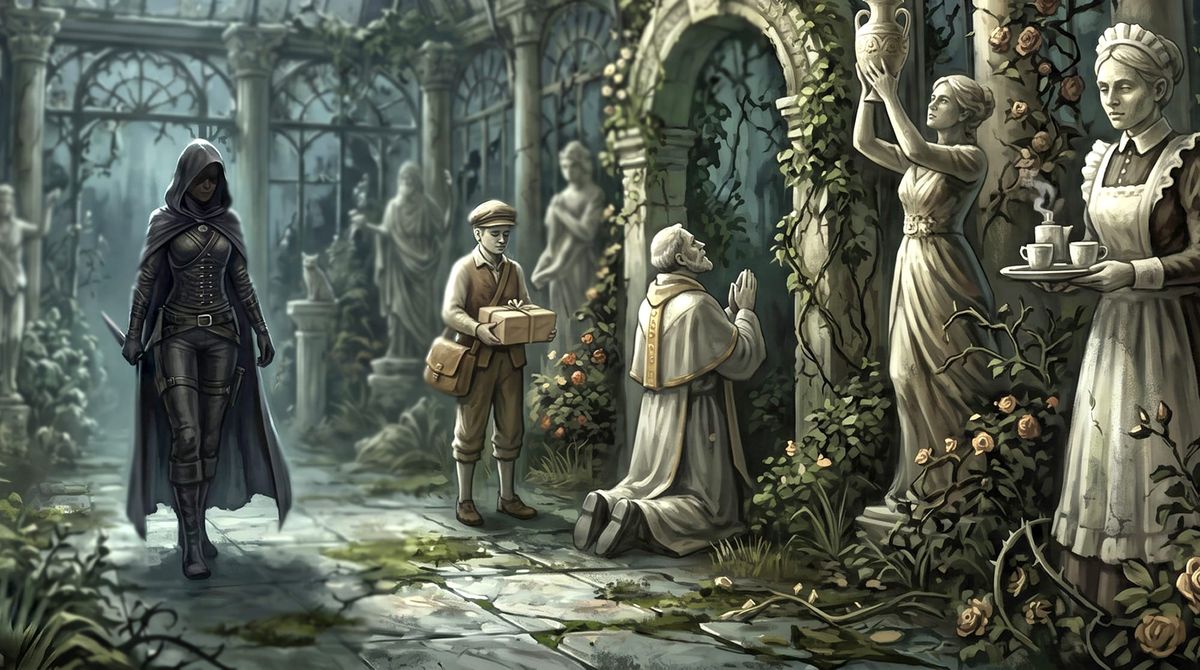
Violinne freed herself, dropped to the soil, and rose among wet fronds, silvered vines, lemon blossoms, and marble people arranged beneath the vaulted glass in theatrical clusters. Every face seemed to look at her with intimate concentration.
A maid stood with one hand raised before a tray of glasses.
A woman in a beaded gown leaned backward with a vase poised above her shoulder, defending herself from an invisible threat.
A priest knelt with his mouth open, expression so offended that Violinne suspected his final sermon had been interrupted.
Beside a fountain, a young man in an outdated courier’s cap held a parcel under one arm and presented a calling card in the other, his eyebrows lifted in the doomed optimism of delivery boys everywhere.
There were also six marble birds, two marble cats, a marble gardener tangled in roses, and an unfortunate swordsman gripping his weapon with total confidence and no visible competence.
Violinne studied him for an extra moment. Somewhere among the statues, a voice scraped like a spoon against a teacup.
“You really should duck now.”
Violinne folded downward, and a poisoned dart hissed over her shoulder, struck the swordsman’s stone armor, and shattered a marble feather.
She rolled behind the maid as another dart snapped past the lemon tree, then drew one throwing knife from her sleeve and sent it spinning toward the bronze cherub fountain where a nozzle clicked shut with an indignant wheeze.
The maid’s stone lips did not move, but the same voice muttered, “The cherubs have dreadful manners after midnight.”
Violinne pressed her back against the pedestal and examined the maid’s frozen face.
“Are you the maid, a ghost, or the house pretending to be staff?”
“The housekeeper, in fact,” the statue replied through some mineral resonance in its throat, “and formerly alive enough to resent your tone.”
“That explains the marble and the resentment.”
“My name is Dola,” said the statue. “Madam Dola Veinstone, last housekeeper of Erevan House, still gravely underpaid and now permanently calcified.”
Violinne glanced toward the greenhouse doors.
“The mirror is here, then.”
“Yes, it is here,” Madam Dola said, “and so are several reasons to leave without it.”
“That would be a more persuasive warning if my client had not offered twelve thousand moon opals and a townhouse in the eastern district.”
“Your client wants the mirror for a reason that involves poor taste and likely murder.”
Before Madam Dola could answer, something enormous moved beneath the floor, and the roots of the lemon tree tightened through the soil like fingers remembering a throat.
The Angel in the Cistern
The hidden stairway opened beneath the fountain after Violinne noticed the jagged feather in the swordsman’s hat matched a groove in the fountain rim, twisted it, and discovered a keyhole.
Its stairs sank through damp limestone, past walls frescoed with saints, serpents, and gardeners pretending not to notice one another, until the air grew more humid and the music of rain changed into the heavier dripping of underground water.
Below Erevan House lay a sunken chapel built inside an old cistern, where pillars rose from black water and silver chains stretched between walls in loops that had once been holy.
At the center of the flooded chamber, bound beneath the roots of the greenhouse, sat an angel.
He was sitting like a noble prisoner who had exhausted grief, boredom, fury, diplomacy, and every available hymn, leaving only posture and exasperation.
His dusk-gold wings were pinned with silver hooks to the walls, and his rain-pale hair fell around a face too solemn for anything so beautiful.
Violinne stopped on the lowest stair, her boots half submerged.
“Lumen Haille, by any chance?”
The angel lifted his head, and a lambent radiance moved behind his eyes.
“You know my name,” he said, in a voice polished by recent annoyance.
“Your name was scratched under a statue of a priest upstairs, beside the words help him, blame not the woman with snakes.”
“That priest was Father Odran, and he apologized for calling me ornamental once he began turning to stone.”
Violinne stepped onto the chapel floor, water licking at her calves, and examined the chain fixed across his sternum, where symbols flared and faded like trapped fireflies.
“I was hired to steal a mirror, not rescue celestial nobility from basement décor.”
“Then your vocation has broadened beautifully.”
One corner of Lumen’s mouth moved despite his visible intention to remain solemn.
Violinne decided he looked as though he had been painted by someone with far too much affection for shoulders.
She moved around the chains, noting the knots of angelic script, the silver hooks through feathers, the roots grown over each fastening with vegetal relish.
“Did Medusa do this work?”
“Medusa did not do this,” Lumen said, and every lamp in the cistern burned higher on that denial. “Medusa is not the monster of Erevan House.”
“That is exactly what a monster-adjacent angel would say to a woman holding knives.”
“Medusa has saved more fools than she has punished.”
“Then who made the garden upstairs?”
Lumen’s gaze shifted toward the ceiling, where roots pressed through stone, flowering in darkness.
“The Basilisk Collector made it.”
Violinne stared at him.
“He has posed as the ghost of this mansion for generations, drawing hunters, priests, scholars, thieves, and self-important heroes into the greenhouse, where he calls their terror beautiful and makes it permanent.”
Violinne looked back toward the stairway, remembering Madam Dola, the courier with the parcel, the cats, the birds, and the swordsman.
“Medusa gets blamed because of the statues.”
“Convenient,” Violinne said.
“Angelic light can reveal what the stone conceals,” Lumen said. “That is why he chained me where I could illuminate nothing.”
He nodded toward the brightest symbol on the chain.
“Copy that sigil onto something you carry close,” he said. “I can follow the echo, though not far and not for long.”
Violinne reached for the first silver hook, then hissed when the chain spat a blue spark across her glove and left the leather smoking.
Lumen gave her a look of serene disapproval.
“You must not touch the binding with mortal skin.”
“Thank you for telling me after.”
“I assumed professional problem-solvers with knives tested danger first with tools.”
The roots above them shuddered again, and a voice from the upper greenhouse rang down through the stone, mellow, amused, and extravagant.
“Dear intruder, the gallery opens in one hour, and punctuality is the last refuge of the visually distinguished.”
Violinne and Lumen looked at one another.
She turned toward the stairway.
“Stay dramatic,” she said. “I’ll come back before the gallery opens.”
Medusa Takes Her Tea
Medusa lived beneath the eastern wing of the greenhouse in a hidden bathhouse tiled in green, white, and tarnished gold, where warm water steamed beneath skylights, vines braided themselves through marble pillars, and dozens of snakes slept in baskets, basins, cupboards, and one velvet hat that had plainly been stolen from someone important.
She was seated beside an empty bathing pool, wearing smoked-glass spectacles, bronze bangles, and a robe embroidered with red roses, while she read a newspaper dated sixty-one years earlier and drank tea from a chipped ceramic cup.
The snake coiled around her shoulders opened one drowsy eye as Violinne entered with Lumen’s chain sigil copied onto the back of a calling card.
Medusa turned another brittle page.
“You are dripping on a mosaic of Poseidon behaving badly.”
Violinne glanced down at the floor, where the sea god did indeed appear to be losing a wrestling match against several offended nymphs.
“My apologies to the historic embarrassment.”
“Accepted on his behalf, though he has never deserved courtesy.”
Medusa removed one hand from her cup, and three little snakes lifted their heads from a warmed brick as if called by a private bell.
“You smell of lemon rind, and that angel’s appalling sense of duty.”
“Lumen Haille is chained beneath the house.”
“So he continues to mention.”
“That sounded less concerned than expected.”
Medusa sighed, folding the newspaper with patrician fatigue.
From the corridor behind Violinne came a dragging shimmer of wings, because Lumen had managed to manifest part of himself through the copied sigil, not enough to escape his chains, but enough to project a ghostly figure into Medusa’s bathhouse.
“Medusa Gorgona, after so long,” he said, “your hospitality remains indirect.”
“Lumen Haille, despite everything,” she replied, “your existence is impossible to ignore.”
Violinne looked between them, then at the snakes, then at the ancient newspaper.
“You two know each other.”
“Decades of shared imprisonment make acquaintanceship inevitable,” Medusa said. “He glows under the west roots, and the Basilisk tells everyone my eyes are the problem.”
A tiny snake sneezed.
“The spectacles are a courtesy,” Medusa said. “Contrary to rumor, I do not petrify people by accident unless they work very hard to deserve it.”
Violinne looked at the tiny snake in surprise.
“That snake sneezed so properly.”
“Her name is Petunia, and she has standards,” Medusa said.
Violinne found herself smiling, which was a dreadful habit during cursed assignments.
“About the mirror, then,” she said. “My client claimed it belonged to you and could kill monsters.”
Medusa’s expression altered behind the smoked lenses, humor withdrawing like a tide from black rocks.
“The mirror never belonged to me.”
Lumen’s projected form flickered.
“It belongs to the Basilisk Collector.”
Medusa rose, and the snakes around her shifted into wreaths of living bronze, green, ivory, and coal-dark motion.
Violinne took the vellum contract from her boot and placed it on a dry ledge near Medusa’s teacup.
The ink had not run despite the water.
Medusa touched the wax seal with one fingernail, then angled it toward the lantern, revealing a pattern Violinne had mistaken for decorative scales.
“That is basilisk shed,” Medusa said. “Your client is either his servant or his buyer.”
Violinne recalled the gentleman who had hired her beneath the blue awning of an apothecary, his face hidden by a pearl-gray veil, his gloved hands perfumed with crushed fennel, his voice delighted by the phrase original acquisition.
A short memory returned with the scent of rain: she was younger by six years and poorer by every measurable dignity, standing outside a different noble house while her mentor, old Plintha Vint, tapped a contract with one knuckle and said that aristocrats never paid assassins to remove monsters unless the monster had stopped benefiting them.
In the past, Violinne had laughed, believing cynicism was another kind of armor. By dawn, the monster had been dead, the nobleman had been worse, and Plintha’s lesson had followed her through every door she had opened since.
Back in the bathhouse, thunder rolled over Erevan House, and Medusa lowered the contract as though it were an insect preserved in sugar.
“The buyer wants the mirror moved,” Medusa said. “Without it, the Basilisk cannot transport his collection safely, but with it, he can continue elsewhere.”
“A moving service for atrocities,” Lumen said.
“That is distressingly thematic,” Medusa replied. “A true case of statue of limitations.”
Violinne stared at her.
Medusa resumed sipping her tea.
“No one appreciates legal humor until they have been slandered for centuries.”
A Curator in Formalwear
The Basilisk Collector announced his opening with organ music from no visible organ, seven bronze bells struck by invisible mallets, and a procession of candles floating through the greenhouse in the shape of an applauding hand.
By then, Violinne had prepared three knives, two smoke pellets, one borrowed snake named Petunia, and a plan so dependent upon vanity that she trusted it more than any map.
Medusa had agreed to enter through the rafters with her spectacles on until the final instant, accompanied by several snakes who seemed thrilled by the prospect of social consequence.
Lumen, still bound beneath the west roots, had gathered the dregs of his radiance into the copied sigil on Violinne’s calling card, which she now wore tucked against her heart beneath the lining of her vest.
“I dislike entrusting my last usable light to a woman who fell into a lemon tree,” he had said.
Curtains of moss had parted from the glass walls, chandeliers descended from hooks shaped like talons, and the marble statues had been rearranged into circles facing a dais where the mirror stood draped in peacock silk.
He had the height of a gentleman, the posture of a theatrical undertaker, and a scaled throat that gleamed above his collar. His robe was velvet the color of old wine, his fingers glittered with rings, and jeweled spectacles covered his eyes in lenses that flashed green and gold.
“Miss Violinne Romina, at last,” he called, spreading his arms. He watched her with the indulgent menace of a collector certain that every moving thing would eventually become still.
Violinne stepped from behind Madam Dola, her hood lowered, her face arranged into admiration so artificial it might have belonged on a birthday cake.
“Your Excellency, your reputation made the greenhouse sound crowded, but it failed to mention the curatorial ambition.”
The Basilisk touched his chest.
“Curatorial ambition is merely loneliness with labels.”
“That may be the saddest thing ever said by someone dressed as an upholstered bruise.”
Madam Dola’s statue produced a grinding noise that might have been laughter.
The Basilisk turned his jeweled spectacles toward the housekeeper.
“Dola darling, dear fossil of service, do not encourage the burglary.”
The Basilisk smiled, revealing teeth too narrow and too numerous. He swept toward the mirror and pulled away the silk with a flourish, revealing an oval of black glass set in a frame of interlocked serpents and feathers.
“This mirror is an instrument of discernment, a device for appreciating peril without participating in it,” he said.
“A coward’s vanity shield,” Lumen’s voice rang from beneath the floor, weak but resonant.
The Basilisk’s smile tightened by visible degrees.
“Ah, the flickering lamp in the cellar speaks.”
“Better a lamp than a lizard in formalwear.”
Violinne heard Medusa’s snakes stirring in the rafters.
The Basilisk’s robe hissed across the aisle as he approached Violinne.
“So my buyer hired you honestly enough,” he said. “Retrieve the mirror, deliver it, collect your jewels, and never trouble your conscience with how many breathing souls remain awake in stone.”
“They remain awake inside stone,” Violinne repeated.
“Some of them remain aware,” the Basilisk said, shrugging. “Not all, and not always, and never with useful timing.”
Violinne walked closer to the black glass, feeling Lumen’s calling card warm against her vest.
She needed the Basilisk positioned before the surface, needed his jeweled spectacles angled toward his own reflection, needed Medusa above him, needed Lumen’s last light in the mirror before the Collector understood that admiration was bait.
That was the thematic hinge of Erevan House, she thought: evil here had not hidden in darkness, but in display.
Some monsters curate.
Violinne gazed around the greenhouse and gave a long, appreciative breath that would have made Plintha Vint either proud or suspicious.
“You know, upon reflection,” she said, “the arrangement has force, but the central figure lacks audacity.”
The Basilisk stilled.
“Explain that before you become an accent piece.”
“The priest and the vase woman draw the eye, naturally, while Madam Dola creates domestic tension, and the swordsman displays courage. But the mirror is too passive where it stands.”
The Basilisk’s rings flashed as he lifted one hand to his spectacles.
“You consider my mirror passive.”
“Beautiful, yes, but not in the right place.”
The word beautiful landed exactly where she needed it, between his vanity and his suspicion.
The Basilisk tilted his head.
“What would you suggest, Miss Romina?”
Violinne stepped around the dais and gestured toward the central aisle, where moonlight poured through the cracked roof in a silver column.
“The glass should face the audience, and you should stand before it as the living curator among eternal guests, so every viewer understands whose vision turned decay into composition.”
Lumen groaned from below.
“Do not overfeed him.”
The Basilisk moved anyway, drawn by praise the way a moth approaches candle flame while composing poetry about destiny.
He repositioned the mirror himself, because men who believe only they possess taste must always adjust their own pedestals.
Violinne smiled.
Above the dais, Medusa’s voice drifted from the rafters like silk sliding across a blade.
“Centuries old, and still undone by applause.”
The Basilisk jerked his head upward.
Petunia dropped first, landing across his spectacles with all the majesty of a duchess declaring war.
He shouted, clawing at the little snake, and Violinne crushed Lumen’s sigil against the mirror frame.
Angelic light erupted from the calling card, flooded the black glass, and spilled through the greenhouse in gold ribbons, revealing pupils behind stone eyelids and tears trapped inside mineral cheeks.
The Basilisk tore Petunia away, his spectacles askew, and in that instant Medusa removed her smoked-glass lenses.
She looked at his reflection.
The mirror caught the Basilisk’s own unveiled gaze, caught Medusa’s ancient curse moving through reflected sight, caught Lumen’s holy light and the living witness of every stolen soul in the greenhouse, and turned them together into judgment.
The Collector screamed.
His fingers stiffened around his rings, his velvet robe froze into chiseled folds, and his jeweled spectacles became opaque disks.
Stone climbed his throat, sealed his mouth, and left him standing before the mirror as the centerpiece of his own collection.
The black glass split from rim to rim, releasing one final ribbon of gold before collapsing into harmless, ordinary shards.
For a moment, the greenhouse held still beneath the thunder.
Then the swordsman fell over.
The House After Stone
Once the Basilisk became marble, the curse holding his gallery together broke, and the roots beneath the floor withdrew from the sunken chapel.
Lumen’s chains broke shortly before sunrise, with a collapse that sent him splashing into the cistern and cursing in an ancient language.
Violinne found him on the chapel steps, wings dragging, silver hooks fallen away, hair soaked, and his expression regal.
“You are liberated at last,” she said, offering her coat. “Try to look more victorious.”
“I do not require human assistance.”
Lumen considered the coat with immense suspicion, then accepted it and wrapped it around his shoulders, where it looked absurdly small against the ruin and splendor of his wings.
Above them, the greenhouse had become an uproar of restored people, cracked pedestals, broken marble shells, indignant cats, sobbing birds, confused gardeners, and one delivery boy from 1894 who demanded to know whether anyone had signed for the parcel.
Madam Dola, flesh once more but stiff in every limb, took command within twelve minutes, proving that a competent housekeeper could outrank terror, immortality, and architectural curses without raising her voice.
“You with the weapon,” she said to the swordsman, “stop holding that thing near your own leg, and Father Odran should apologize again if he has remembered why.”
The priest, now elderly only in the historical sense, rubbed marble dust from his face.
“I apologize for every conclusion reached with insufficient evidence.”
“Your apology is accepted,” Medusa said, passing him a towel without looking directly at him.
Medusa had taken the entrance hall by midmorning.
She placed the Basilisk Collector beneath the grand staircase, where visitors would have to pass him on their way to anywhere interesting, and tied a little brass plaque around his petrified wrist.
Please Do Not Touch: Formerly Insufferable, Eternally Tasteless.
By dawn, the mansion no longer felt hungry, though it remained eccentric, damp, curse-marked, and inclined to rearrange rugs when bored.
Medusa announced that Erevan House would become a sanctuary for cursed creatures, maligned women, displaced household staff, traumatized delivery personnel, and snakes of respectable temperament.
The marble cats resumed being living cats and immediately behaved as if petrification had been a minor inconvenience caused by inferior management.
Violinne stood at the greenhouse threshold and considered the practical result of the adventure. Lumen stood beside her with the borrowed coat clasped at his throat and his wings half folded in the tentative posture of someone learning how not to be chained.
“You lost your townhouse,” he said.
“I am grieving it in private.”
“And your buyer?” Lumen asked.
Violinne touched the ruined contract in her sleeve.
“If he still wants his mirror,” she said, “he can come collect the receipt from Medusa.”
Lumen looked toward the restored garden, where Medusa was instructing Petunia not to accept apologies from anyone who did not set a good example.
“You could have taken the mirror before the light destroyed it.”
“So you noticed that choice.”
Violinne watched the greenhouse glass catch the sun, and for one rare moment, she allowed an answer to leave her without armor.
“Some jobs pay in opals,” she said. “Some pay in knowing who was never the monster.”
Medusa approached with a small ivory card between two fingers, her spectacles restored to the bridge of her nose and Petunia draped over one wrist like a bracelet with opinions.
“This is for future emergencies,” Medusa said. “Or for clients who need boundaries explained with consequences.”
Violinne read the card.
Medusa Gorgona
Discreet Petrification and Curse Reversals
Private Consultations by Appointment Only, Naturally.
Below the lettering, in smaller script, someone had added: Snake Rudeness Will Incur a Fee.
Violinne slipped the card into her sleeve.
“I assume the fee is severe.”
“Only when necessary,” Medusa said.
The sun broke fully over the house, which had once been a gallery of stolen endings. Around the greenhouse rose coughing, laughter, arguments, tea orders, cat complaints, and the living commotion of people returned to time.
Violinne descended the front steps with Lumen Haille walking beside her in borrowed clothing, his wings weak but luminous in the morning air.
At the gate, he glanced down at the road, then at his bare feet, then at her boots.
“Do mortal cities still contain shoemakers?”
“Usually between bakeries and bad decisions.”
“Will you guide me there?”
Violinne looked back once at the greenhouse roof, where Medusa’s snakes had arranged themselves along the gutters like ornamental judgment, and where Madam Dola was already shouting at someone about tea inventory.
Then she looked at Lumen.
“Only for a reasonable fee,” she said.
Together, they walked into dawn.
✦ Related Reading & Themes
This story explored:
how a monster can disguise itself as taste, elegance, and authority
how the wrong person can be blamed when a story is easier than the truth
how vanity can become its own undoing
how mercy sometimes means seeing who was never the monster
how unlikely allies can form beneath glass, stone, and thunder
how cursed places can become sanctuaries once the real danger is gone
Tags for similar stories:
mythological fantasy, gothic fantasy, romantic fantasy, fantasy adventure, haunted mansion, cursed greenhouse, basilisk, assassin heroine, chained angel, marble garden, petrified garden, cursed estate, magical mystery, gothic romance, fantasy romance, atmospheric fantasy, light gothic fantasy, mythological retelling, monster twist, misunderstood monster, curse breaking, enchanted house, greenhouse fantasy, marble statues, romantic adventure, soft gothic, whimsical gothic, cozy gothic fantasy, speculative romance
✦ If You Liked This Story
You might also enjoy:
Marked by the Storm - When an archaeologist steps into the missing place of an unfinished ritual, it binds her to a guardian who has spent centuries alone. She must decide how much of herself she’s willing to give to keep the world from breaking.
You’ve reached the end of this story.
But not the end of the world it belongs to.
New stories appear regularly.
Stay curious.
If you want more stories like this, explore the full Petalstorm Press library → HERE
© Petalstorm Press — Original Fiction
This story is part of the Petalstorm Press library.
Redistribution or reproduction without permission is prohibited.
All stories shared through Petalstorm Press—and the channels linked here—are the official home of this work. Any versions found elsewhere are not authorized unless clearly noted.