Marked by the Storm
She was not meant to survive the strike. When an archaeologist steps into the missing place of an unfinished ritual, it binds her to a guardian who has spent centuries alone. She must decide how much of herself she’s willing to give to keep the world from breaking.
“If this chamber gives us an unknown king, I am putting your name on something permanent.”
Those were the words of Sami Sayeed, my field epigrapher.
“Let’s confirm it first before you start making promises,” I said, kneeling beside the exposed lintel.
When the tomb emerged from the ocher earth, half my team had already begun speaking of book deals and museum bids.
He laughed, though in a whisper, because the place only invited low voices.
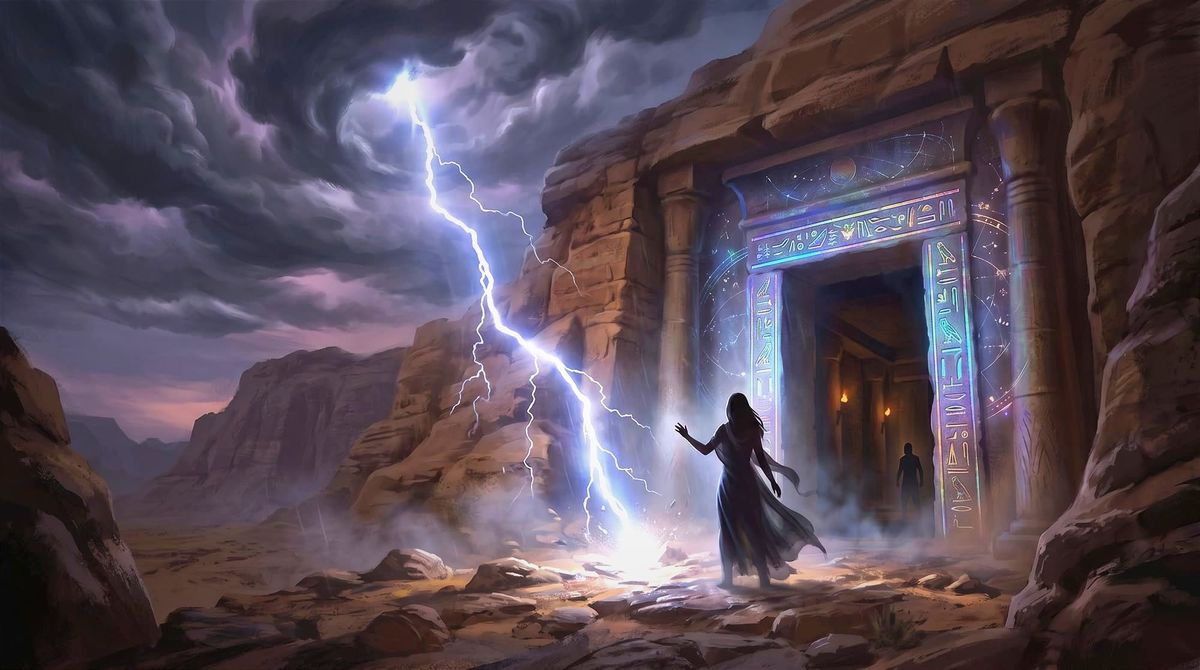
Even before we breached the entrance, the tomb radiated a powerful energy.
Across the threshold ran bands of carved symbols that did not belong to any orthodox funerary repertoire I had spent my career studying.
Donata Farouk, our conservator, crouched beside me and brushed sand from one of the inscriptions.
“These are directional marks,” she murmured.
The walls inside the first chamber resembled a map. Carvings wandered across cracked limestone in braided lines, then veered upward into clusters of stars etched with mathematical poise.
Corridors connected to carvings of constellations. Celestial bodies were paired with doors, wells, and geometric nodes.
Sami held his lantern higher. “Burial architecture tied to the heavens,” he said. “A ritual of some kind, I presume.”
“Perhaps,” I answered, though I was already unconvinced by that modest explanation.
Every pattern in the chamber mirrored the others except for one vexing exception.
Near the eastern wall, where several carved paths converged, a section had been left incomplete, as though the artisan had paused and never returned.
I traced the shapes in the air above them without touching the stone.
“Something is missing.”
Donata glanced up. “A missing panel?”
“A missing participant,” she said, pointing toward a half-completed silhouette carved with what looked like instructions.
Sami gave me a sidelong look. “That sounds unlike you, Maryam. When did you start believing in curses?”
He was right. I had built a reputation by stripping legend from archaeology. Still, as the desert wind hissed through the entrance and stirred the grit at our feet, I could not escape the conviction that this tomb had a hold on me I couldn't articulate.
That evening, in camp, our generator coughed and sputtered while notebooks filled and tempers frayed.
Donata wanted the site closed until Cairo sent additional specialists. Sami wanted another full day of studying inscriptions.
I wanted respite. Long enough to think about the last panel.
The incomplete section corresponded to a human stance—arms angled, feet braced, body positioned between converging lines like the final mark in a ritual equation.
I should have waited until morning. Instead, my curiosity won.
I took my lamp and went alone.
The horizon turned bruised violet. I entered the tomb with my notes tucked under one arm.
Inside, the air lay cool and mineral-rich. My footsteps whispered across the floor. I stood before the unfinished convergence and studied the carved geometry once more.
Then, setting the lamp aside, I aligned myself with the pattern—left foot upon a marked disc, right arm extended toward a cluster of incised stars, chin turned toward the entrance where the last light pooled.
Then the chamber hummed. I dropped my arm and ran.
The sky became a vault of blackened cloud, gathering from nowhere over the tomb mouth. Static furred across my skin and the hairs along my forearms lifted.
I stumbled toward the entrance.
Light split the dark in a jagged seam. Every nerve in me recognized danger too late.
The strike descended with violence. White fire engulfed the threshold. Agony drove through me, and within that ruinous instant I saw him.
A figure in linen and bronze darkness stood beyond the chamber, one hand outstretched as if commanding the storm. His posture was martial, immovable.
Yet his face—what little I perceived of it—changed in the final fragment of that moment.
Then the world vanished.
When I woke in Cairo, my throat felt scored raw. My sister Clara, who had flown in from London with formidable efficiency, sat beside the bed with a paperback she clearly had not been reading. She leaned forward at once.
“You're alive,” she said, with the controlled emotion only family can manage.
I attempted a smile. “Did they save the site?”
She exhaled. “I see your priorities remain elsewhere.”
The physicians called it a freak desert strike.
When the nurses changed the dressings, I saw the scars.
They spread from my collarbone down across my side in pale, branching tracery.
Lightning scars, one doctor explained.
His composure faltered when I asked whether lightning commonly left geometric impressions, because the marks were not random.
That night I woke to a crackle under my skin. Blue sparks leapt between my fingers when I touched the metal rail of the bed.
On the third night I dreamed of descending corridors I had never entered. Torches guttered in niches. Doors of opulent black stone opened before me one by one. At the end of the passage stood the man from the storm, watching as though he had waited through empires.
When I gasped awake, the monitor beside my bed emitted a shrill electronic protest. Clara startled upright from the chair.
“You were speaking,” she said. “In your sleep.”
“What did I say?”
She hesitated. “I do not know. I can tell you that it was not English.”
I was discharged two days later with stern instructions and a packet of medical cautions I ignored almost at once. Donata and Sami objected when I insisted on returning to the site.
“You were struck by lightning,” Donata said in the hotel corridor.
“Then stay in Cairo,” I told them. “Both of you.”
Against my wishes, they came anyway.
The tomb admitted me differently the second time.
The entrance stones yielded at my touch. Passageways that had ended in blank walls now opened along unseen seams. The structure recognized a frequency lodged inside me.
Sami swore under his breath. Donata, sweating around her flashlight, said nothing at all.
We reached a descending corridor absent from every prior survey. Halfway down, a set of bronze blades shot from the wall with lethal speed. I froze. Before I could move, the mechanism shuddered and stopped inches from my throat.
Someone had intervened.
At the corridor’s end lay a chamber vast as a sanctuary. A sarcophagus of dark stone stood open, its lid resting aside as if abandoned mid-rite. Before it stood the man I had seen in the lightning.
He was wrapped in aged linen crossed by tarnished gold fittings. His frame was tall and disciplined, his bearing so erect it suggested command long after death should have humbled him.
His face, uncovered, bore the stillness of carved basalt. His eyes were fixed on me.
Sami made a strangled sound and stepped back.
The man ignored him. “You should not have survived.”
His voice was low and resonant, touched by an accent older than any living nation.
The truth landed in me before I shaped it into words. “You,” I said. “You were there when the strike happened.”
“I activated the defense.”
He moved closer.
“You were not meant to endure the strike.”
“And now the bond is unstable,” he added.
His name, once coaxed from inscriptions and reluctant answers, was Isek-Ra, a royal guardian consecrated to a prison beneath the tomb.
He had been bound to it through rites that yoked flesh, will, and centuries together. The chamber below his sarcophagus held a seal stone veined with strange metal and etched with the same stellar cartography now branded across my skin.
“I guard what sleeps beneath,” he said while leading us through a passage lined with dormant mechanisms.
“If the seal breaks, what is contained there reaches outward.”
“What is contained there?” Donata asked.
He paused. “Something my creators feared more than death.”
As we explored, Isek-Ra prevented traps from springing and redirected us away from collapsing floors. He spoke only when necessary and he never apologized. Yet every act of protection carried the rigid precision of atonement.
At length we reached a wall inscription preserved in unusual clarity. Sami translated the Middle Egyptian under my guidance, his voice trembling with excitement.
“Not one keeper,” he read, “but two. The Sentinel Below and the Anchor Beneath the Sun.”
I stepped closer. The paired figures carved there mirrored the incomplete design from the upper chamber. One stood within the tomb. The other stood at the threshold, living, mortal, necessary.
“The system was meant to be shared,” I said.
Isek-Ra inclined his head once. “So it appears.”
“Appears?” I rounded on him. “You have been here for centuries and never knew?”
“I knew only my charge,” he said. “Knowledge was portioned, not gifted.”
A chill rippled through me, colder than the subterranean air. “When I survived the lightning, I assume the ritual completed incorrectly.”
“Yes.”
“And that is why the map changed,” he added.
“What does unstable mean?” Donata asked softly.
I already knew the answer. My body had begun to tire in peculiar ways. Time felt jagged around the edges. My reflection sometimes startled me with a fleeting gauntness that vanished when I looked twice.
Isek-Ra met my eyes directly. “The tomb draws years from you to compensate for imbalance.”
Sami swore with impressive fluency.
I folded my arms to stop them trembling. “What happens to you?”
“My immortality frays in the opposite direction. The force that keeps me here weakens.”
The room felt silent, full of calculation and dread.
“If we don't correct it, then the seal eventually breaks and whatever my ancestors kept inside the deepest layer of the tomb extends beyond the structure.”
“Then we fix it,” I said.
Isek-Ra’s gaze focused. “The correction requires exchange.”
“How much?”
“Years from you. Eternity from me.”
Sami stepped forward at once. “No.”
I did not look at him. “How many years?”
Isek-Ra answered with brutal honesty. “A substantial amount. But not enough to end you.”
We argued in the upper chamber while torchlight shivered against the walls.
Sami wanted the site flooded with military and scientific personnel.
Donata, practical even in terror, pointed out that no institutional response would arrive swiftly enough to halt a metaphysical collapse.
In the end the choice remained mine, and Isek-Ra knew it.
Before dawn I found him standing alone near the entrance where the stone still bore a blackened scar from the strike. The desert beyond lay hushed and argent beneath the moon. He seemed almost part of the architecture, another upright certainty amid old burdens.
“Did you choose me?” I asked.
He did not evade. “No. I chose to stop you.”
The answer hurt more for being expected.
He continued after a measured pause. “I saw a threat and I acted according to my charge.”
When I turned back, his expression had altered by a degree so minute it mattered more than any dramatic change. “I would choose differently now,” he said.
The words were plain. Their plainness made them weighty.
“You barely know me.”
“I know enough.”
Something electric stirred beneath my scars, though no storm gathered overhead.
“That is either reassuring or I can consider myself cursed eternally.”
“For you,” he said, “perhaps both.”
At sunrise we prepared the chamber. Donata arranged the lamps in accordance with the stellar inscriptions.
Sami recited the translated liturgy with a scholar’s trembling fervor. I took my place in the carved convergence at the threshold while Isek-Ra stood within the inner line.
Sami’s voice echoed through the tomb. The stone awakened beneath us. Warmth coursed up through my feet, not scorching now, but immense. The scars on my side kindled with amber light.
Isek-Ra lifted his hand, not to strike, but to offer.
I extended mine.
Energy moved between us in a lucid, continuous current. I felt years slip from me—not stolen, but surrendered.
In return something loosened in him. The ageless tension that had held his features in ceremonial stillness softened into living strain. Color, pale at first, but real, returned beneath his skin.
The chamber rang once, like a great bell struck under water.
Then the light ebbed.
I staggered, and Isek-Ra crossed the distance before I could fall. His grip was firm, warm, unmistakably mortal.
Behind us, the seal stone settled into silence.
I stood at the entrance once more, the desert stretching bright and immense before me. My body felt altered, lighter in some ways, sobered in others. I knew I had paid a price.
I also knew I remained wholly alive.
Isek-Ra came to stand beside me. Without the tomb’s binding force around him, he seemed less spectral and more severe in a distinctly earthly way, like a knight displaced into the wrong millennium.
He looked at the horizon, then at me. “I misjudged you.”
I touched the faded tracery at my side. “You nearly killed me.”
A pause passed between us, quiet and companionable.
“Try not to do it again,” I said.
To my astonishment, the corner of his mouth shifted. It was not quite a smile, but it possessed the rare dignity of one being learned.
“We are now protectors of the tomb in the fullest sense,” he said.
“What is asked of us?” I asked.
“The seal is safe,” he said.
“But we make sure it stays that way,” he added.
“Consider this place sealed.” I said.
Behind us, Sami shouted for someone to bring water and a camera. Donata began cataloguing the final chamber with brisk authority.
I laughed, the sound carried off by a mild desert wind.
Isek-Ra glanced toward the camp, then back to me. “What awaits beyond this place?”
“Noise,” I said. “Complications and bureaucracy. Oh, and my sister Clara's wrath.”
He considered that. “And after?”
I looked at the open world beyond the tomb and felt, for the first time since the lightning, no dread at all.
“After,” I said, “we find out.”
Then, together, not untouched and not unchanged, we walked away from the place that had marked us and chose, with all the imperfect freedom of the living, what came next.
You’ve reached the end of this story.
But not the end of the world it belongs to.
New stories appear regularly.
Stay curious.
If you want more stories like this, explore the full Petalstorm Press library → HERE
© Petalstorm Press — Original Fiction
This story is part of the Petalstorm Press library.
Redistribution or reproduction without permission is prohibited.
All stories shared through Petalstorm Press—and the channels linked here—are the official home of this work. Any versions found elsewhere are not authorized unless clearly noted.