Every Other Sunday
Set in the soft rhythm of a local market, Every Other Sunday is a short cozy rivals to lover romance about art, identity, ambition, and the tension between authenticity and success.
A Short Story by Polly Pinwheel
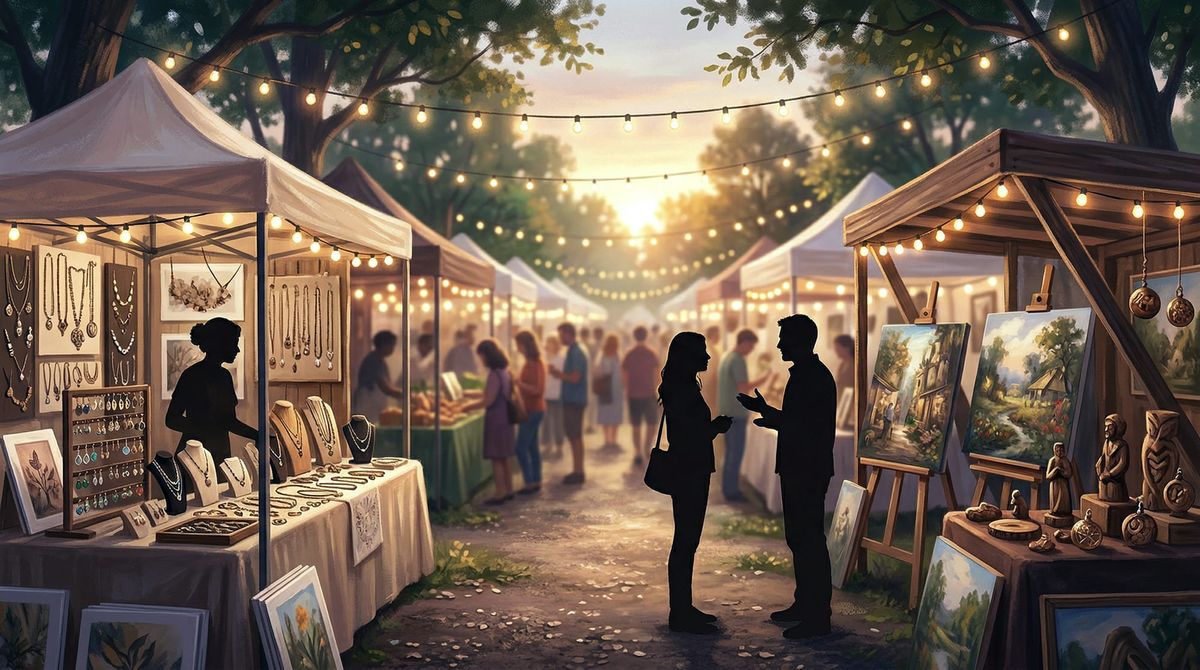
Every other Sunday, she built a business across from a man who treated his like a hobby.
Dove arrived early that morning.
The asphalt still held the coolness of night when she stepped out of her car, her arms already full with neatly packed crates labeled in her own handwriting.
She moved with efficiency, unfolding tables, smoothing linens, arranging risers in a way that guided the eye exactly where she wanted it to go.
Nothing in her space was ever accidental, even when it pretended to be.
The market opened and her booth was already prepared.
Soft palettes arranged in gradients of muted gold, washed terracotta, pale sage, and dusty rose created a visual rhythm that felt both curated and effortless.
Shining jewelry lay draped across velvet boards, long chains catching the light in ways she had already anticipated before the sun had even risen high enough to participate.
Her prints leaned in layered stacks, each one echoing the next in tone, in concept, in mood, so that a customer did not choose just one piece.
By the time the first wave of customers arrived, she was already reading them with instinct that she had refined over years of watching hesitation unfold in microseconds.
The woman with the canvas tote and clumsy hands needed reassurance framed as discovery.
Later, the couple hovering too close together required separation disguised as suggestion.
The teenage girl, already overwhelmed, needed something framed as identity.
Dove adjusted accordingly with every situation.
Her voice shifted without effort, her posture softened or straightened depending on who stood before her.
Across from her, he did none of this.
She had noticed him the first Sunday she set up beside that particular stretch of the market, and she had not needed long to categorize him.
His name had been written on a small, unassuming placard at the edge of his table, as though the work itself refused to compete with it.
Sterling.
His booth was sparse in a way that bordered on wild.
A few paintings rested against wooden easels, each one distinct, each one unmistakably original, each one priced high enough to dissuade anyone who had not already decided they understood what they were looking at.
Sculptural pieces occupied the remaining space, their textures irregular, their forms deliberate without explanation, their presence quietly commanding in a way that felt almost inconvenient for the casual passerby.
Leather bracelets and wood-crafted earrings were scattered throughout his tables.
People lingered. They tilted their heads, stepped closer, asked questions that stretched too long, stayed in conversations that never seemed to conclude with anything as practical as a purchase.
Then they left.
Dove had watched the pattern repeat itself enough times to recognize its inefficiency. Talent, she had already decided, was not his problem.
His problem was everything else.
A customer paused between them just after mid-morning, her fingers brushing over one of Dove’s necklaces before drifting toward the direction of Sterling’s table.
“I love this,” the woman said, holding the piece lightly, as though it might respond to her hesitation.
Dove smiled in a way that felt both warm and anchored.
“It’s one of my most versatile pieces,” she said, already attuned to the cadence of uncertainty in the woman’s voice.
“It works with almost anything, and the weight is light enough that you forget you’re wearing it.”
The woman glanced across the aisle.
“Those earrings over there are beautiful too though,” she admitted, her tone softening into something more contemplative.
Dove followed her gaze briefly, then returned her attention with a subtle recalibration.
“They are,” she agreed, because contradiction would have been inefficient.
“But they are a commitment.”
The distinction settled exactly where it needed to.
The woman looked back at the necklace, her decision forming.
“I’ll take it,” she said.
Dove wrapped the piece with practiced care, her hands moving with a fluidity that made the transaction feel almost ceremonial, though it was anything but.
As she handed it over, she allowed herself a brief glance across the aisle.
Sterling had not moved.
He stood beside his work with a stillness that bordered on indifference, his gaze drifting over the market without attachment, as though he existed slightly outside of it, even while occupying its space.
Dove turned back to her table, already adjusting her displays to accommodate the next interaction, already anticipating the next decision she would influence into existence.
Talent was one thing. But talent without strategy was merely a hobby, and she was determined to make him understand her point of view.
The Artist
Sterling arrived later than most other vendors but never out of carelessness. His curated morning routine held priority.
He set up without urgency, placing each piece with the same attention he had given it in his studio, though the environment did not reward that kind of attentiveness.
The ground beneath his table was uneven, the light inconsistent, the air saturated with voices that shifted too quickly for any single one to matter.
Still, he arranged his work as though it deserved consistency.
He noticed things that most people dismissed.
The way a man’s hand hovered just a fraction too long before pulling away from a sculpture.
He recognized the way a woman’s eyes lingered on a particular brushstroke without fully understanding why it unsettled her.
He understood hesitation carried more honesty than enthusiasm ever could.
Across from him, Dove moved like she had rehearsed the entire day before it began.
He had not intended to pay attention to her, but attention, once caught, had a way of persisting in ways that felt less like choice and more like inevitability.
Everything about it invited interaction, from the arrangement of her pieces to the way she spoke to people as though she had known them longer than the exchange warranted.
There was an ease to her, but it was artificial.
He watched her adjust herself with each new customer, her tone shifting, her posture aligning, her entire presence recalibrating in real time to accommodate the person in front of her.
It was impressive but also exhausting to watch. He had no interest in performing that way.
If someone wanted his work, they would come to it on their own terms, not through a version of him that had been altered to suit their expectations.
That decision, he knew, cost him. He watched it cost him all morning.
People approached, asked questions that skirted the surface, lingered long enough to suggest interest, then retreated with polite excuses that carried more discomfort than regret.
“It’s beautiful,” one woman said, her voice almost apologetic.
He inclined his head slightly, offering acknowledgment without encouragement.
She looked at the price.
“Oh,” she added, the sound carrying recalculation.
The pattern repeated itself until the day felt less like a series of interactions and more like a continuous erosion of possibility.
Across from him, Dove sold consistently.
He could not ignore it.
And yet, he found himself watching the ease with which she moved through each exchange, the way her words landed exactly where they needed to, the way people responded to her not with hesitation, but with trust.
It irritated him, though he couldn’t decide whether it was the people—or her—that bothered him more.
By early afternoon, he had sold nothing.
It wasn't unusual.
Then someone stopped.
A man approached one of his paintings slowly, his gaze steady, his attention undistracted by the surrounding noise.
He did not ask immediate questions, which Sterling noted with a recognition that bordered on relief.
“How long did this take you?” the man asked eventually, his voice measured.
Sterling considered the question, not because it was difficult, but because the answer required context that most people did not want.
“Several weeks,” he said finally, his tone even.
The man nodded, as though the response had met him where he needed it to.
They spoke for longer than most conversations lasted in that space, but they never spoke about price, only technique, form, and inspiration.
When the man finally reached for his wallet, the action felt less like a transaction and more like a conclusion that had been forming since the moment he stopped walking.
“Four thousand?” he confirmed.
Sterling met his gaze.
“Yes.”
By the time the exchange concluded, the market had shifted into its late afternoon lull.
Sterling wrapped the painting with absolute care, his movements intentional, his attention still anchored in the work itself rather than the transaction it had just completed.
Across from him, Dove was still busy.
Her table remained crowded, her hands still moving, her voice still weaving through conversations with the same practiced ease he had been watching all day.
He found himself looking at her again.
“They weren’t buying art,” he said quietly, th
e words more for himself than anyone else.
His gaze lingered on her for a moment longer than necessary.
The Strategist
Every other Sunday had its own rhythm, and predictability. But when the market offered free parking or food vouchers, packed days operated differently.
The crowd arrived earlier, stayed longer, spent more freely, and most importantly, moved with a heightened sense of curiosity that blurred the line between intention and impulse.
Dove thrived in that blur.
She adjusted her booth before the first wave even settled, expanding outward in subtle ways that made her space feel more abundant without appearing crowded.
Additional risers elevated select pieces into visibility, new prints filled the gaps where repetition might have dulled interest, and her jewelry displays shifted just enough to suggest freshness without abandoning cohesion.
By mid-morning, she was already deep in it.
Sales moved quickly, almost rhythmically, each transaction feeding into the next with a momentum that required little interruption.
She did not have to reach for customers today. They came to her with a readiness that made her work feel less like persuasion and more like facilitation.
“I’ve seen your stuff online,” someone said, her voice bright with recognition.
Dove smiled, already aligning herself with the tone.
“I try to keep it consistent,” she replied, handing over a set of earrings wrapped in soft tissue.
“So it feels familiar when you see it in person.”
The woman nodded, satisfied by the cohesion, by the sense that she was stepping into something already established, already validated.
Across the aisle, Sterling stood within his usual perimeter of stillness.
The market surged around him, voices rising and overlapping, bodies shifting in and out of spaces with urgency without direction, and yet his booth remained unchanged.
People slowed near his work, drawn in by something they could not immediately articulate, just long enough to suggest possibility.
Dove watched one interaction linger longer than most.
A couple stood before one of his larger paintings, their conversation low, their posture angled toward each other in a way that suggested doubt rather than curiosity.
The woman reached out, her fingers hovering just short of the surface. “It’s incredible,” she said.
Sterling inclined his head slightly.
“It is,” he replied, his tone neither persuasive nor dismissive.
The man beside her exhaled, the sound carrying a subtle tension.
“Three thousand?” he asked, not incredulous, but uncertain.
Sterling did not elaborate.
“Yes.”
The silence that followed stretched just long enough to fracture.
“We’ll think about it,” the woman said finally, her voice softening into something apologetic.
They stepped away.
Dove felt the familiar, almost reflexive recognition settle in her chest.
They would not come back.
She turned her attention to the customer in front of her, already recalibrating her tone, her posture, her language.
“You could layer this with something shorter,” she suggested, lifting a second necklace just enough to create a visual without imposing it. “It gives it a little more dimension.”
The customer’s eyes lit up, the decision forming before it was fully articulated.
“Oh, I love that.”
Dove completed the sale with the same fluid precision she had maintained all morning, her movements seamless, her voice steady, her presence anchored in a way that made every transaction feel intentional.
Still, her gaze drifted again.
Sterling had not been affected at all. Something about it unsettled her in a way she could not immediately categorize.
By early afternoon, her inventory had thinned enough to require strategic rearrangement, her displays subtly condensed to maintain the illusion of abundance.
Compliments accumulated alongside transactions, her name repeated with a familiarity that suggested recognition, her work framed as something people wanted to be associated with rather than merely possess.
“You’re killing it today,” another vendor remarked in passing.
Dove allowed herself a brief, controlled smile.
“It’s a good crowd,” she replied, though she knew better than to attribute it solely to circumstance.
Across from her, Sterling’s booth remained largely intact.
The disparity should have felt satisfying, but pity found her first.
Dove stepped away from her table for a moment under the pretense of adjusting a display, her attention shifting just enough to close the distance between them.
“You could sell more if you tried, you know.”
The words came out stronger than she meant, edged with a casualness that masked their intention without fully concealing it.
Sterling looked at her then, irritation in his eyes.
“I’m aware,” he said.
Dove held his gaze for a fraction longer than necessary, waiting for something else to follow.
That’s when she noticed a glimmer beneath exhausted eyes. She’d never admit that it made her weak in the knees.
When a response didn‘t arrive she returned to her booth.
Her movements resumed their practiced rhythm.
She had won the day.
There was no ambiguity in that.
And yet, as the afternoon light softened and the market began its gradual descent toward closing, something about his lack of reaction bothered her greatly.
The Nature of Success
The following market arrived with less spectacle. It suggested a toned down kind of day.
Sterling preferred this version.
There was less noise to navigate, fewer interruptions masquerading as interest, more space for something genuine to emerge without being immediately displaced by the next distraction.
Across from him, Dove adjusted her displays with the same precision she had exhibited the previous week, though the rhythm felt slightly off.
He saw a customer who hesitated longer than expected. Another who asked more questions than usual. Someone accusing her of imitating another vendor. To top it off, the sudden arrival of a massive return.
Dove handled each interaction with composure, but Sterling noticed the shift in her posture.
He did not look at her directly.
The absence of her usual fluidity was enough.
A man approached his booth just before midday, his attention immediate, his gaze fixed on a sculpture that had gone largely ignored in previous weeks.
It was the same man who had previously purchased a painting.
He stepped into the space as though he had already decided to remain.
“This one,” he said, his voice low, his hand gesturing toward the piece. “Tell me about it.”
He spoke about the process, the intention, the decisions that had led to its final form, allowing the explanation to remain as complex as it needed to be without diluting it for the sake of accessibility.
“I’ll take it,” he said.
The transaction completed.
Then behind him, a woman purchased several of his smaller items.
And minutes later, someone related to the first man wanted a unique piece for herself.
By mid-afternoon, Sterling had sold enough to alter the trajectory of his month entirely.
Across from him, Dove’s table had not emptied.
Customers browsed, lingered, asked questions that did not resolve into decisions, their interest diffusing rather than consolidating.
A woman approached her booth holding a small box.
“This just isn’t what I expected,” she said, her tone careful.
Dove received it with composure, her response measured, her expression unchanged.
“Of course,” she replied. “I understand.”
Later, a customer moved between them.
The man paused at Dove’s table first, his fingers brushing over a set of prints, his gaze scanning without settling.
“These are nice,” he said.
Dove smiled, her tone aligning.
“They’re some of my newer designs,” she replied. “They’ve been really popular.”
He nodded, though his attention had already begun to drift over to Sterling’s booth.
“How much is this?” he asked.
Dove watched.
The exchange unfolded without spectacle, without persuasion, without any of the mechanisms she relied on to guide decisions into place.
It simply just happened.
As the market began to thin, she crossed the aisle.
“Big day,” she said.
Sterling glanced at her, his expression unreadable.
“It happens.”
“Not like that. Those are massive wins. You should be proud of yourself.”
She meant to say the words enthusiastically but they landed wrong.
“You should mind your own business.”
The words settled between them, heavier than the conversation warranted.
Disaster in the Market
The wind arrived without warning, which was how most disruptions did.
It began as a shift in pressure, subtle enough to ignore, the air tightening just slightly as if the market itself had taken a breath it did not intend to release gently.
Conversations continued, transactions unfolded, and for a moment, everything held.
Until it didn’t.
A sharp gust tore down the row with a force that felt disproportionate to the clear sky above them, catching loose fabrics first and paper next.
Dove felt it before she fully registered it.
The edge of her canopy snapped upward with a violent motion, the structure straining against its frame as one corner lifted, then another, the entire covering threatening to detach with a sound that cut through the surrounding noise.
“No—”
The word left her before she could contain it.
Her hands moved instinctively, reaching for the frame, trying to anchor something that had already begun to give way.
Jewelry displays rattled, prints lifted in uneven flutters, the careful arrangement she had constructed collapsing into something unrecognizable in seconds.
The canopy tore free on one side.
Then it was airborne.
For a brief, disorienting moment, it hovered above her, caught between falling and escaping, before the wind pulled it further down the aisle.
Dove stood in the center of the disruption, her space no longer contained, her control fractured in a way she had not anticipated for.
Sterling moved without hesitation.
He caught the trailing edge of the canopy before it could travel further, his grip firm, his movements efficient as he redirected it back toward her space.
“Hold this,” he said, his voice steady, already repositioning one of the poles.
Dove reacted without thinking, her hands closing around the frame where he indicated, her focus narrowing to the immediate task rather than the broader disruption unraveling around her.
Together, they forced the structure back into place, the metal resisting before finally settling, the canopy snapping taut again under the renewed tension.
“Wait,” he added, reaching for one of the weights that had shifted during the impact. “It’ll lift again if you don’t secure it.”
She nodded, breath uneven, her attention fixed on his hands as he adjusted the base, tightening the straps with a precision that suggested familiarity with instability.
The market continued around them, but it no longer felt immediate.
Dove became aware of the proximity first.
The way his shoulder brushed against hers as he leaned in to secure the final corner.
She took in how his breath steadied in contrast to her own, slower, more controlled, as though the disruption had not unsettled him in the same way.
“You’re fine,” he said, not as reassurance, but as a statement.
Dove exhaled, the tension in her chest loosening just slightly.
“I know,” she replied, though her voice carried a softness that had not been there before.
He stepped back then, the distance reasserting itself, the moment dissolving just as quickly as it had formed.
Sterling turned at the loud noise that followed.
One of his canvases had slipped during the gust, its edge catching against the metal frame of his easel before falling forward onto the ground.
The impact had been uneven, the corner of the frame pressing into the surface in a way that immediately compromised its structure.
Dove saw it and she moved before he did.
“Wait,” she said, crossing the space between them, her hands already reaching for the painting with a care that mirrored the way she handled her own work, though this felt… different.
Sterling paused, watching her.
“It’s warped slightly,” she said, her eyes scanning the edge. “But not beyond repair.”
He studied her then. The way she handled the piece as though it mattered.
“I have clamps in my car,” she continued, glancing up briefly. “You can realign it before it sets.”
Sterling nodded once. He had prepared for situations like this, clamps already waiting in his car but he was curious to see where the interaction would go.
“Thank you.”
Next Sunday
Dove found herself watching him differently.
“You lose people too early,” she said one afternoon, her tone measured, her posture relaxed in a way that suggested the conversation was not entirely casual.
Sterling glanced at her, his expression neutral.
“I don’t lose them,” he replied. “They lose me.”
Dove exhaled softly, the sound carrying a hint of restrained amusement.
“Same thing,” she said. “Different framing.”
He did not respond immediately.
She continued.
“You don’t give them anything to hold onto,” she added. “No entry point. You just… expect them to meet you where you are.”
“And you don’t?” he asked.
Her gaze held his.
“I try to meet them halfway,” she said.
The distinction lingered.
Later, he watched her more closely.
The way she structured her interactions, the way she guided attention without appearing to direct it, the way her language softened complexity without erasing it entirely.
It was not as hollow as he had first assumed.
“Sit,” he said one afternoon, gesturing toward the empty space beside his table.
Dove raised an eyebrow.
“I’m working,” she replied.
“You’re watching me,” he corrected. “And there’s not a single soul here.”
She crossed the aisle.
The stool was lower than she anticipated, her posture adjusting as she settled into it, her gaze shifting toward the canvas he had set up.
“I don’t have time for this,” she said, though she did not move to leave.
“You do,” he replied, already reaching for a brush.
He did not explain what he was doing and simply began.
The motion was slower than she expected.
“Try,” he said, handing her the brush.
Dove took it, her fingers tightening slightly around the handle as she studied the surface in front of her.
“I don’t paint,” she said.
“You sell paintings,” he replied. “You should know a thing or two.”
She lowered the brush.
The first stroke was uneven.
The second, more controlled.
“Stop thinking about it,” he said quietly, stepping closer, his hand moving to guide hers.
The space between them narrowed, the market fading into something distant, irrelevant, as her focus shifted from the canvas to the sensation of his hand over hers.
“Like that,” he murmured.
December
Months later, the market began to feel smaller. The space that had once contained them now seemed insufficient.
Dove noticed it first. The limitations of the organizers. She grew tired of the repetition, of setting up her booth only to dismantle it again at someone else’s discretion.
She began to resent the way her work remained confined to the same cycle of setup, sale, and repeat.
Sterling felt it differently, but closer to something like stagnation.
The conversations repeated, the patterns reasserted themselves, the movement remained contained within a structure that did not allow for expansion.
Even though sales were excellent, he didn’t want his legacy built on top of someone else’s system. The market noticed his success and began coming up with fees that almost sounded fabricated.
Every other Sunday was no longer enough.
“You’ve thought about it too,” Dove said one evening, her tone quieter than usual, her posture less guarded as they stood beside their partially packed booths.
Sterling glanced at her.
“About what?”
She held his gaze.
“Something bigger,” she replied.
He did not deny it.
“There’s a large space,” she continued, her voice steady, though something beneath it had shifted. “Not far from here. It’s been empty for a while.”
Sterling considered her.
“There’s a coffee shop nearby where artists gather. It’s also in an affluent area.”
“You want to fill it.” He probed.
“I want to expand my horizons,” she corrected.
He exhaled softly.
“And you think I fit into that equation?”
Dove hesitated before answering, but she knew exactly what to say.
“You balance it,” she said.
The honesty in the statement lingered longer than either of them expected.
Sterling looked at her then.
“That’s one way to put it,” he grinned and held her gaze.
Then—
Dove smiled.
“We’d balance each other out.”
Sterling’s expression shifted, something quieter moving beneath the surface.
“Or ruin each other.”
She rolled her eyes and returned to her booth.
There were only a few Sundays left before that could happen.
You’ve reached the end of this story.
But not the end of the world it belongs to.
New stories appear regularly.
Stay curious.
✦ Related Reading & Themes
This story explored:
the tension between art and commerce, and what is lost or gained in translation
the difference between being chosen often and being chosen deeply
identity shaped through perception, presentation, and performance
envy not as hatred, but as recognition of something missing in oneself
the quiet rivalry that forms through proximity and repeated exposure
the way routine can transform strangers into something more complicated
Tags for similar stories:
contemporary romance, rivals to lovers, creative fiction, artist romance, art vs commerce, character driven fiction, emotional tension, atmospheric storytelling, soft romance, introspective fiction, creative identity, small town setting, market setting fiction, opposites attract, quiet romance, grounded romance, cinematic fiction, artistic lifestyle fiction, relationship driven story, subtle emotional drama, modern romance, intellectual tension, understated romance
✦ If You Liked This Story
You might also enjoy:
Tension on the Sales Floor - Two rival assistant managers compete during a high-stakes skate shop launch, until a chaotic theft changes everything. A rivals-to-lovers story set on the sales floor.
If you want more stories like this, explore the full Petalstorm Press library → HERE
© Petalstorm Press — Original Fiction
This story is part of the Petalstorm Press library.
Redistribution or reproduction without permission is prohibited.