Cato at the Threshold
A woman moves into the cheapest apartment in the city, only to discover she is one of seven humans living among vampires. When a figure in her hallway begins warning her to leave, she must decide whether to escape alone—or risk everything to save the others before the building claims them.
A Short Story by S.P. Luna
It wasn’t sleep paralysis.
Estrella knew the difference between fear born from sleep deprivation and fear that carried depth.
She had experienced sleep paralysis before, more than once.
Each time it had followed the same pattern of suffocating stillness, frantic awareness, and the crushing sensation of something pressing down against her chest while her voice remained locked somewhere behind her teeth.
Whatever visited her that night did not feel like a misfiring brain or a chemical miscommunication between waking and dreaming.
It was aware of her in a way that no nightmare had ever managed to replicate, and over time, that distinction became impossible to ignore.
By the third night, she locked the door every night without exception. Sometimes she whispered a hurried prayer because she was never entirely certain what she was sealing out.
Since she began treating the nightly ritual with that level of seriousness, he had not come inside.
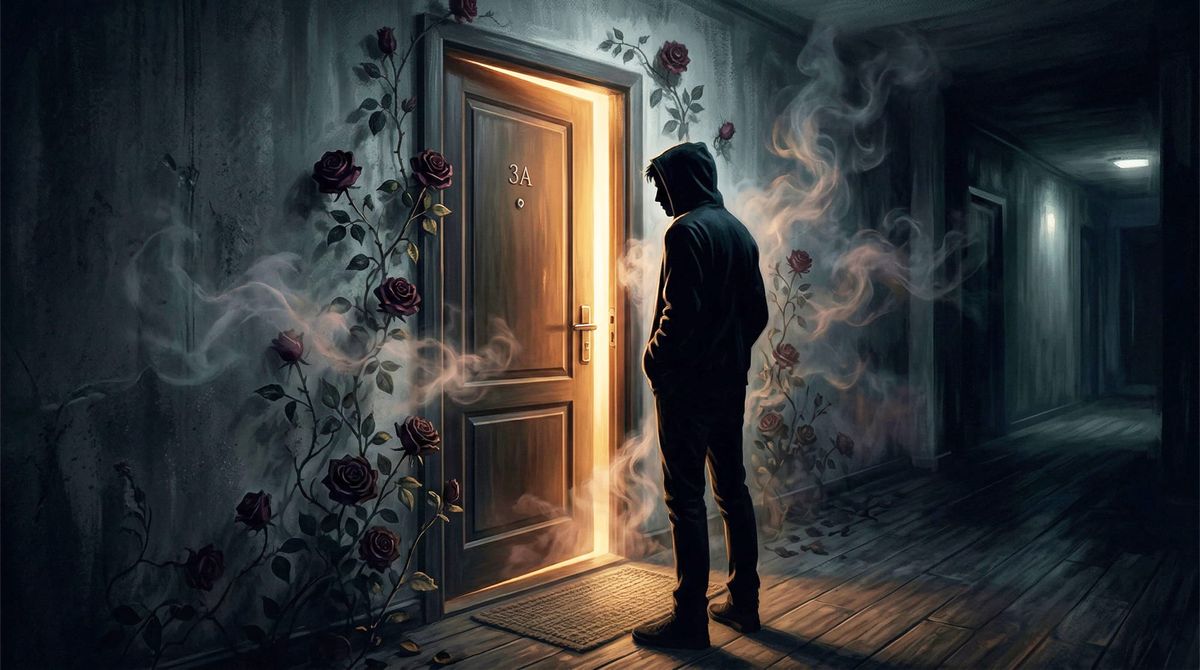
In the beginning, he existed only as a presence occupying the space where her narrow hallway met the threshold of her bedroom and he only ever appeared when the door was unlocked.
She had never witnessed him forcing entry, had never heard the handle turn or the hinges shift. He did not break in or push himself inside.
He simply crossed it when it was open to him.
That detail, more than anything else, anchored the experience in reality. It followed a rule. It adhered to something consistent, even if she did not yet know what governed his actions.
There was a strange thought that returned to her again and again, that if he ever stepped into the light, she would recognize his face.
But the light never reached him, and he never made any visible effort to seek it.
He remained where the hallway held him, as though he understood something she did not.
As though he knew she would slip eventually. The thought unsettled her more than his presence ever had.
Last night, she almost did.
Exhaustion had dulled her focus, her routine slipping just enough for the moment to pass without its usual precision.
Her cat had been restless, pacing across the bed with unusual attention, her tail curling and uncurling slowly, as though she were tracking something invisible.
Estrella fed her, checked the windows, turned off the lights, and for a single, accidental second, she walked away from the door without locking it.
The realization came instantly, a hollow drop settling into her chest before she had even fully registered the mistake.
She turned back quickly, crossing the room in two steps, her hand finding the lock and turning it with a force that bordered on urgency.
When she returned to the bed, her cat was already curled near her feet, her gaze fixed unwaveringly toward the doorway.
Estrella followed that line of sight without thinking.
He was there, sprawled out on the floor, his back leaning against the door.
She could not see his face, but she did not need to because she knew he was looking at her.
Her cat shifted suddenly, her paw brushing against Estrella’s ankle in a brief, unexpected movement that pulled a sharp breath from her lungs.
He vanished in the way a thought disappears mid-sentence, leaving behind only the absence of what had been there before.
She could not sleep, and eventually morning came without interruption, light spilling through the window in a way that felt almost indifferent to everything that had occurred during the night.
For a while, she convinced herself that it had ended there.
That whatever pattern had been forming had finally broken.
Then one evening, she walked into the kitchen and found a vase on the counter.
It was made of clear crystal, its surface catching the light in fractured reflections that scattered across the countertop. Inside it, arranged with deliberate care, was a gradient of roses that shifted from bright, vivid red to a deep, near-black at the edges.
They were still damp and freshly cut.
She did not need to question where they had come from.
Because the night before, when she stood at the door, and her hand rested against the lock, she hesitated.
Daylight Dissonance
Morning settled over the building. Estrella stood in her kitchen watching the fractured reflections of sunlight shift across the counters as the day slowly established itself around her.
The roses remained unnervingly perfect, their petals holding a saturated richness that felt almost excessive in contrast to the muted interior of her apartment.
She stepped back, forcing her attention toward routine, toward the small, predictable actions that made the space feel grounded. Coffee, keys, shoes, the familiar sequence of leaving that required just enough focus to keep her thoughts from circling back to the same unanswerable question.
The door. She locked it behind her, turning the key with deliberate pressure before stepping into the hallway.
The building greeted her with its usual placidity. Sound did not travel easily here. Conversations, footsteps, even the distant hum of appliances seemed to dissolve into the walls before they could fully register.
Estrella moved toward the stairwell, her sneakers echoing faintly against the old wood flooring.
Halfway down the stairs, she heard a voice.
“Well, you look like you slept through something strange.”
The tone was warm, edged with a familiarity that suggested observation rather than assumption.
Estrella glanced up to find Dawn standing at the landing below, one hand resting against the railing.
Dawn had the kind of presence that softened a space without overt effort, her posture relaxed, her expression open in a way that felt genuinely inviting.
Her hair, streaked with silver, framed her face in loose, unstructured waves, and there was something about the way she held herself that suggested resilience.
“Oh jeez, do I?” Estrella replied, allowing a small, cautious smile to settle into place as she continued down the steps.
“Just an observation,” Dawn said, her lips curving slightly as she turned to walk alongside her.
“Have you experienced anything strange?” Estrella asked, her curiosity threading quietly through the question.
Dawn let out a soft breath that might have been a laugh, though it lacked any real amusement. “Nothing to complain about,” she said, shrugging lightly after a brief pause.
“In any case, people are strange everywhere one goes.”
They reached the ground floor together, the lobby stretching out before them in a space that felt larger than necessary, as though it had been designed to accommodate more people than it currently held.
The furniture was arranged with careful symmetry, every surface clean, every detail maintained with a level of precision that bordered on excessive.
Estrella glanced around, her gaze catching briefly on the front desk, where no one was ever present, despite the building’s insistence on structure.
“Do you ever see the landlords?” she asked, her voice quieter now, as though the question itself required a certain level of discretion.
“Only when something needs fixing,” Dawn replied, her expression remaining neutral. “They’re very attentive in that regard. You won’t find better maintenance anywhere else in the city.”
Before Estrella could press further, another presence entered the space.
“Good morning.”
The voice was smooth. Estrella turned to see a woman approaching from the far end of the lobby.
Dagna.
Estrella had seen her before in passing, always at a distance, always alone. Up close, the details became more pronounced.
Her features were symmetrical to the point of discomfort, her expression held in a polite neutrality that did not quite reach her eyes.
“Morning,” Estrella said, matching the greeting automatically.
Dagna’s gaze settled on her, not with curiosity, but with a kind of focused attention that felt more like assessment.
“I hope your last few weeks have been comfortable,” Dagna said, her tone courteous.
“It has been,” Estrella lied, maintaining the polite exchange despite the faint unease threading through her awareness.
“That is good to hear,” Dagna said, inclining her head slightly.
There was no warmth in the statement, only precision.
Dawn shifted beside her, the movement subtle but noticeable, her body angling just slightly closer to Estrella as though narrowing the space between them without drawing attention to it.
“We were just heading out,” Dawn said, her tone still pleasant, though there was a quiet finality in the phrasing that suggested the conversation was complete.
“Of course,” Dagna replied, stepping aside with an effortless grace. “Enjoy your day.”
As they moved past her, Estrella felt the weight of Dagna’s attention linger for a moment longer before it receded, leaving behind a space that felt somehow lighter in her absence.
Outside, the air carried the familiar warmth of the city, the sounds of traffic and distant conversation reasserting themselves in a way that felt almost overwhelming after the contained quiet of the building.
Estrella exhaled slowly, her shoulders relaxing as the tension she had not fully acknowledged began to dissipate.
“She’s… intense,” she said, glancing toward Dawn as they stepped onto the sidewalk.
Dawn considered that for a moment, her expression thoughtful rather than dismissive. “That’s one way to put it,” she said. “You’ll find that some of the neighbors are more… particular than others.”
“Particular how?” Estrella asked, though she suspected the answer would not be entirely straightforward.
Dawn’s gaze shifted briefly back toward the building before returning to Estrella, something unreadable passing through her expression in that moment.
“Just be careful of your surroundings,” she said, her tone gentler now. “If you ever need anything, you can always knock on my door.”
They parted shortly after, the conversation dissolving into the rhythm of the day, though it lingered in Estrella’s mind longer than she expected.
What They Prepare For
Below Estrella’s apartment, beneath the polished quiet of the lobby and the carefully curated stillness of the upper floors, there was a level that most residents never noticed.
It did not appear on the elevator panel, and the stairwell door that led to it remained locked with a mechanism that required more than a simple key.
It was there that they gathered.
The room itself was expansive without being ostentatious, its architecture mirroring the rest of the building in restrained tones and clean lines, though the air carried a density that distinguished it from the spaces above.
They arranged themselves without discussion, each taking a position that reflected something unspoken yet clearly understood.
Some remained standing, others seated, but no movement appeared accidental, no posture unconsidered.
Dagna stood near the center.
Her composure remained unchanged from the version of her that moved through the lobby, though here, without the need to simulate casual interaction, her authoritative presence became more apparent.
“We are approaching the end of the cycle,” she said, her voice carrying easily through the room without the need for projection.
“The current residents have remained stable, and there have been no irregularities that require intervention.”
There was a brief pause, not for effect, but for acknowledgment, as though the information itself required space to settle before the discussion could continue.
“The gathering will proceed as scheduled,” she added, her gaze moving across the room with quiet efficiency.
“Attendance will be expected from everyone.”
A murmur followed, not loud enough to disrupt the atmosphere, but present enough to register as collective agreement.
At the far end of the room, seated with a posture that suggested exhaustion, Cato listened.
His form was relaxed, one arm draped loosely along the back of the chair, his gaze angled slightly downward as though the discussion held only a passing relevance to him.
“The distribution will follow the established rotation,” another voice said, this one lower, edged with something that approached anticipation but never fully crossed into overt expression.
“Seven tenants, seven assignments, no overlap.” the voice added.
Cato’s gaze shifted slightly, not enough to draw attention, but enough to indicate that the detail had registered.
“We will maintain discretion until the final hour,” Dagna continued, her tone unchanged, though the cadence of her speech carried a subtle tightening that suggested the importance of what followed.
A voice from near the back spoke, measured and calm. “And the newer resident?”
Dagna’s expression did not change, but the slight shift in her focus indicated that the question had been anticipated.
“She remains within acceptable parameters,” she said.
The answer was precise, but not expansive.
“Who is she assigned to?” the same voice asked.
There was a pause this time, brief but noticeable, as though the response required a degree of consideration that the previous statements had not.
Then, without turning, without raising her voice, Dagna said, “Cato.”
Cato did not react immediately.
He allowed the silence to stretch for a fraction longer than necessary before lifting his gaze, his attention settling on Dagna with a neutrality that mirrored her own.
“Noted,” he said.
The single word carried no resistance, no visible hesitation, no indication that the assignment held any significance beyond routine. It was an answer that satisfied the room.
“Ensure compliance,” Dagna added, her tone unchanged, though the directive beneath it was unmistakable.
Cato inclined his head slightly, the movement minimal, controlled, offering acknowledgment without invitation for further exchange.
“Of course,” he said.
The discussion moved on.
Logistics followed, then timing, then smaller details that refined what had already been decided.
There were no disagreements and no need for negotiation. The structure they operated within had been established long before this particular cycle, long before these particular residents, long before Estrella had ever stepped through the front door and signed her name to a lease that had already accounted for her presence.
Eventually, the gathering concluded.
The room emptied without ceremony.
Cato remained seated.
His gaze lifted toward the indirect light that never quite illuminated the space in its entirety.
He had participated in the event more times than he cared to count, each cycle blending into the next until the distinction between them had eroded into something indistinct.
It had never required thought until now.
He stood up laggardly, the movement unhurried, his attention already shifting upward, beyond the concrete layers of the building, beyond the controlled environment of the room, toward a space that did not belong to this level of operation.
Toward Estrella. He had observed her longer than necessary, much longer than the assignment required.
Long enough to understand that she had noticed him.
Cato could have forced the lock open if he chose to, though crossing that boundary carried consequences he had no interest in invoking.
He moved toward the exit without urgency, his steps silent against the floor, his presence folding back into the structure of the building as he ascended.
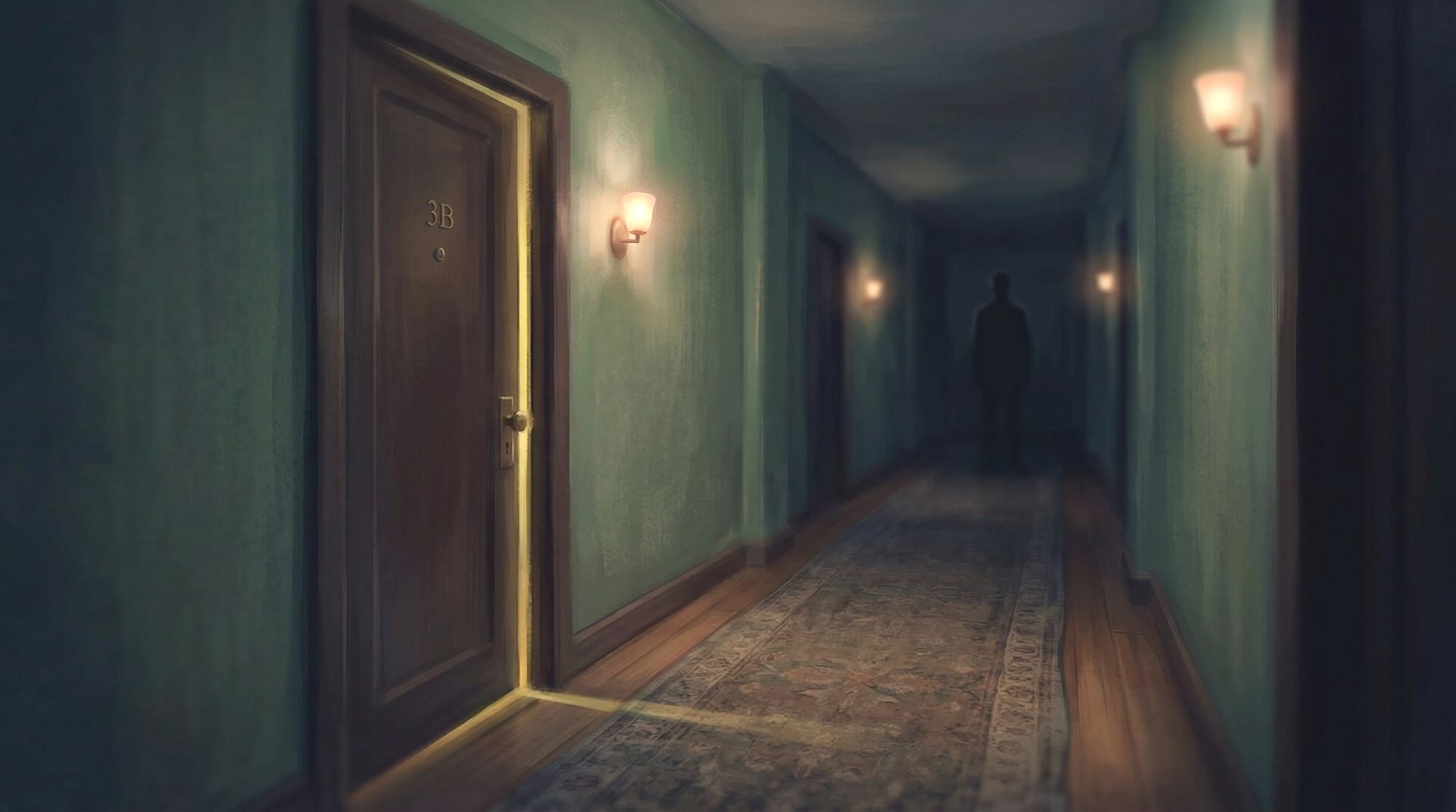
Estrella’s door stood at the far end, closed, undisturbed, its surface offering no indication of the attention it had already drawn.
Cato stopped before reaching it.
He did not need to test the handle to confirm whether it was locked.
So he remained where the hallway darkened slightly, where the light thinned just enough to create a threshold that was not entirely visible but still distinctly present.
And he did not break the boundary she had reinforced.
But as the day gave way to evening, and the subtle shift of the building’s internal rhythm began to settle into place, he allowed his attention to rest there, steady, patient, and entirely deliberate.
Inside the apartment, Estrella moved through her evening without knowing that the decision had already been made.
Without knowing that the gathering in the lobby had already been set in motion.
The Invitation
The notice appeared in the late afternoon, slipped beneath Estrella’s door. When she held it against her fingers, she noticed the paper was heavier than she expected, the texture smooth beneath her fingers as she lifted it from the ground.
It was a single card with clean typography and a curated design.
Resident Gathering
Friday Evening — 11:30 PM
Food, Drinks & Community
Lobby Level
What unsettled her as strange was the time. It was later than she had expected for an event of this kind. She set the card on the counter beside the vase, the roses unchanged, their presence still as beautiful as it had been nights before.
Vitaly introduced himself the following morning. Estrella encountered him in the hallway. He stood at a comfortable distance, not obstructing her path, not imposing, but present in a way that made avoidance impossible.
“Good morning neighbor,” he said, his voice warm, carrying an ease that contrasted sharply with the controlled neutrality she had come to associate with Dagna.
He was younger in appearance than the other residents, his posture relaxed, his expression open in a way that felt practiced but not entirely insincere.
There was something disarming about him, something that suggested approachability without quite earning trust.
“I wanted to make sure you received the invitation,” he continued, gesturing lightly toward her apartment with a small, polite movement of his hand.
“I did,” Estrella replied, her tone neutral, her attention sharpening despite the casual framing of the interaction.
“Good,” Vitaly said, his smile widening slightly. “We try to encourage a sense of community here. It can be difficult in a building this size, and it’s important that everyone feels included.”
“What kind of gathering is it?” she asked, allowing the question to carry just enough curiosity to remain natural.
“Oh, I think it'll be a fun one,” he said easily. “A chance to meet your neighbors, spend some time together outside of the usual routines. We don’t host them often, so it’s something people tend to look forward to.”
His gaze lingered on her for a moment longer than necessary, not intrusive, but attentive in a way that suggested he was measuring her response.
“You’ll come?” he asked.
It was phrased as a question.
“It's a bit late.” She replied.
“Ah yeah, but it's only a few hours of fun. You know how it is with work schedules.”
Estrella held his gaze for a fraction of a second before nodding slightly. “I’ll think about it,” she said.
Vitaly’s smile did not falter.
“Of course,” he replied. “I’m sure you will.”
He stepped aside then, creating space for her to pass, the movement smooth, controlled, entirely courteous.
As she walked past him, she became aware of something she could not immediately define.
Closer
Estrella moved through the apartment with the same deliberate pacing she had established over the past weeks, her attention fixed on the sequence of actions that had become necessary rather than habitual. She checked the windows, adjusted the lights, fed her cat, and finally approached the door with a focus that bordered on ritualistic.
The card remained on the counter and the roses remained unchanged.
Everything existed exactly where she had left it.
She turned the lock.
The click settled into the space with quiet finality.
For a moment, she stood there, her hand still resting against the door, her awareness extending beyond the apartment, into the hallway, into the space where she knew—
Where she expected—
He would be.
She allowed the moment to stretch, the silence settling around her in a way that felt almost anticipatory.
Then she stepped back.
This time his presence carried a different quality, something more immediate, more defined.
When she turned toward the doorway of her bedroom, he was no longer fully contained by the hallway.
He stood tall at the threshold. The line between shadow and light touched him now, revealing more than it concealed. His form was clearer, his posture upright, his presence controlled in a way that suggested restraint rather than hesitation.
Estrella did not move.
Her body reacted as it always did, not with panic, not with the instinct to flee, but with that same unsettling calm that had defined every encounter so far.
Her heart slowed and her breath steadied.
And for the first time—
He spoke.
“You should leave.”
The voice was low, measured, carrying a clarity that cut through the space without raising in volume. It existed exactly where it was meant to, as controlled as everything else about him.
Estrella’s gaze sharpened.
“You’ve had weeks to say that,” she replied, her tone steady despite the quiet tension threading beneath it. “Why now?”
In the dim light, she could make out more of his strange features now, enough to recognize structure.
His attention flickered briefly toward the kitchen, toward the card resting beside the vase.
“This,” he replied.
“The card?” she asked.
He did not answer directly.
Instead, he stepped forward.
The ceiling lights caught him more completely, revealing the details she had only partially seen before.
His clothing was precise, tailored, the fine fabric structured in a way that suggested intention rather than convenience. Everything about his appearance controlled and undeniably expensive.
The contrast did not escape her.
“You’re telling me to leave,” she said, her tone amplifying. “Just pack my things and go. Do you know how much it costs to live anywhere else in this city?”
His gaze remained steady, though something in it shifted, not irritation, not impatience, but a recognition of the barrier she was presenting.
“Cost will not matter if you stay,” he said.
“That’s easy for you to say,” she replied, her attention flicking briefly over him, taking in the details she had not allowed herself to fully acknowledge until now.
“Do you even live here? You’re not the one trying to make my rent.”
Cato adjusted his approach.
“Then consider it temporary,” he said, his tone unchanged, though the phrasing shifted, more measured now, more precise. “Leave for a few days. A week at most. Do not attend the gathering.”
“And then what?” she asked. “I come back and everything is fine?”
“No,” he said.
The honesty of the answer was immediate, he hadn't thought about what would happen if she came back.
“Then why would I leave?” she pressed.
“Because staying ensures a worse outcome,” he replied.
Estrella studied him for a moment, the calm that had defined her earlier reaction beginning to fracture slightly under the weight of the conversation.
“You’re being intentionally vague,” she said.
“It's for the best,” he replied.
The admission was as direct as everything else.
“Why would I listen to you?” she said, her voice steady, though the tension beneath it had sharpened into something more defined now.
Cato held her gaze. Once it was said, it could not be retracted, and once the boundary shifted, it would not return to what it had been.
He stepped forward again.
This time, inside the room.
Estrella did not step back.
Her body remained still, though her awareness sharpened, every detail registering with a clarity that left no room for misinterpretation.
“You need to leave,” he said again, his voice quieter now, though no less controlled.
“You're scaring me. Why?” she asked.
Cato did not look away this time and did not attempt to reframe the statement into something less direct.
“They are going to kill you,” he said.
The words settled into the space without distortion, without exaggeration, without any attempt to cushion their impact.
“Kill me?” she asked, her voice steady, though the composure beneath it required more effort now than it had moments before. “If you expect me to walk out of here without a second thought, you’re going to tell me exactly who and how that happens.”
Cato remained still.
“The gathering,” he said finally, his tone measured, each word selected with deliberate care. “You and the others.”
Estrella did not look away.
“The minute everyone is in attendance and their guard is down the doors will be secured and exits controlled.”
Her breath caught, not out of calm, but out of focus.
“And then?” she asked.
Cato did not hesitate this time.
“They will feed.”
The simplicity of the statement carried more weight than any elaboration could have provided.
Estrella’s gaze shifted briefly, her attention pulling inward as the pieces aligned, each fragment of unease she had carried over the past weeks locking into place with a precision that made it impossible to ignore what had been forming beneath the surface.
The thought surfaced immediately, not as a question, but as a realization.
“And the others...,” she said, her voice lower now, though no less controlled.
“Yes,” Cato said.
The confirmation landed harder than anything else he had said.
“They don’t know,” she said, the words forming as she spoke them. “Dawn doesn’t know.”
“No,” Cato replied.
“Then they need to,” she said.
Cato’s expression changed for the first time.
“That would be unwise,” he said.
“They’re going to die,” Estrella replied, her voice steady despite the urgency that threaded through it. “You expect me to walk out and leave them here?”
“I expect YOU to survive,” his tone increased.
The response was immediate.
“And I expect you to understand that introducing even more uncertainty into a controlled structure will not produce the outcome you are imagining.”
“I’m not imagining anything,” she said. “I’m telling you I’m not leaving without them.”
Cato stepped closer.
“You are one person,” he said. “They are operating within a system that has functioned without disruption for longer than you have been alive. You will not dismantle it through warning.”
“Then I’ll try anyway,” she replied.
The certainty in her voice did not waver.
He exhaled slowly, the motion subtle, though it marked a departure from the stillness he had maintained until now.
“This complicates the situation,” he said.
The distance reestablished itself, though the dynamic had shifted in a way that would not return to its previous state.
“I will see what can be done,” he said.
He turned then, the movement precise, his attention already shifting away from the conversation, from the room, from her.
“Do not speak to anyone about this,” he said without looking back and then disappeared into the shadows.
He did not return the following night or the night after that.
The hallway remained still, the threshold empty, the subtle shift in the air absent in a way that felt more noticeable than his presence ever had.
Vitaly found her again not too much later.
This time, his warmth was more pronounced, as though the proximity of the event had heightened his investment in its success.
“We’re looking forward to seeing you,” he said, his tone easy, his smile unchanged, though there was something beneath it now that Estrella could not unsee.
“I’ll be there,” she replied flatly.
The lie came easily.
“Excellent,” he said. “And if you have a friend, you’re welcome to bring them. We encourage participation.”
Estrella nodded once, offering nothing further, her attention already shifting past him, away from the conversation, away from the implication.
That night, she did not sleep.
Cato returned the night before the gathering.
Estrella turned before he spoke.
“You were gone so long,” she said.
“That does not matter right now,” he said. “I have a plan.”
The words landed with a precision that cut through everything else.
Estrella stepped closer.
“Tell me,” she said.
Crashing the Gathering
The lobby was already filled when they arrived.
Estrella stood near the edge of the space, Dawn beside her, the presence grounding in a way that felt necessary.
“This is different,” Dawn said quietly, her gaze moving across the room with a subtle tension that had not been present before.
“It is,” Estrella replied.
She did not elaborate.
Across the room, Vitaly moved easily between residents, his demeanor unchanged, his warmth consistent, though now it felt structured, directed, purposeful.
A large spread of hot and cold foods covered the table and a bar surrounded by red stools were on the other side, displaying a sign promising free drinks throughout the event.
Some residents sat around the bar, laughing easily, not sharing the same tension.
Dagna stood near the center of the room.
Above them, mounted against the far wall, a large black clock marked the time.
11:57.
Several of the residents were watching it.
Estrella’s breath slowed, her awareness sharpening, every detail registering with a clarity that left no room for distraction.
She felt him before she saw him.
The shift in the air, the recalibration of space, the presence that anchored itself behind her without announcing itself.
“Be ready,” Cato said quietly.
She did not turn or acknowledge him, just nodded.
12:00.
The alarm blared, cutting through the room with a jarring clarity that shattered the atmosphere, the suddenness of it forcing every head to turn, every conversation to break, every movement to pause.
For a fraction of a second, confusion overtook structure. Dagna scowled and motioned others to the doors.
Then the sprinklers activated.
Water poured from the ceiling in an immediate, overwhelming cascade, drenching the room, disrupting visibility, breaking the carefully maintained composure that had defined the space moments before.
Estrella did not hesitate.
“Follow me!” she shouted, her voice cutting through the noise, the urgency undeniable, the direction immediate.
Dawn moved first. Others followed, some in apprehension and not all at once.
Behind them, Dagna moved with startling speed.
Her attention locked onto the break in formation, her pursuit immediate, her composure intact despite the chaos.
“Go,” Cato said.
This time, Estrella turned.
He stood in the center of the room now, no longer contained by shadow, no longer restrained by distance, his presence fully realized in a way that left no ambiguity about what he was.
The gas tank rested at his side and the flame in his hand burned steady.
“If any of you follow, the building burns,” he said.
Dagna stopped.
“Traitor,” she spat out, her voice edged with venom.
The others hesitated and Estrella ran.
The night air hit her with a force that felt almost unreal, the sound of movement, of breath, of uncontained space overwhelming after the structured silence of the building.
Dawn was beside her. The others scattered and no one looked back.
Behind them, the fire took. She clenched at her chest, the realization striking with sudden clarity that the actual ignition had not been part of the plan.
It grazed the building at first, then moved faster and then consuming.
Estrella stopped at the edge of the street, her attention pulling back toward the building despite everything in her urging her forward.
Flames climbed the structure, breaking through windows.
She searched for him but there was nothing to see.
Dawn’s hand found her arm, steady, grounding.
“We have to find safety,” she said.
Estrella did not respond immediately.
Her gaze remained fixed on the building, on the place where he had stood, on the space that no longer existed in a way she could return to.
“He said he would come find me,” she said finally, her voice quieter now, though no less certain.
Estrella turned.
Behind them, the building burned as fire trucks arrived at the scene.
Adjacent to the building, a silhouette stood on a fire escape. Its hand swayed slowly in recognition.
Once she saw it, she had a certainty that he would return.
You’ve reached the end of this story.
But not the end of the world it belongs to.
New stories appear regularly.
Stay curious.
Note: This is an expanded version of a micro story called At the Threshold, He Waits.
✦ Related Reading & Themes
This story explored:
the quiet horror of living inside a system designed to consume you
the illusion of safety within controlled, domestic spaces
predation disguised as routine, politeness, and structure
the tension between instinct and restraint within a monster who refuses to act
the significance of thresholds—what is allowed in, and what is kept out
recognition before understanding, and the body’s instinct to trust what it should fear
the slow unraveling of normalcy when patterns begin to reveal intent
survival not as escape, but as defiance against something larger
Tags for similar stories:
vampire romance, supernatural thriller, dark romantic fantasy, soft horror, urban fantasy, apartment horror, hidden vampire society, predator and protector dynamic, morally gray love interest, slow burn supernatural romance, survival horror, atmospheric fiction, psychological suspense, forbidden connection, modern gothic, threshold symbolism, secret world fiction, human vs monster tension, romantic suspense, cinematic storytelling, eerie domestic setting, controlled horror, dark fantasy romance
✦ If You Liked This Story
You might also enjoy:
The Night Elias Hesitated - After a violent encounter shatters her ordinary life, Rue is forced into a quiet, dangerous proximity with something not entirely human. A haunting short story about restraint, secrecy, and the fragile beginning of something that should not exist.
If you want more stories like this, explore the full Petalstorm Press library → HERE
© Petalstorm Press — Original Fiction
This story is part of the Petalstorm Press library.
Redistribution or reproduction without permission is prohibited.