Tension on the Sales Floor
Two rival assistant managers compete during a high-stakes skate shop launch, until a chaotic theft changes everything. A rivals-to-lovers story set on the sales floor.
A Short Story by Polly Pinwheel
By the time the posters went up in the window, Val had already memorized the layout of the launch display twice over.
“Concrete Myths,” printed in thick white lettering across matte black vinyl, stretched from one side of the glass to the other.
Beneath it, the smaller text read:
An exclusive drop by Kieran Hale.
Kieran Hale was the kind of skater who had become too famous for the local kids to admit they idolized him.
He was all rough interviews, grainy street parts, old injuries, expensive sponsorships, and the kind of reputation that made teenage boys rave about him.
Concrete Myths was his first clothing line, and the shop had somehow landed one of the only opening-day releases in the county.
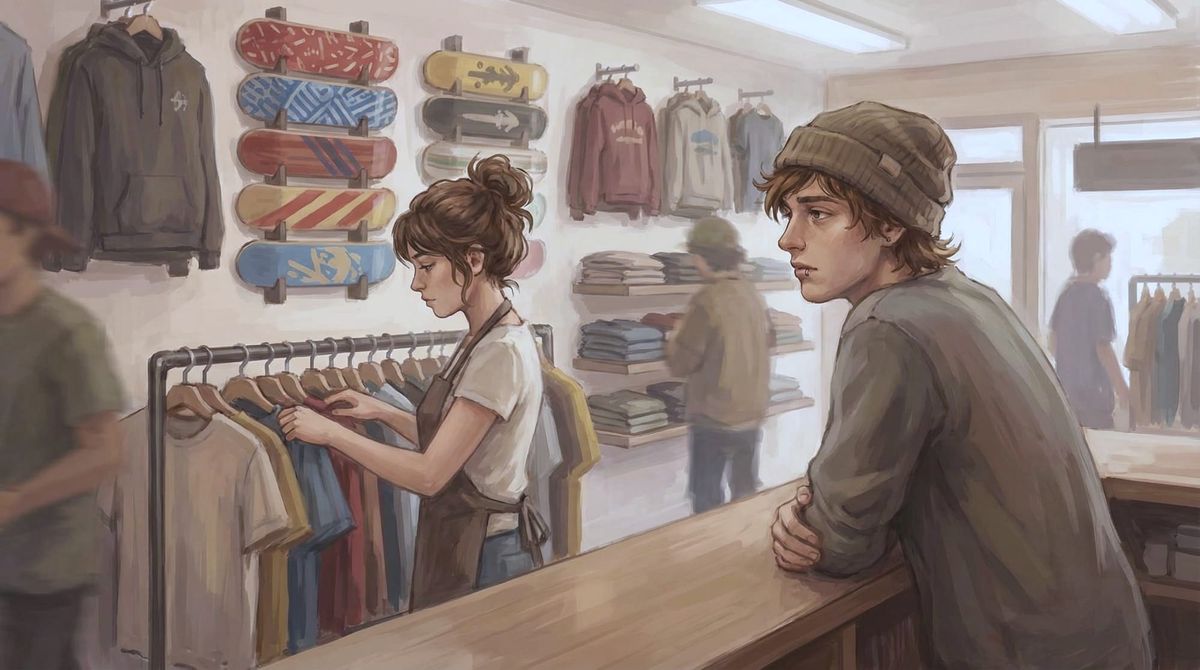
Val adjusted the hem of one of the hoodies on the front rack, smoothing it flat even though it already hung perfectly. The fabric was soft but dense, the kind that suggested care.
Everything about this new line had intention. There were even small tags printed with tiny myth references no one would catch unless they were looking.
Behind her, the entry chime rang, followed by the scrape of a skateboard dragged over tile.
“You’re gonna iron those next?” Rory’s voice carried easily across the shop, casual and teasing in something that hovered between humor and irritation.
Val didn’t turn immediately. She adjusted one more sleeve, stepped back, and only then glanced over her shoulder.
“Not everything has to look like a garage sale,” she said.
Rory dropped his skateboard against the wall with a dull knock and leaned on the counter, arms crossed.
His hair was still damp at the ends, probably from a rushed shower, and he wore the same black T-shirt he’d worn yesterday, the collar slightly stretched.
A silver ring was hooked through the left side of his lower lip that caught the shop lights every time he moved his mouth.
It was the kind of detail Val had hated herself for noticing months ago and had never managed to forget since.
“Garage sale’s been working fine for the past five years,” he said.
“Yeah,” Val replied, “and we’re still not profitable.”
He let out a short laugh, but there wasn’t much amusement in it.
“You sound so sure. Did you read about how to figure that out in your fancy business classes?”
Val finally turned to face him fully. “Did you read your schedule this week, or are we still treating that as optional?”
Rory pushed off the counter, walking toward her with a slow stride. “I show up when it matters. The numbers usually matter more than anything anyway.”
“So you're unreliable,” Val said.
He stopped just short of her, close enough that she could smell the laundry detergent on his clothing.
“Funny,” he said, “because I could’ve sworn I’ve been here every time something actually needed fixing. Like last week when you almost built that complete backward.”
Val held his gaze, scowling. “We're supposed to work together.”
“Then stop acting like you’re already my boss.”
The shop hummed around them—ska music drifting from the speakers, the distant clatter of someone adjusting trucks near the back.
Then Rory stepped past her, brushing just enough against her shoulder to feel intentional.
Val exhaled through her nose and turned back to the display before she said words that would make Denise walk out of the shop and take a cigarette break.
Denise's Departure
The idea hadn’t been officially announced.
Their general manager, Denise, had started saying things like, “I’m not gonna be here forever,” with a lazy smile.
She moved more carefully now, one hand occasionally resting against her stomach when she thought no one was paying attention.
“Guess no more smokes for a long time, boss lady.” Val said when she noticed the gesture.
Rory had noticed too, though he hid it by pretending not to notice anything at all.
Denise had been at the shop long enough to know things. She knew which regulars pretended they were there to buy hardware when what they actually wanted was to chat her up.
She knew who would steal and she knew when an angry parent was about to arrive and demand to know why their son needed a board that cost more than their electric bill.
Three nights before the launch, Denise called them both into the back room while a ceiling fan pushed warm air in tired circles overhead.
“You two are exhausting,” she said without preamble.
Val folded her arms. Rory leaned against a shelf stacked with shoeboxes and grinned like he was proud of that fact.
Denise pointed between them with a pen.
“And before either of you asks, no, I’m not making an announcement. I’m not doing a little speech and I’m not gathering everyone in a circle. But I will say this. If I were leaving this store in someone else’s hands, I’d want them to know the difference between being busy and being useful.”
That got both their attention.
Val straightened. Rory’s grin thinned.
“A good manager,” Denise went on, “isn’t the person who does the most and it’s not the person who talks the most either. It’s the person who knows what matters in the moment. Sometimes that’s just folding shirts and managing inventory. Other times it’s calming down a twelve-year-old who just got laughed at by the older boys. And sometimes it's running to catch the one idiot who’s about to walk out with your inventory under his hoodie.”
“You,” Denise said to Val, “usually default to hard work. You think if you out-organize everybody, out-plan everybody, outstay everybody, you’ll deserve whatever comes next.”
Val opened her mouth, but Denise lifted a hand.
“And you,” she said to Rory, “usually default to smart work. You trust instinct and your charisma. You think rules are for people who can’t read a room.”
Rory gave a half shrug.
“Usually works better.”
“Until it doesn’t,” Denise said. “That’s the issue with both of you. No balance.”
Val looked down at the scuffed floor. Rory rolled his lip ring lightly between his teeth.
Denise sighed and sank into a plush chair. “The launch matters greatly. I'm not going to say one perfect day decides the future of this store, because that would be stupid. But it’ll tell me a lot about who handles it better.”
Preparations
They were both scheduled for every prep shift leading up to the event.
By the third night, the hostility between them had gone low key but somehow more persistent, like a low-frequency vibration under everything they did.
Val sat cross-legged near the front display with a box of folded shirts open beside her, checking tags and reorganizing sizes. Rory stood on a ladder hanging a second Concrete Myths banner above the denim wall.
“It’s tilted,” she said without looking up.
“It’s not,” he replied.
“It is,” she said, still focused on the tags. “Left side’s lower.”
Rory shifted, tugged at the cord, then leaned back slightly.
“…okay, maybe a little.”
He huffed, making the adjustment.
After a few minutes, Rory spoke.
“You actually care about this stuff?” he asked.
Val paused, the tag between her fingers.
“What do you mean?”
“All of it.” He gestured toward the display, the posters, the spacing she had been measuring by eye for the past half hour.
“It’s just clothes and good marketing.”
“It’s not just clothes,” she said. “It’s thoughtful branding and presentation. People decide what something is worth before they even touch it.”
Rory climbed down from the ladder, setting it aside. “Or maybe they decide what it’s worth based on whether they like it.”
“That too,” she said. “But they have to notice it first.”
He watched her for a moment.
“You ever get tired of thinking about everything like that?” he asked.
Val tilted her head slightly. “Like what?”
“Like everything has to mean something,” he said. “Or lead somewhere.”
She looked back down at the shirts, smoothing one flat before answering.
“Do you ever get tired of acting like relying on your instinct is enough for everything?”
Rory let out a quiet scoff, almost a laugh.
“Usually instinct is just pattern recognition, which is what intelligent people excel at.”
She gave him a dry look. “That sounds like something someone says when they don’t want to admit they rely on luck.”
The words landed more harshly than either of them expected.
Val’s hand stilled on the shirt.
Rory looked away first, toward the line of decks mounted on the wall.
“I used to read a lot of mythology,” he said suddenly, leaning against the counter.
Val glanced up again. “Used to?”
“Before crappy roommates and bills and all the glamorous things.” His mouth tilted around the ring.
“Mostly Norse.”
Val’s interest flickered, subtle but present. “I like Greek mythology.”
“Of course you do,” he said, eyes rolling, but there was no bite to it.
She narrowed her eyes. “Why is that always your answer?”
“The whole thing is just too structured,” he said.
“And Norse isn't?” she asked.
He shrugged. “Norse feels… messier, realer. Like everything’s kind of doomed, but they keep going anyway.”
Val considered that, turning it over in her mind.
“That sounds bleak,” she said.
“Maybe,” Rory replied.
Their eyes met again, and this time neither of them looked away immediately.
“You really think hard work wins every time?” he asked.
“No,” she said. “I think hard work keeps you from embarrassing yourself when talent doesn’t show up.”
He considered that with more seriousness than she expected.
“My dad used to say hard work is what people worship when they don’t know how to get ahead any other way.”
Val lifted a brow. “That sounds cynical.”
“Oh, he was very cynical.” Rory pushed off the counter. “But smart work matters. Reading people matters, because knowing when somebody wants to be sold to and when they want to be left alone is important.”
Val looked at the display, then back at him. “So Denise was right. We’re both half annoying.”
Rory barked a laugh. “That might be the kindest thing you’ve ever said to me.”
There was something there now—a warmth that was welcomed momentarily.
Then the moment passed, as easily as it had come.
“Banner’s straight,” Rory said, pushing off the counter.
Val looked up. “Finally.”
Launch Day
Launch day started at ten and felt electric by ten-thirty.
The shop filled faster than expected, bodies pressing in from the mall walkway, gritty music turned louder to match the energy.
It was full of teenagers, college kids, older skaters pretending they were only there to browse, and parents trying not to look confused.
A team member had brought extra speakers, and the bass vibrated through the floor in a steady pulse.
Val moved through the crowd with purpose, answering questions, directing people toward the new line, adjusting displays that got knocked out of place by wayward children.
The front windows glowed with black vinyl, concrete-colored hoodies, faded long sleeves, caps with stitched symbols, and a freestanding board where Denise had written in silver marker:
VAL: 0
RORY: 0
“Is that really necessary?” Val asked when she saw it.
Denise, who looked beautifully unbothered in a loose black dress and sneakers, lifted one shoulder. “You’re both competitive in a way that makes other people shudder. Might as well make it useful.”
By noon, the energy peaked.
Every Concrete Myths hoodie sold by both went on the board. Every successful upsell—a hat, a deck, a pair of socks added to the purchase—counted too. Denise kept score with merciless delight, calling out numbers over the noise.
“Val, three hoodies, two hats.”
“Rory, four hoodies, one beanie, and somehow you got that kid to buy grip cleaner. Impressive.”
Val moved through the crowd with polished efficiency, answering questions, explaining the story behind the line, steering customers toward products that suited them and redirecting wandering hands from stacks she’d already organized.
She was excellent at making people feel as if choosing to buy had been their idea all along.
Rory worked the opposite side of the floor and the register when needed, loose where she was composed, quick where she was methodical.
He read people fast. Instantly, he knew which teenage boys wanted validation, which girls wanted to browse without being hovered over, which dads needed a practical reason to agree to a hundred-dollar purchase. Watching him sell was infuriating because it came so natural to him.
By one-thirty the board read:
VAL: 11
RORY: 12
“Try not to cry,” Rory said as she brushed past him with an armful of restock.
“Try not to flirt with every customer under thirty,” she shot back.
The launch was going wonderfully. They were in sync despite themselves, covering for each other without comment, restocking when the other was trapped, redirecting traffic, adapting to the rhythm of the room with a shared current that felt almost thrilling.
Denise watched them with folded arms and an expression that looked suspiciously like amusement.
At two-fifteen, the board read:
VAL: 18
RORY: 18
“Toe to toe,” Denise murmured as Val passed. “Interesting.”
Val ignored her. Her pulse was already too high.
“Uh earth to Val? I'm stepping out for a few minutes, my back is killing me. Keep up the good work.” Denise announced hunching slightly.
“We're in the freaking zone! No worries boss.” Rory shouted from the counters with a fist pump.
The Launch, Ruined
A group of girls crowded near the front, laughing loudly, asking questions all at once. One of them knocked a rack sideways, and Val moved to fix it, guiding them gently but firmly away from the display.
At the same time, Rory was pulled toward the register by a customer insisting on splitting a payment across three cards.
Another group slipped in behind them—teenagers, restless, moving quickly, their energy scattered and unpredictable.
One asked about sizes and another asked about returns. Someone dropped a stack of shirts near the fitting area.
It didn’t feel coordinated at first, just chaotic retail energy they were accustomed to.
Then Val noticed the pattern.
People shifting positions too strategically and hands moving faster than they should.
“Rory,” she called, scanning the room.
He didn’t hear her over the music.
By the time he looked up, it was already happening.
A girl darted toward the door, a hoodie tucked under her arm. A boy near the caps wall shoved two beanies into a backpack. Another followed, then another.
“Hey—!” Rory vaulted over the counter, shouting.
The entry chime over the door rang repeatedly as bodies pushed through it, laughter trailing behind them like something careless and cruel.
Val grabbed for one of the bags near the front, but it was already empty.
“Security,” she said, her voice tight. “Call security.”
Rory was already at the door, scanning the walkway, trying to track which direction they’d gone.
A few of them were caught, held back by a security guard who had just stepped in from the neighboring store—but most had disappeared into the crowd.
The shop felt suddenly hollow, the energy drained out of it.
Val stood near the display, her hands still clenched at her sides.
“We lost a third of the inventory,” she said.
Rory turned back toward her, breath uneven. “You were right there—how did you not see it?”
Val’s head snapped up. “I was managing the floor.”
“You were rearranging racks,” he shot back.
“At least I wasn’t stuck arguing over payment methods while people walked out with everything.”
“Oh, so this is my fault now?”
“If you had been paying attention—”
“If you weren’t so focused on making everything look perfect—”
They stopped at the same time, both of them flushed with adrenaline and blame.
For one awful second, Val thought he looked genuinely wounded.
Then she looked away first.
“Forget it,” she said.
Rory didn’t answer.
The New Hire
The owner’s response was exactly as bad as Val expected and somehow less intelligent.
“We can’t afford this kind of loss,” he said, his tone flat. “We need someone who can actually handle situations like this.”
Denise stood beside him, her expression unreadable.
A week later, the owner hired a new manager from outside the store.
His name was Brent. He had a decent resume, a pressed button-down, and confidence. On paper, he looked excellent.
In person, he was a catastrophe wrapped in a clipboard.
He turned the music down because it was “distracting to conversion.”
A cheesy greeting script was developed and he expected everyone to use it.
He insisted that each customer be offered three product recommendations in the first two minutes of contact.
Val noticed that he had also reorganized the hardgoods wall by “profit visibility” and managed to separate decks from hardware in a way that made three regulars swear at him before noon on the first Saturday.
Worst of all, he knew nothing about skateboarding and he didn’t seem to understand that not knowing wasn’t the problem. The problem was thinking it didn’t matter.
Returns went up almost immediately.
Val and Rory adapted in different ways. She corrected mistakes quietly and re-folded whatever Brent disrupted. Rory started intercepting customers before Brent could reach them, redirecting conversations, smoothing over awkward sales pitches with the ease of someone used to repairing other people’s damage.
They spoke less after the theft, but the tension between them changed under Brent’s management. It was no longer sharpened by rivalry.
One slow Wednesday, Brent tried to pitch high-end bearings to a woman in her sixties who had entered the shop only because she thought it was a clothing store.
Val watched the woman’s expression flatten into discomfort as Brent launched into a memorized explanation of “lifestyle crossover accessories.”
Denise, who had stopped in to pick up a mug and a forgotten sweater from the back room, appeared beside Val at the register.
“I recommended you,” she said under her breath.
Val blinked. “What?”
“For the manager position. Before I left.”
Denise’s gaze flicked toward Brent, who was still speaking at the woman like she was trapped in an elevator.
“Looks like the owner is finally realizing a nice resume isn’t the same thing as knowing what to do with people.”
Val swallowed. “You got that right.”
Denise looked at her for another beat, then said, “For what it’s worth, the two of you were best when you stopped trying to beat each other and started accidentally helping each other. Shame you both only discovered that five minutes before the apocalypse.”
The Position's Future
That night, Val found Rory outside the mall, sitting on the curb with his board beside him. The parking lot was washed in amber light.
“I recommended you,” she said.
Rory looked up at her, confusion flickering across his face. “What?”
“For the manager position,” she repeated. “When they inevitably replace Brent.”
He stared at her, then let out a humorless laugh. “Why?”
Val crossed her arms loosely. “Because you are much better at this than I am.”
“That’s not true,” he said immediately.
“It is,” she replied, crossing her arms loosely. “You actually understand the people who come in here. You keep things moving and the wheels spinning, and you fix problems before they escalate.”
Rory shook his head. “But you care about this place more.”
Val exhaled, looking out at the street. “No,” she said. “I care about winning.”
He studied her, quieter now. “What changed?”
Val hesitated, then said, “I don’t want to become someone I don’t like.”
The words settled between them.
Then, she added, softer, “And you’re already someone I respect.”
Rory’s expression shifted, something unguarded flickering through it.
“You don’t even want the job, do you?” he said.
Val shook her head slightly. “Not like you do.”
Silence stretched, but it wasn’t uncomfortable.
“You’re leaving the team,” he said eventually.
“Classes will start soon,” she replied.
He nodded, absorbing that.
Their hands brushed as she shifted beside him, neither of them pulling away right away.
Together is Better
Val should have left then. But Rory looked tired in a way she had not let herself see before—worn thin from trying to hold together a life that did not pad his mistakes. She thought of the offhand line about not being able to pay rent sometimes. The roommates she’d never met. The way he always skipped or picked up random shifts without talking about why.
“You were right, you know,” she said.
He looked back at her. “About what?”
“Hard work isn’t everything.”
His mouth twitched. “Don’t tell me that. You’ll ruin my whole day.”
She smiled despite herself. “I’m serious.”
“So am I.”
Val stepped closer until she was standing right in front of him. “But you were wrong also.”
Rory tipped his head back to look at her. “About smart work?”
“About thinking street smarts can carry everything.” She tucked a strand of hair behind her ear. “The day of the launch, we were actually doing well because we were both there. You were reading people. I was seeing the floor and tracking numbers. It wasn’t one or the other.”
He studied her face for a long second. “So what are you saying?”
“That Denise was right,” Val said. “I hate that she's always right all the time. But she was.”
A laugh escaped him.
Rory shifted on the curb, then stood. His board rested against his shin. He was close enough that she could see the small scar near his jaw and the faint shadows under his eyes.
“You know what your problem is?” he asked softly.
Val arched a brow. “I have several. Be specific.”
“You only say the truth when it costs you something.”
The words hit with precision.
Val opened her mouth and found she had nothing prepared.
Rory’s voice dropped. “You recommending me and admitting any of this. None of that makes you look better, so I know you mean it.”
She looked at him, really looked. At the fact that somewhere along the way he had stopped being a rival-shaped obstacle and become a person whose disappointment she dreaded.
“I do mean it,” she said.
He nodded once, but did not step back.
“Think you’ll come back after classes end?” he asked.
Val glanced toward the darkened mall windows. “Think you’ll make it worth it?”
A slow smile broke across his face, not cocky this time.
“Maybe,” he said. “But I think I’d need another chance.”
She tilted her head. “At managing?”
His eyes dropped briefly to her mouth, then returned to her face. “At not being awful to you every other sentence.”
Val felt the heat rise under her skin.
“You weren’t awful every other sentence,” she said. “Sometimes you were just annoying.”
Rory laughed, and the sound was warm enough to make the whole parking lot feel altered.
Their hands brushed when she shifted her weight. This time neither of them moved away.
His fingers turned slightly, just enough for the backs of them to rest against hers. The contact was feather-light, absurdly small, and somehow more intimate than if he had grabbed her outright.
When she lifted her head again, he was watching her with an openness she had never seen on him before.
The parking lot noise seemed to recede. Somewhere far off, a shopping cart rattled over pavement.
“I was awful after the theft,” she said.
“So was I.”
“I blamed you because I was scared.”
Rory’s expression softened. “Yeah. Me too.”
That simple admission undid something in her chest.
Before she could overthink it, she reached up and touched the edge of his lip ring with the tip of one finger, barely there. A reckless, curious gesture. Rory inhaled and went still.
Val had never seen him speechless before. It was deeply satisfying.
“And this,” she said, trying for composure and failing slightly, “is distracting.”
His eyes darkened. “You brought it up first.”
“I know.”
When he kissed her, it was careful at first, as if he were asking a question he already suspected the answer to. Val answered by catching the front of his shirt in her fist and pulling him closer. The kiss deepened, warm and slow and full of all the tension they had spent weeks disguising as irritation. The hand not touching hers came to her waist, steadying her.
When they finally parted, both of them stayed close.
Rory rested his forehead briefly against hers and laughed under his breath, stunned. “Wow.”
Val was smiling too much to stop it. “Very articulate.”
“Sorry. I had a whole speech planned.”
She let out a laugh and smoothed her thumb once over the fabric at his shoulder.
“You’ll think of another one.”
He looked at her like he couldn’t decide whether this was real or whether she might vanish if he blinked wrong.
Then he said, more seriously, “If I get it—the position—I’m not taking it because you handed it to me.”
“I know.”
“I’m taking it because I can do it.”
“I know that too.”
He searched her face, found whatever he needed there, and nodded.
They stayed outside longer than they meant to, talking in fits and starts. About her evening classes and about his messy roommates. About how Brent had tried to turn skate culture into something like a conference package.
When Val finally turned to leave, Rory caught her hand.
She looked back.
“I'll call you,” he said.
The words were simple.
Val squeezed his hand once. “You’d better.”
Then she let go and walked to her car with the feeling that things had moved into place—not in the way she might once have wanted, but where there was possibility blooming.
You’ve reached the end of this story.
But not the end of the world it belongs to.
New stories appear regularly.
Stay curious.
✦ Related Reading & Themes
This story explored:
how rivalry can hide respect before either person is ready to admit it
how ambition can become complicated when winning starts to cost too much
how different strengths can clash before they learn to balance each other
how workplace tension can reveal chemistry, frustration, and unexpected tenderness
how being good with people is its own kind of intelligence
how failure can expose what competition was covering up
how connection can begin when two people stop trying to prove themselves and start seeing each other clearly
Tags for similar stories:
contemporary romance, workplace romance, rivals to lovers, coworkers to lovers, opposites attract, retail romance, skate shop romance, competitive romance, workplace tension, romantic tension, banter, workplace banter, rivals with chemistry, slow emotional shift, forced proximity, character-driven romance, modern romance, low angst romance, short romance, free short story, indie romance, workplace dynamics, ambition and vulnerability, hard work versus instinct, smart work versus hard work
✦ If You Liked This Story
You might also enjoy:
Strawberry Girl at the Strawberry Farm - The barista at the café calls her Strawberry Girl. Then she catches him flirting with another girl, so she stops going. Which would have worked perfectly…if she hadn’t run into him a week later at a strawberry farm.
If you want more stories like this, explore the full Petalstorm Press library → HERE
© Petalstorm Press — Original Fiction
This story is part of the Petalstorm Press library.
Redistribution or reproduction without permission is prohibited.