What Grows Below Ward Four
Some patients survive against all odds. A night nurse starts to realize those miracles aren’t random—and someone is responsible.
His badge read Elior, and no one I asked could recall when he had been hired or which department he technically belonged to.
In a place where agency nurses came and went and float staff filled in the gaps without introductions, it wasn’t unthinkable that he had slipped through the cracks of everyone’s attention.
Nothing about him seemed to belong to the fluorescent, sterile ecosystem we all shared.
He moved as though every step had already been decided before his feet touched the ground.
The rest of us carried the residue of exhaustion in our posture and voices, he looked untouched by it.
I first saw him in Room 411, where a man in his late sixties had been declining steadily despite every intervention we could justify, his chart thick with attempts that read increasingly like negotiations with inevitability.
The monitors had begun their slow, irregular descent into patterns we all recognized.
I stepped out to update the attending when I noticed Elior entering the room without checking the chart or calling it out to anyone.
That alone would have been enough to irritate me, but it was what he did next that held me in the doorway longer than protocol would have allowed.
He drew something from his pocket—a clear vial that did not match anything stocked in our crash carts or medication drawers—and held it up briefly to the light as if confirming its clarity before administering it.
There was no hesitation in his movement, no glance toward the monitors, no acknowledgment of the boundary he was crossing, only a heightened focus on the act itself.
I stepped inside before I could reconsider.
“That’s not in the chart,” I said, keeping my voice low but even, the way you learn to speak when escalation helps no one.
He didn’t flinch, which told me he had already known I was there before I made myself visible.
“It will not interfere with current treatment,” he replied, his tone measured and unhurried, as though we were discussing something routine.
“Not what I said,” I said, moving closer, my eyes tracking the syringe, the patient, the monitors, searching for any immediate change I could anchor myself to.
“Where did you get it?”
He finished administering the dose before answering, pressing the plunger down with controlled precision that made the gesture feel less like improvisation and more like something he had done many times before.
“It is not part of your inventory,” he said.
I exhaled, more curious than alarmed, which was not the reaction I would have expected from myself under normal circumstances.
“Okay,” I said, softer now, because nothing about him read as reckless or intentionally harmful.
“Then what is it?”
He paused for a fraction of a second, as though considering how much to say.
“An adjustment,” he said.
“To what?”
He glanced briefly at the patient, then back at me, his expression unchanged but not dismissive.
“To unfavorable outcomes.”
I followed his gaze to the monitor, expecting to see the continued decline we had been anticipating, but instead there was an upward shift which interrupted the pattern we had been watching all night.
“What's happening?” I said, though without much conviction.
“You'll see,” he replied.
The patient regained consciousness slowly, and the monitor ran a healthy rhythm once more.
I didn’t report him, which I knew I should have at least considered, but I just watched him save someone's life.
After that, I started noticing him more.
He moved through the hospital like someone who knew it intimately. I think he understood the way certain hallways felt at certain hours. He never looked uncertain, even in areas that confused new staff for weeks.
“You’ve been here a long time,” I said one night as we crossed paths near the ICU family lounge, the chairs empty, the overhead lights dimmed to something gentler.
“Yes,” he said.
“It couldn't have been that long, not like Dr. Wells, who's hitting 37 years at the hospital.”
He considered me for a moment.
“A sufficient duration,” he said.
I smiled a little at that, more entertained than suspicious.
“So you just… know your way around better than the rest of us.”
“Exactly. That would be accurate,” he replied.
There was something peculiar about the way he phrased things, but not enough to set off alarms, just enough to make me register him as someone a little harder to categorize.
It wasn’t until later that I noticed the other detail.
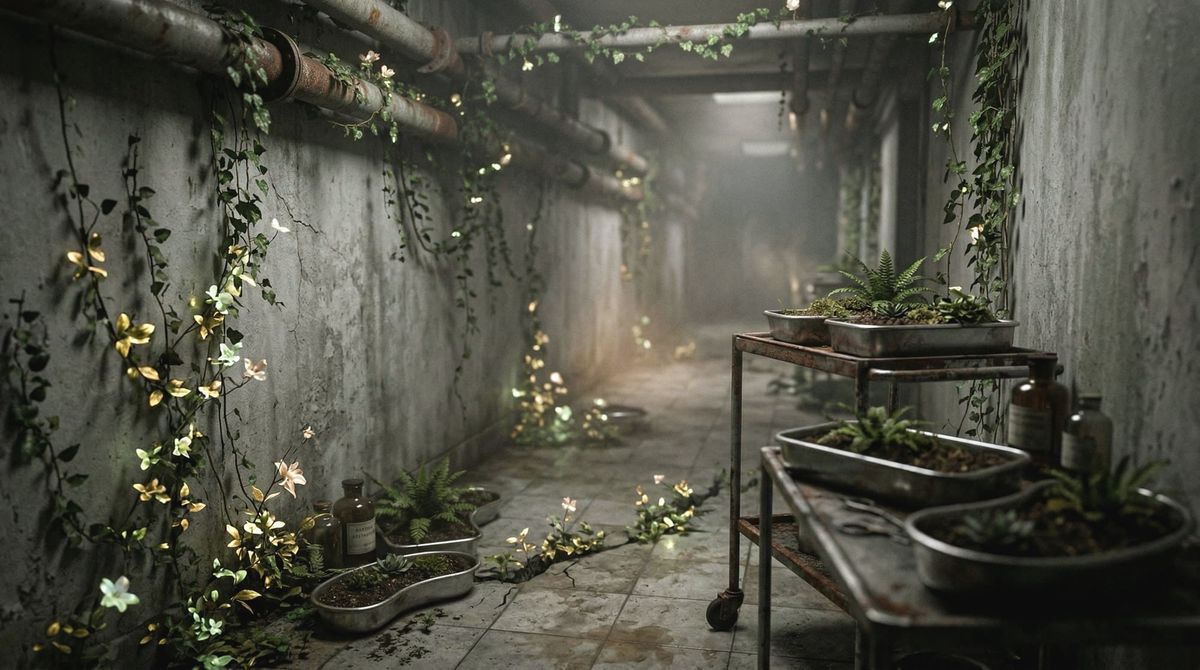
I had taken a stairwell I didn’t usually use and ended up in the lower levels of the hospital.
I saw him before he saw me, or at least before he acknowledged that he had.
He was crouched near the wall, not doing anything immediately recognizable as work, his attention focused on something small, living and low to the ground.
I moved forward without thinking, curiosity pulling me closer.
There, near his hand, was a small, unfamiliar presence. It was a fox-like creature no larger than a cat, its body composed of soft green textures and root-like filaments.
The odd creature had a verdant glow that shifted as it moved.
“What is that?!” I gasped.
It looked up at Elior, then at me, and then it slipped behind a pipe and disappeared.
I blinked, certain for a moment that I had misinterpreted what I saw, that fatigue had finally started distorting things for me.
Elior stood slowly, as though nothing unusual had occurred.
“Miss Nellie, you shouldn’t be down here,” he said, though without any real urgency.
“I should be saying the same to you.” The words slipped out before I could stop them. My brain was melted, I didn't know how to process the sight before me. The strange fox-like creature and Elior's composed nature at this time of night.
“This area is maintained,” he added.
“By you?”
“Yes.”
I glanced around, taking in the dim expanse and the hum of distant machinery.
I couldn’t articulate the strangeness of my environment.
“It doesn’t look like part of your shift,” I said lightly.
“It is adjacent to it,” he said.
That answer, like most of his, didn’t quite resolve, but it didn’t feel wrong either, just slightly misaligned with the way things were usually explained.
“Right,” I said, nodding as though that clarified something. “You just know the area.”
“Yes.”
I hesitated, then added, “I saw that creature.”
He watched me for a moment, his gaze steady but not probing.
“What was it?” I asked.
“A small moss familiar,” he said. “It assists with growth.”
He said it so matter-of-factly that it felt easier to accept than to challenge.
“What,” I said, because I didn’t have a better response than that.
“You're not normal,” I said, not entirely sure why I said it, only that it felt closer to the truth than anything else I had asked.
“This structure was built around a special place that required oversight,” he said carefully, dismissing my words entirely.
“And let me guess, you’re the oversight?”
“Yes.”
I then received this urge to pull me back into the part of the night that followed protocols and charts and things I could explain.
“I should get back,” I said.
“Yes.”
I turned to leave, then paused, glancing back at him.
“Whatever that was earlier,” I said, meaning the vial and the patient, “was miraculous.”
He didn’t respond immediately, and when he did, his voice was softer than I had heard it before.
“It was what he needed,” he said.
I nodded, accepting that in the same way
I had accepted everything else.
As I made my way back upstairs, the hospital settling once again into its familiar rhythm, I couldn’t shake the sense that something just beneath it all was being taken care of and reserved for special cases.
And for reasons I didn’t yet understand, I trusted that whatever he was doing down there… it was the reason some patients got to stay.
You’ve reached the end of this story.
But not the end of the world it belongs to.
New stories appear regularly.
Stay curious.
If you want more stories like this, explore the full Petalstorm Press library → HERE
© Petalstorm Press — Original Fiction
This story is part of the Petalstorm Press library.
Redistribution or reproduction without permission is prohibited.
All stories shared through Petalstorm Press—and the channels linked here—are the official home of this work. Any versions found elsewhere are not authorized unless clearly noted.