Where the Pool Meets the Sea
At the edge of an infinity pool, where saltwater and still water blur together, a woman discovers something beneath the surface that refuses to remain hidden.
A Short Story by Mila Meraki
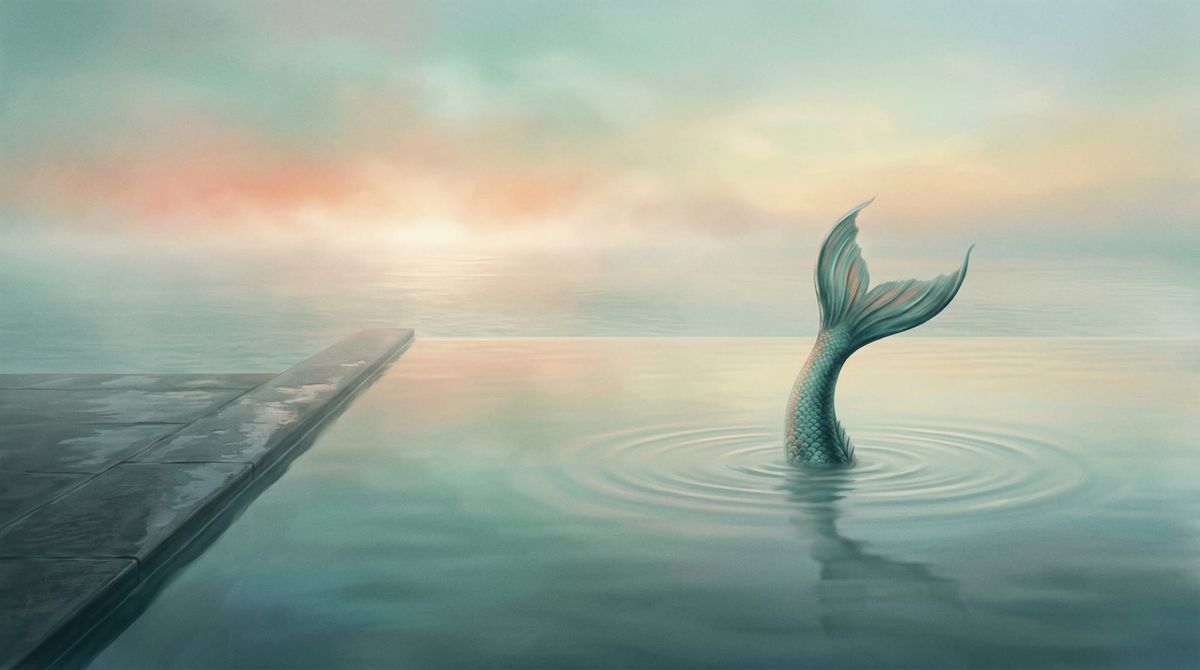
The hotel pool was designed to imitate the infinity of the sea itself.
From the terrace, it appeared as though the water dissolved seamlessly into the Atlantic beyond—chlorine surrendering to salt and tile giving way to sand.
People loved the illusion created between the pool and the sea.
Spring breakers drifted lazily between pool and sea, bronzed limbs glistening against the Florida sun.
Champagne flutes were abandoned along the edge, sweating themselves into translucent halos against the stone, while laughter danced through the air in bright, careless bursts.
A group of college-aged vacationers had formed a loose circle, counting down loudly before tipping cans back in unison, beer spilling freely over their hands as they cheered at nothing in particular.
Marley was seated at the edge with her legs submerged in the shallow end. She watched rather than participated, her eyes lingering not on the bodies or the music, but on the place where the pool met the sea, where the ocean began.
Contact
She saw him on the second night of her vacation.
He was a disturbance in the water, like the ocean had experienced a glitch and then recalibrated. His silhouette popped out in the distance, but never long enough for Marley to make out his shape.
She returned the next day and the next, looking out into the sea, hoping to catch a glimpse.
By the third evening, she had begun to suspect she was being observed.
The feeling was not unpleasant. It reminded her, oddly, of being in a museum alone, of standing before something ancient and realizing it might be looking back.
On the fourth day, she saw the fin.
It broke the surface of the shining ocean. The appendage caught the light in radiant shards—iridescent and ethereal. With a splash, it disappeared almost immediately, leaving only that brief shimmer behind.
But Marley had already leaned forward.
She entered the seawater that evening without hesitation, though her pace remained measured, her movements cautious in a way that might have seemed timid to an outside observer.
The ocean met her gradually, alive in ways the infinity pool could never replicate.
The sand shifted beneath her feet, pulling and settling in slow, tidal yanks, as though the ground itself could not decide whether to hold her or release her.
She went deeper.
And then—he surfaced.
Meeting Indigo
His form was vaguely human in structure, but the resemblance dissolved upon scrutiny, replaced by intriguing details that resisted categorization.
The texture of his skin—if it could be called that—caught the fading light in fragmented reflections, like glass that had been shattered and then meticulously reassembled. It was something in between human flesh and scales.
Along his collarbone, his hair drifted around like weightless strands—white, or something close to it, like seafoam caught in suspension—softly undulating with the movement of the water.
When he tilted his head, Marley caught the uncanny gleam of his eyes, slit slightly like a cat’s, reflective in a way that did not belong to anything terrestrial.
His fingers tapered into subtle, retractable points, as though they had been designed to cut through resistance without effort.
Marley did not move.
His eyes lingered on her, as if waiting for something.
“Hi,” she said nervously.
He tilted his head and whispered into the water.
“Indigo.”
Marley blinked in surprise.
“Is that your name?”
“Yes.” He answered with a shaky voice.
She smiled, though she was not entirely aware of doing so.
“Marley.”
He repeated it, slower, careful with each syllable.
“Mar…ley.”
The way he said it made her acutely aware that no one else on that beach, or in her entire life, had ever spoken to her like that.
A Distance Maintained
He always kept his distance. It became clear, over time, that he was not merely cautious.
Marley began to return at the same hour. She would get close enough to speak and to observe. But never close enough to touch.
He was shy.
Not in the human sense of social discomfort, but in a more profound way—as though being seen was a condition he had not yet learned to endure.
“You come here,” he said once, voice barely disturbing the surface tension of the water, “every day.”
Marley nodded.
“So do you.”
He looked away, almost embarrassed. She laughed for a second at his flustered face but then turned serious.
“You’re not supposed to be this close, are you?”
Indigo’s gaze shifted downward, toward the water itself, as though the answer existed somewhere beneath it.
“No,” he said eventually.
“Then why are you?”
“There were more of us, once… I don’t see them anymore.”
“Others like you?”
“Yes. I’m not meant to be alone… but I’ve been for a while.”
“Did something happen to them?”
He didn't answer and swam back underwater.
Marley exhaled and called it a day.
The Unmarked Vessel
A strange boat anchored farther out than usual—sleek, dark and unmarked. It did not belong to the casual chaos of spring break.
The sea was peppered with jet skis, small boats and luxurious yachts. In the midst of all those, it stuck out like a sore thumb. Where other vessels radiated indulgence, this one emanated intention.
Marley asked around the hotel but no one knew anything.
That night, when Indigo surfaced, she gestured toward the far blue distance.
“Do you see that?”
He followed her gaze and his body shifted in the water. A tension entered his posture, a coiling awareness that had not existed before.
“We should not speak,” he said.
Marley frowned. “Why?”
“They are searching.”
Her stomach dropped.
“For what?”
Indigo hesitated.
“For me.”
“Who are they?” she asked, her voice lower now.
He glanced again toward the boat.
“Those who map the sea,” he said, the phrasing strange, archaic, “and believe that what they find belongs to them.”
The Commander
Marley noticed the shift before she understood it. The beach had not emptied—vacations rarely allowed for such abrupt evacuations—but something in its rhythm had been interrupted.
There were new figures along the shoreline that did not fit in with the sun-warmed young bodies that came here for leisure.
They wore muted tones—charcoal, slate, ocean-dulled blues—and moved with a coordination that belied the illusion of independence.
At first glance, they dissolved into the landscape with unnerving efficiency—positioned just beyond immediate attention, their spacing intentional, their presence calibrated to be overlooked rather than concealed.
Marley watched from beneath the shade of a linen umbrella, her sunglasses acting as both shield and vantage point, her attention narrowing despite herself.
In the beginning, she attempted to rationalize them—marine researchers, perhaps, or a privately funded survey team—but the equipment they carried made her reconsider her assumption.
Sleek instruments emitted intermittent pulses that caused the water’s surface to quiver in subtle, unnatural ripples.
Others were stationed along the sand, partially embedding devices that seemed to listen rather than broadcast, their function obscured but their intent unmistakable.
At the center of this operation stood a man.
Commander Dorian Irving.
Marley did not know his name, but she recognized authority when she saw it. He held the aura of someone accustomed to being obeyed without question.
He stood slightly apart from the others. There was no wonder in his gaze as he stared out into the sea, just calculation.
A subordinate approached him, speaking in low, measured tones, the words indistinct beneath the ambient sound of waves and distant laughter.
Dorian listened without interruption, his expression unchanged, his attention fixed not on the speaker, but on the waterline—as though whatever information he received was merely confirmation of something he already knew.
“Thermal variance?” he asked.
“Yes, sir. Intermittent. Not consistent enough to track a school.”
“Of course not,” Dorian replied.
His voice carried a peculiar quality—measured, articulate, each word came out with clinical precision.
He stepped forward, closer to the shoreline, the tide reaching toward his boots before retreating again, hesitant, as though unwilling to commit.
“Deploy the secondary array,” he said. “Widen the net. They don’t travel alone.”
The subordinate hesitated, just slightly.
“Sir, with respect—if this is a singular specimen—”
Dorian turned his head.
“Nothing in the ocean is singular,” he said, his tone devoid of impatience.
“Especially not the ones with fins.”
The words settled with quiet weight.
Marley felt something in her spine tighten.
“They are adaptive,” Dorian continued, almost contemplative now, his gaze returning to the water. “Elusive by design.”
He crouched briefly near one of the embedded devices, adjusting its position with careful precision, as though tuning an instrument only he could hear.
The device emitted a low hum and the water responded.
“For years,” he said, not turning, though the statement seemed directed at the team behind him, “we’ve treated these sightings as folklore—misidentified fauna, optical illusions, collective fabrication.”
A pause.
“That was our first mistake.”
He glanced once more at the glittering divide.
“And now,” he continued, his voice lowering by a fraction, “we correct it.”
Marley’s breath slowed, though her pulse did not. She understood with chilling clarity the world that Indigo faced.
Marley's Vantage Point Foiled
Dorian Irving did not look at her immediately.
He finished speaking with the subordinate beside him, his attention lingering on the horizon a fraction longer than necessary, as though concluding a thought that had nothing to do with the present moment.
Only then did he turn—smoothly, without haste—and begin walking in her direction.
His path curved just enough to make it seem like a coincidence. By the time he reached her, it would have appeared—at least to anyone less attentive—that he had simply chosen a place to stand.
Marley kept her posture loose, her gaze angled toward the water, though she was acutely aware of the way his presence altered the space around her.
“Enjoying the view?” he asked.
His voice was composed, low, and impeccably controlled—each syllable articulated with the kind of care that suggested habit rather than effort.
Marley glanced up, allowing a polite, almost absent smile to form.
“It’s hard not to.”
“Of course,” he said, following her gaze out to sea. “People come here for that exact reason.”
Then, almost casually—“You heard us earlier.”
Marley felt the smallest tightening in her chest, though her expression didn’t shift.
“Hard not to,” she echoed lightly. “You’re not exactly subtle.”
A flicker of something passed through his expression—approval, perhaps, or quiet amusement.
“An occupational hazard,” he said.
He turned his head slightly then, his attention settling fully on her for the first time.
“We’re conducting a naval exercise,” he continued, tone even, almost rehearsed in its clarity.
“Pattern recognition, anomaly detection. The kind of thing that sounds more dramatic when overheard out of context.”
Marley let out a small breath of laughter.
“So you’re not actually hunting… what was it—” she tilted her head slightly, feigning recall, “—‘the ones with fins’?”
For the briefest moment—he smiled.
“Not in the way it sounded,” he said.
His gaze lingered on her a second longer than necessary, as though measuring the effect of his words.
“Although,” he added, “I find people tend to hear exactly what they’re prepared to believe.”
Marley held his eyes, matching his composure with calm confidence.
“And what do you think I’m prepared to believe?” she asked.
“That depends,” he said softly, “on whether you’re observing… or participating.”
He straightened slightly, the moment dissolving as cleanly as it had formed.
“In any case,” he continued, returning his attention to the shoreline as though nothing significant had occurred, “you’re perfectly safe.”
Something about the way he said it made the assurance feel less comforting than intended.
Then, almost as an afterthought—
“You have a good vantage point,” he added, his tone shifting just enough to suggest something lighter—almost conversational, almost charming. “If you notice anything… unusual…”
His eyes flicked back to hers, followed by a small wink.
“I’d be very interested to hear about it.”
And then he moved on.
Dorian Irving moved on as though the conversation had been inconsequential.
As though she had been.
Marley stayed seated beneath the umbrella for several minutes after he disappeared into the loose formation of his team, her gaze fixed on the water though she no longer saw it in the same way.
The facade—the carefully constructed serenity of the resort, the soft music drifting from hidden speakers, the vacationers slipping between pool and sea—had blurred.
Looking for Something Rare
That night, Indigo did not come.
The absence settled into Marley like a persistent ache, one she tried not to think about. She remained by the water longer than she intended, the tide slipping in and out with mechanical indifference.
She returned to her room and rested.
At 4:03 AM she woke up.
The world felt suspended.
The pool, viewed from her window, bathed in low blue light.
It looked less like a place designed for leisure.
The scene almost resembled an underwater city, submerged like a structure that had always belonged to the ocean but had been temporarily lifted from it.
She went downstairs and headed towards the pool. Her footsteps slapped against the wet tile as she approached the edge, her gaze instinctively drawn to the deep end.
Marley stopped when she saw that he was in the pool.
Indigo hovered just beneath the surface, his body bobbing in the artificial water.
“You left the sea,” Marley said softly.
He looked at her.
“I wanted to see,” he replied, “what holds you.”
She smiled and stuck her feet into the shallow end.
“It’s just a pool.”
He tilted his head.
“It is very small,” he said, as though puzzled.
Marley stepped closer, stopping just before the depth shifted beneath her feet.
“They’re looking for you,” she said.
“I know.”
“You need to go farther out.”
“No.”
“Why? Aren't you worried they'll find you?”
Indigo’s gaze lingered on her, his expression difficult to decipher, caught somewhere between uncertainty and something he did not have the language to articulate.
“Because,” he said slowly, “I do not understand leaving without seeing you again.”
The words landed with a devastating tone.
Marley swallowed.
“You might not get another chance if you stay,” she said.
“I know.”
“Then you have to go.”
On the other side of the hotel, there were sounds of footsteps and voices.
Indigo’s entire body shifted, instinct threading through every movement, sharper now, more urgent.
But he did not leave immediately.
“Marley,” he said.
“Go,” she whispered.
He vanished beneath the surface of the pool itself, his form dissolving into the artificial depths.
Marley forced herself to move, stepping back, pulling her expression into something neutral. She was ready to fabricate a story.
Two drunk vacationers rounded the corner, laughing, one holding another in his arms. One of them glanced at the deep end of the water. Then they moved on, without a care in the world.
Marley exhaled.
Indigo resurfaced only enough for his eyes to meet hers.
Then, with a serpentine motion, he was gone.
Missing Indigo
The weird boat was gone by morning along with its men it carried.
Whatever operation had briefly occupied the shoreline dissolved with the same unsettling efficiency with which it had arrived.
The beach had returned to itself.
Ravenous laughter resumed and tropical music reverberated through the sand and water. Bodies moved between pool and ocean as though nothing had ever been at stake.
Marley stood at the edge of the water longer than she needed to, applying sunscreen lazily. She couldn't get Indigo out of her thoughts.
The ocean stretched before her, vast and impenetrable, its surface offering no indication that anything extraordinary had ever existed within it.
He did not come back for the remainder of her vacation, so she left two mornings later and headed north.
The drive home felt longer than it should have, the coastline unfolding in familiar repetitions—gas stations, beach access points, weathered signage bleached by sun and salt.
It was the same ocean, technically. The same body of water stretching endlessly along the shore.
Marley told herself, more than once, that what had happened was contained and localized to that strip of the beach.
Maybe it was something about the magic of the infinity pool and the illusion of boundaries dissolving—the structure that had allowed the impossible to happen.
She was back in the ordinary version of the world.
The weekend after, she went to her local beach.
Where she lived there were no trendy bars and no loud music. Just the sound of the tide pulling in and out with clear, unembellished rhythm.
Marley walked barefoot across the sand, the grains cooler here, finer, shifting more subtly beneath her weight.
The ocean looked darker here, without the artificial lights of the hotel or that blinding Florida sun.
She stood there for a while, staring out into nothing in particular, trying not to expect anything at all.
Because expecting anything often meant disappointment.
What the Water Connects
When she decided to head back to her car, she heard a whistle coming from the sea.
Indigo rose up from the water like a response to a miraculous wish.
His eyes found hers immediately.
“I followed.”
Her heart stuttered as she approached the sea.
“You—what? How?”
Indigo glanced out toward the horizon briefly, as though orienting himself, then swam in her direction.
“The water does not divide the way you think,” he said, hovering closer, voice low, careful with each word.
“It connects.”
Marley let out a small, disbelieving laugh, though it trembled at the edges.
“You just… found me?”
Up close, she could see the fine tension in his hands again—the restrained flex of his claws, as though proximity to her required a kind of control he was still learning.
“Remember when you told me about the beauty of this place called North Carolina?”
He approached closer.
“I do. I still remember you telling me about your home as well.”
His smile was dazzling, face filled with crystal-like iridescence.
The simplicity of it did something irreversible to her.
“These are places I cannot bring you yet,” he said quietly.
She stepped forward without thinking this time, the water rising higher along her legs, the distance closing before she could second-guess it.
“That may be so, but you shouldn’t be this close again,” she said, though there was no conviction behind it now.
Indigo didn’t move away.
“They are not here.”
“Not now,” Marley said. “But they could be.”
He considered that.
She could see it—see the way his mind moved through possibility differently than hers, less constrained by fear, more anchored in instinct.
“Then I will leave when they show up,” he said.
Her chest tightened.
She smiled despite herself.
The space between them lingered for a moment longer.
Then—Marley lifted her hand.
This time, she didn’t stop herself.
She reached the final inch and her fingers brushed his shoulder.
Marley let her hand rest there for a fraction longer than necessary before pulling it back.
“You’re getting more comfortable,” she said.
Indigo looked at her.
“So are you.”
The tide shifted around them, the water moving in slow, continuous rhythm, as though the ocean itself had accepted the adjustment.
Marley glanced out across the dark horizon, then back at him.
“Wow,” she said, almost to herself.
Indigo tilted his head.
“What does this mean? Wow?”
She laughed.
“We’ll figure it out.”
He didn’t disappear immediately this time.
And when he finally slipped beneath the surface, it wasn’t like before.
Marley stayed at the edge of the water long after he was gone, the ocean stretching endlessly before her, collecting seashells before the ride home.
And when she finally turned to leave, she didn’t feel like she was walking away from anything at all.
You’ve reached the end of this story.
But not the end of the world it belongs to.
New stories appear regularly.
Stay curious.
✦ Related Reading & Themes
This story explored:
the boundary between the known and the unknowable
the pull toward something unfamiliar & the instinct to step closer rather than away
loneliness and the risk of choosing connection anyway
the difference between watching and being seen
trust formed through presence, not promises
the way environments shape connection—what is allowed in one place, and forbidden in another
the ocean as both barrier and bridge
Tags for similar stories:
coastal fantasy, liminal romance, ocean mythology, merman romance, supernatural romance, atmospheric fiction, soft fantasy, magical realism, slow burn connection, character driven fiction, introspective fiction, quiet tension, ethereal storytelling, dreamlike fiction, seaside setting, forbidden proximity, otherworldly connection, soft paranormal, cinematic storytelling, subtle suspense, longing and restraint, emotional fantasy, minimal dialogue fiction, immersive atmosphere
✦ If You Liked This Story
You might also enjoy:
Bound by the Siren's Coin - A hidden coin in a Florida spring awakens a long-dead pirate bound by a siren’s curse. As the water begins to call to her, Uma must decide whether to break the tether or lose herself to it forever.
If you want more stories like this, explore the full Petalstorm Press library → HERE
© Petalstorm Press — Original Fiction
This story is part of the Petalstorm Press library.
Redistribution or reproduction without permission is prohibited.