A Perfectly Inefficient Rivalry
A competitive college trivia tournament brings two brilliant rivals face to face. A short story rivals-to-lovers romance filled with wit & soft tension.
A Short Story by Polly Pinwheel
“Welcome to the Spring Crown,” the host said, smiling. “Let’s begin.”
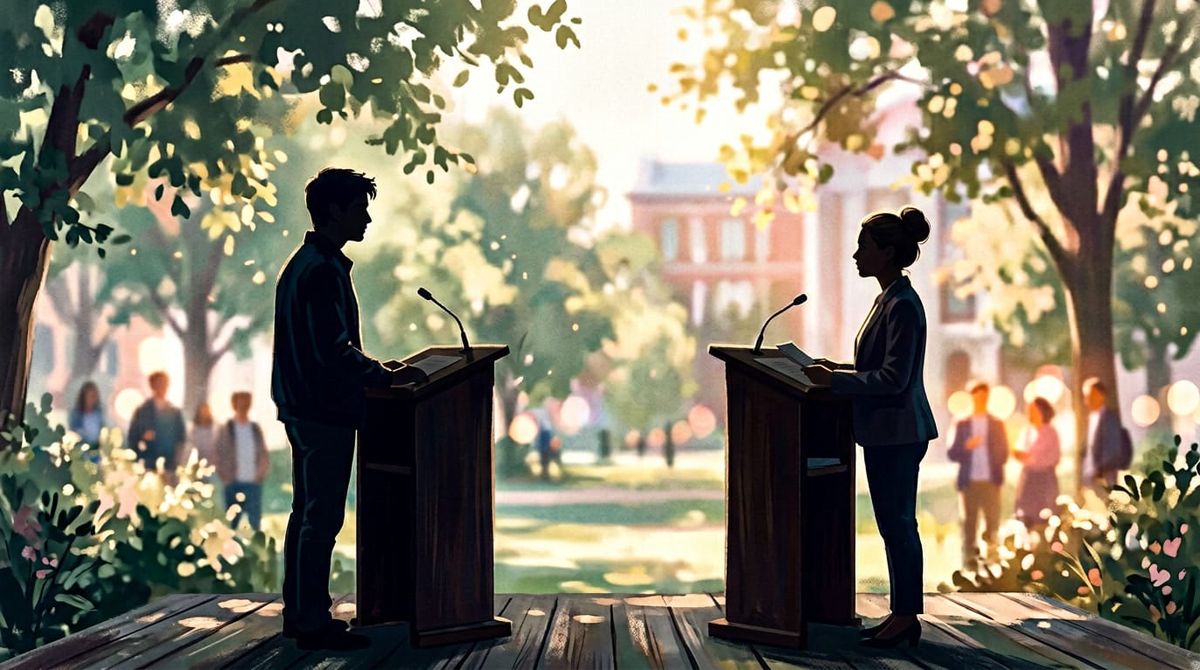
By the time Melody's name was called, she had already decided that the lighting on stage was too glaring for optimal visibility, and that the returning champion—who stood at the far podium—was going to be intolerable in a way that would raise her blood pressure.
The quad had been transformed for the event. Folding chairs were arranged in lines, and colorful banners strung between trees. The stage was constructed to inspire confidence. A scattering of early spring blossoms drifted intermittently through the air.
Before her name was called, she sat on a folding chair, flipping through large flashcards.
Beside her, Sasha shifted in her chair.
“It’s kind of pretty,” Sasha said softly, glancing at the stage, the trees, and the spring decor of the entire setup.
“Sure,” Melody replied, adjusting the small strand of hair that had escaped from her bun for what was now the third time.
“The seating arrangement suggests a disregard for visual hierarchy, which becomes problematic in later rounds where prompt clarity is important.”
As usual, Sasha nodded because Melody spoke with a certainty that discouraged contradiction.
“You’re still going to win,” she added, after a moment.
“I am statistically favored,” she responded with a wink and continued to flip through the cards.
A few rows ahead, two students leaned toward each other, their voices lowered but not nearly enough.
“That’s her,” one of them said. “She cleared the bio bracket in like… three rounds.”
“No way.”
Melody did not react, though she heard every word, filing it away as noise she would eventually have to outgrow.
Across the rows, Fletcher laughed. His posture relaxed as if he held a profound misunderstanding of the stakes.
His best friend, Kip, was leaning back in his chair with an almost artistic disregard for posture, scrolling on his phone with intermittent interest, occasionally glancing up just long enough to make a comment that suggested he found the entire event amusing.
“Bro,” he said, not bothering to lower his voice, “you better not lose this. You got that big ass brain and it'd be a waste.”
Fletcher smiled mischievously.
“Nahh,” he said. “I won't lose to Bunhead over there.”
Fletcher noticed her at the exact moment she stepped into place. He approached the podium with practiced confidence.
Their eyes met and they both arrived at the same conclusion.
Annoying.
Inefficient, he thought, though not without a flicker of appreciation he immediately chose to ignore.
She, meanwhile, had already identified the eyebrow piercing, a small metallic interruption that disrupted an otherwise symmetrical face in a way she found both unnecessary and, irritatingly, not entirely ineffective.
Unjustified, she thought, with immediate disapproval.
They held each other’s gaze for a fraction longer than necessary, then they both looked away, as though the moment had not occurred.
The host walked back to center stage, smiling as the contestants took their places.
The First Half of the Tournament
The board lit up.
Categories:
Rivers of the World
Famous Last Lines
Championship Records
Spring Bloom
Film in Focus
“Something wrong?” Fletcher asked, his tone light, his posture fixed forward as though the question had nothing to do with her, which of course meant that it had everything to do with her.
“Not at all,” Melody replied, already identifying three categories she would dominate and two she would endure, her fingers resting lightly near the buzzer. “I was simply evaluating the distribution.”
“I’m sure you’ll adapt,” he said.
The host, sensing something far more entertaining than trivia unfolding between them, cleared his throat.
“Rivers of the World for four hundred points.”
The clue appeared, but Melody barely needed it, because she had already anticipated the trajectory of the category the moment it had been revealed, which was precisely why it irritated her when Fletcher’s buzzer sounded a fraction of a second before her own finger moved.
This river, the longest in South America, flows through the Amazon rainforest and discharges more water than any other river on Earth.
He moved first, as expected.
“The Amazon River,” he said, with cool confidence that suggested not just certainty, but familiarity, as though the answer had been waiting for him rather than the other way around.
“Correct.”
Melody inclined her head slightly, not in acknowledgment, but in recalibration, because now she knew something about him that mattered: he moved fast, perhaps too fast, and people who moved fast often mistook momentum for accuracy.
She pressed her buzzer on the next question before the final word finished appearing, not because she needed to, but because she wanted him to notice that she could.
This flowering plant, often associated with renewal, produces bulbs that can remain dormant underground for years before blooming in early spring.
“Tulips,” she said.
“Correct.”
Fletcher did not look at her, which she found predictable and therefore disappointing.
“Spring Bloom for six hundred,” she said, selecting the category with preference instead of strategy, though the distinction, in her mind, was negligible.
The clue shifted, and this time she watched him openly, because there was no reason not to.
This plant, known for its rapid growth, can be invasive in certain ecosystems and is often used as a metaphor for resilience despite adverse conditions.
He buzzed too quickly and hesitated.
Melody tilted her head slightly, just enough for him to notice, just enough to suggest awareness without commitment.
“Bamboo,” he said, the word arriving with a trace of uncertainty he could not fully disguise.
“Correct.”
Melody exhaled, unimpressed.
Fletcher, despite himself, let out a small breath of relief.
“Lucky guess,” she said.
She did not believe it had been entirely luck, which made it worse, because partial uncertainty combined with confidence produced a type of player she found disproportionately difficult to predict.
The host moved on quickly, though not before glancing between them with undisguised interest.
“Famous Last Lines for eight hundred.”
The board shifted again.
In F. Scott Fitzgerald’s The Great Gatsby, the final line reflects on humanity’s struggle against time, ending with this phrase.
He didn’t even wait for the full clue.
“So we beat on, boats against the current, borne back ceaselessly into the past.”
“Correct.”
“You probably didn't even read the book.” She muttered.
The host was visibly enjoying himself now.
“Film in Focus for four hundred,” Fletcher said.
The clue appeared.
This 1997 film won eleven Academy Awards and helped turn a Celine Dion ballad into a cultural phenomenon.
Melody pressed her buzzer with confidence that lasted exactly one second too long.
The audience leaned forward in a manner that audiences do when they sense something fragile, something on the verge of either triumph or collapse.
She lowered her hand.
Shit. Too slow.
Fletcher pressed his buzzer gently, almost kindly, which somehow made it worse.
“Titanic.”
“Correct.”
He glanced at her, and this time, the devious smile was unmistakable.
“Wow,” he said, just loud enough for her to hear, “are you even trying, buns?”
She turned her head, meeting his gaze fully for the first time.
“You are, without question, the worst kind of person.” she said.
He laughed.
The game continued, the board changed, the scores adjusted, but beneath it all ran a current of attention that neither of them acknowledged and neither of them escaped, each glance carrying more weight than it reasonably should have.
He buzzed faster when she watched.
She waited longer when he expected her to rush.
And by the end of the round, it was no longer a matter of who was winning or losing.
Break Time
The break arrived as a short reprieve.
Melody sat on the folding chair next to Sasha. She let out a loud groan of frustration, which made Sasha jump at the sudden sound.
One question.
He was ahead by one question.
It was not, in any way a decisive margin or an indication of defeat. Regardless, the existence of that gap lodged itself in her mind like a burrowed tick in her ear.
“I’m fine,” she said, before Sasha had the opportunity to speak, her voice composed, her posture unchanged, her grip on her flashcards just slightly tighter than necessary.
Sasha blinked.
“But I didn’t say anything,” she replied gently.
“You were about to.”
“I was going to ask if you wanted water.” Sasha tilted her head.
“Not thirsty. Thanks though.” Melody's face was glued to the flashcards.
Sasha nodded, though her attention had already moved, her gaze drifting past Melody’s shoulder, noticing something she suspected would become relevant.
“Oh no,” she said softly.
Melody did not turn immediately.
“He’s coming over,” Sasha added.
Melody exhaled once, before setting her cards down with care and turning.
Fletcher approached with an unhurried ease, his attention already fixed on her in a way that suggested this interaction had been inevitable.
Kip followed beside him, his posture loose, his expression openly entertained, as though he had recognized the dynamic unfolding between them several minutes ago and was now simply waiting to see how far it would go.
“Buns,” Fletcher said, stopping just within conversational range, his tone honeyed, as though he had chosen the word for its effect, “I didn’t realize selective non-response was part of your strategy.”
Melody turned fully now.
“If you are referring to the film question,” she said, her voice even, each word placed with intention, “it was a momentary lapse in intellect.”
Kip made a sound that could only be described as delighted disbelief, his eyebrows lifting as he glanced between them.
“That is,” he said, shaking his head slightly, “such a weird way to say that you blanked on Titanic.”
“I did not blank,” Melody replied, without looking at him, her attention remaining fixed on Fletcher. “I rejected the premise.”
“You rejected a question,” Fletcher responded slowly, as though testing the phrasing, “in a competition defined by answering them.”
“I rejected the assumption that recognition equates to knowledge.”
Sasha, who had been standing just behind Melody, leaned slightly toward Kip, her voice barely above a whisper.
“They’re arguing,” she said.
Kip shook his head immediately.
“No way,” he said. “They’re doing something much worse.”
“What’s worse than arguing?”
“Thinking this isn’t flirting.”
Sasha blinked.
“Oh my.”
Melody, who had heard just enough of that exchange to register its existence, chose not to respond and continued to banter with Fletcher.
“I am not concerned with movies.”
“You should be,” he said lightly. “They seem to be a recurring blind spot.”
“I bet you've never even read the Great Gatsby,” she said, without missing a beat.
“Still got the question right.”
They all moved to a cluster of tables.
Melody sat first, her posture aligned and her attention returning to the cards she had spread across the table.
Fletcher sat across from her, uninvited but not unexpected.
Kip leaned back beside him, entirely at ease, while Sasha remained just to Melody’s side, her presence meek but attentive
No one spoke for a few minutes.
“You know,” Fletcher said eventually, “you could fix that.”
Melody’s hand, already halfway to her hair, paused. She did not need clarification but she wanted it.
“Fix what,” she asked.
“The strand,” he said, gesturing vaguely, though his gaze was anything but. “It keeps escaping.”
Melody exhaled slowly.
“It is temporarily uncontained,” she said, her gaze fixed on the table, as though denying him visual confirmation.
Fletcher leaned back slightly, watching her with a smirk. At this point, this had become, for him, a point of interest rather than a passing observation.
“You’re observing me,” she said, her voice narrowing slightly, as though the conclusion had been reached against her will. “Which is, frankly, unnecessary.”
“Incredible,” he murmured. “Truly incredible.”
Sasha nodded.
“I don’t think they realize.”
“They realize,” Kip said. “They just don’t agree on what it is.”
When the call came for contestants to return, the shift was immediate.
There was anticipatory tension, the audience was more attentive, and everyone was now waiting to see how it would resolve.
Melody stepped back into position.
Fletcher did the same.
Her fingers hovered near the buzzer, her focus narrowing once more, though beneath it ran something new, something she had not accounted for in her initial calculations.
The board lit up and the host grinned with delight.
New categories appeared and the sequence of questions began.
Melody answered first.
Correct.
Fletcher answered.
Correct.
Melody adjusted her timing, pressing earlier, risking more than she normally would. Her eyes fixed on him more often than the questions themselves.
Fletcher slowed, leaning into adaptation rather than dominance. He laughed to himself as her bun bobbed on her head, loosening slightly.
Clearly, they were not just competing in a trivia game anymore.
The audience leaned forward, the host’s voice carrying a note of barely concealed excitement, the energy in the quad tightening as the numbers aligned.
“It's a tied game!” The host roared.
Melody glanced at Fletcher, but he was already looking at her.
And the Winner Is
The final question arrived sooner than they both expected.
There was no dramatic shift in lighting, no orchestral swell and no planned pause designed to heighten anticipation.
This was it.
Melody felt it before the category even appeared.
Fletcher, across from her, did not move at all.
He stood with the same relaxed posture he had maintained throughout the entire tournament.
The board shifted.
Final Category: Abstract Quantitative Reasoning
A flicker of irritation surged through Melody's body. A math question was inconvenient and unwelcome at such a critical point.
Her mind was already beginning to map potential frameworks, equations, structures, with the recognition that this would require some thought, which, under pressure, introduced variables she preferred to eliminate.
Beside her, Sasha clasped her hands together with wide eyes.
“Go Melody! You got this!”
Kip leaned forward in his chair, suddenly far more invested than he had been all day.
“Dang,” he murmured. “I just know this is going to hurt someone.”
The clue appeared and Melody did not know right away.
The problem stretched across the board in dense, complicated phrasing, something involving recursive sequences and conditional transformations.
Across from her, Fletcher stilled. He saw the answer clearly but he didn't move.
In the space between knowing and acting, something else intervened, something far less logical and far more interesting.
He looked at her with a cheeky smile.
Melody was still thinking and working through the problem, her brows drawn together slightly, that strand of hair once again slipping free as though in defiance of her attempts to control it.
She was close and he could see it. Not there yet, but close enough that, given another second—she would get it.
Fletcher made a decision that he would not, under any reasonable circumstances, have been able to justify.
He didn’t press the buzzer.
Melody’s eyes flicked once, twice, the pieces aligning with sudden, almost violent clarity, the structure snapping into place in a way that felt less like discovery and more like inevitability.
She pressed.
“Two hundred fifty-six?”
There was a pause.
“Correct.”
The sound that followed was immediate, the audience reacting with a burst of applause.
“And your Spring Crown Champion is—Melody Harrow!”
Applause surged again.
Melody blinked once, grounding herself in the sound, the light, the undeniable reality of the outcome.
Beaming with pride, she stood tall bathing in the attention.
She had won.
That had always been the most probable outcome.
And yet—something was off.
Across from her, Fletcher stepped back from his podium.
“You were more accurate this time,” he said, when she turned to him, his voice calm, lacking the grating edge it had carried all day.
Melody studied him.
It took her exactly twenty-three seconds to realize.
He was at the edge of the quad now, Kip beside him, their conversation low, his posture relaxed in that same infuriating way, as though nothing of consequence had occurred.
“You let me win,” she said.
And there it was again—an impish smile that meant nothing good.
“I didn’t stop you,” he said.
“Why,” she said, stepping toward him now, her composure intact but strained at the edges. “You had the answer.”
“Possibly,” he said.
“You saw the structure before I did.”
“I saw something.”
“And you didn’t buzz.”
Fletcher held her eyes.
“Because,” he said slowly, “you were going to get it.”
Melody stared at him, the realization settling in with a clarity that felt almost physical.
“You altered the outcome,” she said.
“And that,” she added, her voice tightening, though not entirely with anger, “is unacceptable.”
Kip, who had been watching this unfold with increasing delight, leaned slightly toward Sasha.
“She’s big mad,” he said.
“Stop it, she’s flustered,” Sasha corrected.
Fletcher reached into his pocket.
Melody’s gaze followed the movement automatically, her focus narrowing as he pulled something small from the lining of his jacket, something brightly colored.
He held it out to her.
It was a gummy candy shaped like a trophy.
Melody stared at it and then at him, and then back at it again.
“This,” she said slowly, “is not an appropriate response.”
“It’s a prize,” he said.
“I have already received a prize.”
“That one’s official,” he said. “This one’s from me.”
“It is candy.” She looked to the left.
“It’s a trophy.” He nudged it closer to her hands.
“It is gelatin and artificial sugar.” She turned away.
“It is symbolic.” He grinned.
At that point, she snatched it out of his hand and her fingers brushed his in the process.
She felt a subtle heat rise up in her body that she could not explain.
Kip made a whistling sound and Sasha covered her mouth.
“This does not resolve anything,” she said, though her voice had shifted, just slightly.
“It wasn’t meant to,” Fletcher replied.
“Then what was it meant to do.”
He stepped closer and his hand moved—hesitated—and then settled lightly at her waist.
Melody froze.
“I was thinking,” he said, his voice lower now, less performative, “you should probably watch more movies.”
Her brain, which had spent the last several hours operating at a level of precision she considered optimal, ceased functioning entirely.
“That is not—” she began.
“You need the knowledge,” he continued, as though this were a logical extension of their previous argument.
“That is not how—”
“There’s a screening tonight the film students are putting on in Building A.”
“I do not—”
“You’re going.”
“I am not—”
He smiled, putting a finger on top of her nose.
“You are.”
She stared at him.
Then, without fully deciding to, she reached up and pulled the pin from her hair and the bun fell, the strands loosening around her shoulders.
The action altered the entire structure of her appearance.
Fletcher blinked.
“Wow buns,” he said.
Kip lost it, laughing hysterically at the whole situation.
Sasha laughed outright and covered her mouth a moment after.
Melody, who had not intended to do that, who had not planned for that, who had not accounted for the effect of that, stood very still, her expression caught somewhere between composure and complete internal collapse.
“This changes nothing,” she said.
“It changes several things,” Fletcher replied.
“This does not mean I am agreeing to anything,” she said.
“It means you’re considering it.”
“Nope. It means nothing.”
“It means you’re coming.”
She hesitated.
“I will evaluate the premise,” she said.
Fletcher smiled.
“That’s all I’m asking you to do.”
The Application of Knowledge
The screening was, in Melody’s opinion, an inefficient use of time.
This was the conclusion she reached approximately three minutes after agreeing to attend, twelve minutes after returning to her dorm to “prepare,” and thirty-seven seconds after stepping into the lecture hall that had been temporarily repurposed into a makeshift theater.
The dim lighting and uneven acoustics already presented several issues she intended to catalogue for later justification of why she was not supposed to be there.
“This is a mistake,” she said, not to anyone in particular, though Sasha, seated beside her with a level of anticipation that bordered on emotional investment, nodded as though the statement required validation.
“It's just a movie night,” Sasha replied.
“Sasha, consider the fact that Fletcher will be arriving soon.”
“Wasn't that the idea?”
“I hate him.”
Sasha smiled.
“You keep saying that.”
Melody did not respond.
Across the room, Fletcher entered with Kip trailing behind him.
He spotted her immediately.
Melody, who was not looking toward the door, became aware of his presence in the way one becomes aware of something persistent and pressing, her focus narrowing in response.
“You’re late,” she said when he reached her row.
“There was a line,” he said, though there had not been any.
“You should account for unforeseen variables.”
He grinned.
She turned away, as though preparing to dismiss him, then stopped because he was holding a small paper bag.
“What is that,” she asked.
“Snacks,” he said.
“What kind?”
“It's a surprise.”
“You should know that I do not like surprises.”
He reached into the bag and pulled something out. A second gummy trophy, larger than the first one.
“You are unbelievable,” she said.
Kip made a quiet choking sound from behind them, which he immediately disguised as a cough that no one believed.
Sasha covered her face.
Melody ignored both of them.
The film began. She attempted to watch while looking for patterns in the narrative.
“This is predictable,” she whispered, approximately ten minutes in.
“You’re talking during the movie,” Fletcher whispered back, leaning slightly closer than necessary.
“I am just saying.”
“You’re ruining it.”
The film continued and Melody continued to watch, her resistance gradually wearing away.
Fletcher, for his part, was not watching the film entirely. His focus was on her, while trying to not be obvious about it.
He noticed the moment her posture shifted, the slight lean forward when the plot introduced a complication she had not predicted, the way her expression changed, subtly, when a line of dialogue landed in a way that required reinterpretation.
“You’re actually paying attention,” he said quietly.
Halfway through the film, something happened that Melody had not prepared for.
She laughed and Fletcher turned immediately.
“…there it is,” he said.
“That was incidental,” she said.
She turned her head slightly, meeting his gaze in the dim light, her expression composed but her eyes… less so.
When the film ended, the lights came up slowly, and the illusion dissolved just enough to remind them where they were.
“Well,” Sasha said softly, turning toward her, “what did you think.”
Melody considered.
“I believe,” she said slowly, “that was... a satisfactory experience.”
Fletcher stood, stretching slightly, his attention returning to her in that same deliberate manner.
“So,” he said, “was it worth it.”
Melody stood as well, smoothing her hair—still down now, still uncontained, still—
“…it was,” she said.
“Good,” he said.
“Cause we’re doing it again.”
She blushed.
“You need more data.” He responded.
“I will evaluate future opportunities,” she said.
As they stepped out into the cool evening air, the quad now quiet, the banners shifting gently in the breeze, the remnants of the day settling into something softer, something less defined—
Fletcher reached for her again.
His hand settling at her waist.
Melody did not freeze this time.
You’ve reached the end of this story.
But not the end of the world it belongs to.
New stories appear regularly.
Stay curious.
✦ Related Reading & Themes
This story explored:
the tension between knowledge and understanding
the tendency to intellectualize what is, at its core, emotional
the instinct to compete, even when connection would be easier
the way attention becomes something else when it lingers too long
the difference between being correct and being seen
pride as both protection and barrier
the subtle shift from observation to fascination
how proximity changes perception
the moment a system breaks, and something less logical takes its place
Tags for similar stories:
academic rivals to lovers, college romance, intellectual romance, competitive tension, campus setting, character driven fiction, slow burn connection, witty banter, opposites in mindset, soft romance, contemporary romance, introspective fiction, quiet tension, emotional restraint, observational storytelling, subtle romance, modern setting, romantic character study, pride vs vulnerability, cinematic storytelling, internal conflict, dialogue driven fiction, understated emotional arc
✦ If You Liked This Story
You might also enjoy:
Tension on the Sales Floor - Two rival assistant managers compete during a high-stakes skate shop launch, until a chaotic theft changes everything. A rivals-to-lovers story set on the sales floor.
If you want more stories like this, explore the full Petalstorm Press library → HERE
© Petalstorm Press — Original Fiction
This story is part of the Petalstorm Press library.
Redistribution or reproduction without permission is prohibited.