The House That Made Room
When a house begins to shift and respond to emotion instead of logic, Coralie is forced to confront the cost of keeping her life controlled—and what it means to finally make room for someone else.
A Short Story by Mila Meraki
“She was the kindest woman I ever knew,” an elderly neighbor murmured beside her, clutching a checkered handkerchief with trembling fingers.
The sky above St. Augustine hung in a pale and diffused gray. It decided to mute its colors out of respect for the dead, or perhaps out of indifference to the living.
Coralie stood among a sparse congregation gathered around a modest gravesite. Her black dress clung to her skin. The spectrum of emotions inside her became too unwieldy to display in public.
The minister spoke in elongated sentences about legacy and warmth and community.
A few distant relatives dabbed their eyes with tissues, though Coralie could not say whether their grief was genuine or simply inherited along with the obligation to attend.
“She had a way of making people feel like they belonged somewhere,” someone else said.
Coralie nodded politely.
Her grandmother’s casket rested below, sealed in polished wood, containing a woman who had filled every room she entered with laughter and conversation. It was warmth that Coralie had never learned how to replicate.
When the service ended, people lingered briefly, exchanging condolences that sounded rehearsed. Then they dispersed toward their respective lives.
Coralie remained a moment longer, staring at the freshly turned earth.
“I’ll fix it, sell it, and move on,” she thought, the words forming with the same efficiency she applied to most decisions.
The inherited beach house was an asset and a responsibility to face head-on.
Or at least, that was what she told herself as she turned away.
The Squatter
The house's wooden exterior was bleached by years of salt air. Its windows reflected the restless movement of the ocean beyond.
Its foundation leaned slightly. The porch was adorned with wind chimes that sang in irregular patterns whenever the breeze decided to participate.
Coralie approached the entrance with measured steps, her suitcase rolling behind her, the mix of sand and gravel crunching beneath her shoes in a way that felt louder than necessary.
Inside, a waft of citrus and old wood tickled her nose, an odd combination given the age of the house. She stepped through the entryway, her gaze sweeping across the interior, taking note of the worn floorboards, and the mismatched furniture.
“Weird,” she murmured, more to herself than to the house. “But I suppose I can work with this.”
A raspy voice responded from somewhere deeper within.
“You say that like it’s a renovation project instead of a friendly conversation.”
Coralie froze immediately.
A slender man emerged from the adjoining room, barefoot, sun-browned.
He wore a relaxed smile and had a seashell poking out behind his left ear.
“Who are you,” she said, her voice steady but tinged with disbelief, “and why are you in my house?”
He tilted his head slightly, considering her question with what appeared to be genuine curiosity.
“I live here,” he replied, as though stating an obvious fact. “Or at least, I'm staying here. The house hasn’t objected yet.”
“So you're an opportunist,” Coralie said, setting her suitcase down with more force than necessary. “You're trespassing, and I am asking you to leave.”
“I get why you’d think that,” he said. “But the house has a say in these things.”
“The house does not have a say, you basket case,” Coralie snapped. “You are breaking the law.”
“I suppose on some level I am, but you'll find out soon enough.”
She turned toward the door she had entered through, intending to retrieve her phone and call someone who could attempt to remove him with authority.
The door was gone.
Where it had stood moments ago, there was now just wall.
Coralie stared and then she turned back to him.
“What in the world?” she whispered.
“Ah,” he replied. “That's what I meant.”
The Strange House
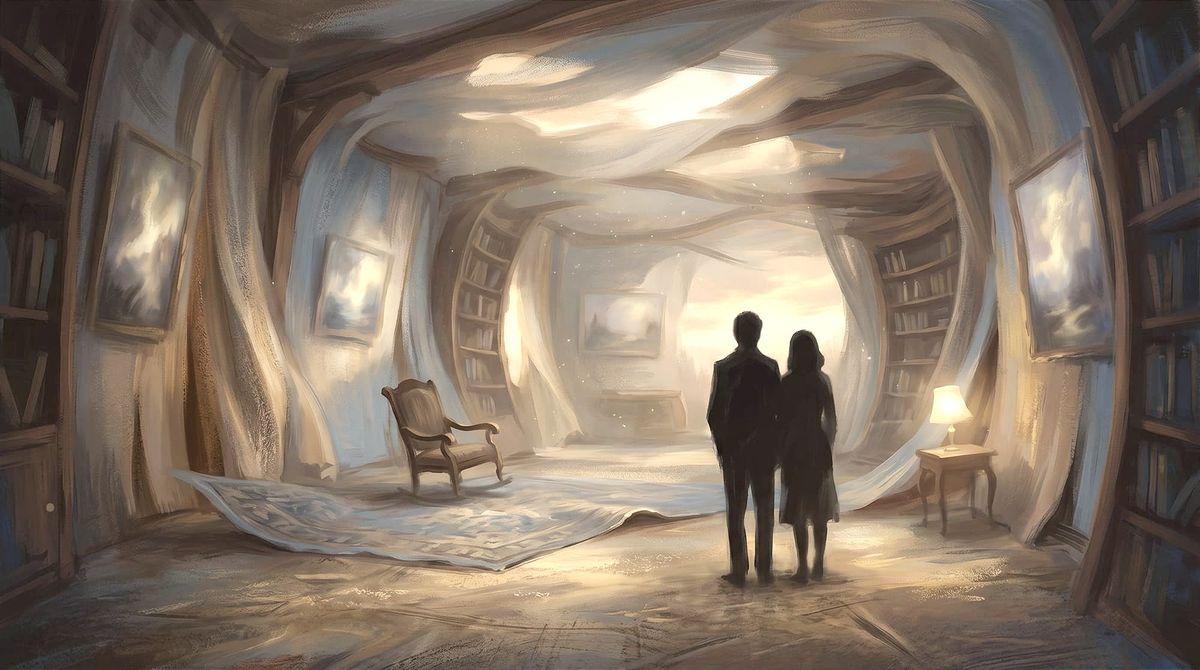
The main hallway was longer than Coralie remembered and the floorboards extended into a distance that suggested an architectural anomaly.
Or perhaps she was experiencing personal hallucination.
“This is wild,” she muttered, pacing, her hand tapping along the wall as though tactile confirmation might restore reason.
“Yep,” the man said, leaning casually against an eggshell blue doorway that had not been there earlier.
A curved window at the end of the hall revealed the ocean, though the angle suggested a vantage point inconsistent with the house’s exterior position.
Coralie turned.
“That window should be facing the street,” she said.
“It faces whatever it decides,” he replied.
She exhaled through her nose, the gesture controlled.
“I am experiencing stress-induced perceptual distortion,” she announced, as though presenting a diagnosis to an invisible audience.
“Or you slipped something into my water bottle,” she added, narrowing her eyes.
“First one is totally possible,” he said. “But I can vouch that it is indeed real. And no I did not drug you, don't be dramatic.”
She walked toward the kitchen, determined to anchor herself in something she understood.
When she reached it, her suitcase sat neatly beside the table, already unpacked, her belongings arranged neatly, organized by color and size.
Coralie stopped and stared.
“Wha-,” she said.
“Ah, yeah it does that.”
The man exhaled. He didn’t mention how the house had kept him fed in its own strange way, offering fruit bowls, clean linens, and doors that opened only when he stopped asking where they led.
She turned toward the back door and stepped through it. Moments later, she found herself standing in the kitchen again.
The Logic of the House
Coralie spent the next several hours attempting to impose logic onto the house, measuring walls, sketching layouts, marking doorframes with pencil lines that vanished when she turned away.
She crouched on the floor with a tape measure.
“Have you ever considered,” the man offered, sitting cross-legged on the counter, “that the house is trying to help?”
“It's a building,” she replied, standing abruptly. “And it's interfering with basic spatial order.”
He shrugged.
“Helping can look like that sometimes.”
Rules of the House
“My name is Hayden,” he said eventually, as though the introduction had simply taken a detour through absurdity.
“Coralie,” she replied, reluctantly.
“Nice to meet you under these architectural circumstances,” he said.
“Explain it,” she said.
He nodded as he lit up a piece of palo santo.
“From what I've experienced so far, the house reacts to emotions, not words,” he began.
“It makes space when people need it and it separates when people get overwhelmed. The poor thing doesn’t always get it right, but it does try.”
“Did you do some weird hippie magic on my grandmother's beach house?” Coralie said.
“Of course not,” Hayden replied, offended.
Connection
Minutes later, they found themselves in a small room that had not existed before, furnished with two chairs and a wicker table bearing two sparkling glasses of citrus-infused lemonade.
“I did not consent to this,” Coralie said, testing the door.
“It’ll open,” Hayden said. “Eventually.”
“When,” she asked.
“When we stop avoiding whatever it wants us to talk about.”
Coralie stared at him.
“You're serious,” she said.
“Can you just trust it for once,” he replied.
“Alright, I'll indulge it,” she groaned.
The cries of seagulls and gentle waves continued in the background as she gathered her thoughts.
“I don’t know what I’m doing with my life,” she admitted.
He nodded.
“Same,” he said. “That’s why I stayed in this place.”
She glanced at him and couldn't help but roll her eyes.
“Our situations are very different,” she stated, accusingly.
He leaned back slightly.
“Consider this. It gave me somewhere to land when I didn’t have one,” he said.
“I was walking on the beach with nowhere in particular to go. I passed this house, felt the door open behind me, and the next thing I knew, I was standing in the front hall. Just like that.”
The door opened.
Grandmother's Spirit
After the conversation, Coralie found a box of her grandmother’s belongings tucked into a corner.
Inside were photographs, letters, notes about dinners and gatherings, seating arrangements annotated with observations about who needed to sit beside whom.
She found a photo in which Coralie was younger and sitting at a crowded table while her grandmother moved effortlessly between guests. She placed her hands on people's shoulders, adjusted chairs, and orchestrated connection like magic disguised as hospitality.
“You put people where they can find each other,” her grandmother had once said.
“Sometimes that’s all it takes to connect.”
Back in the present, Coralie exhaled slowly.
“Maybe the house just… kept doing what she taught it,” Hayden said.
Coralie's Logic
“This isn’t going to work,” she said at last.
Hayden tilted his head slightly, a crease forming between his brows.
“What isn’t,” he asked, though his voice had already softened, like he already knew.
“This,” she said, gesturing vaguely.
“You being here. This insane situation. I came here to handle something real, not…”
She hesitated, searching for a word that wouldn’t unravel her composure entirely. “…whatever this is.”
“You want me to leave,” he said.
“I think that would be best,” Coralie replied, her tone mild, almost clinical.
“Right,” he said.
“If you need time to find somewhere else,” she added, the concession feeling rehearsed even as she spoke it, “I can give you a day. Maybe two. But after that—”
“I don’t need a day,” Hayden interrupted, a roughness entering his voice. He pushed himself off the counter.
“I’ll just go now. The house doesn’t object, right? That’s what you’ve been trying to prove.”
He reached the front of the house. Coralie expected the wall to be there again, expected the house to fold in on itself, to resist, to correct whatever mistake she might have been making.
Instead—the door stood exactly where it should have been.
Hayden paused with his hand on the handle, glancing back at her.
“Guess it agrees with you this time,” he said.
Then he stepped outside and the door closed behind him with a soft, final sound.
Realization
Coralie remained where she stood, her arms folding loosely across her midsection, her posture settling back into something familiar, something contained.
“Good,” she said softly. Gradually, the citrus scent and the trace of palo santo faded.
Coralie’s eyes flickered toward the kitchen, and she noticed the second chair was gone.
The table shrank to a smaller size, its surface clearing itself of the second glass, the condensation ring vanishing as though it had never been earned.
She took a step forward.
“I see,” she murmured.
The hallway shortened and corrected itself into something practical, minimal, and easily documented.
Eventually sold, of course.
The house was cooperating with her intent, giving her exactly what she asked for.
Coralie stood in the center of it, watching the house adjust itself.
“This is better,” she said again.
The words landed flatter this time.
Her own voice stretched into the space as though there were nothing left to absorb it. Coralie listened as it faded, and realized there was nothing in the house anymore that would answer back.
Her gaze drifted toward the corner where the box of her grandmother’s belongings had been. It was still there, unchanged.
She moved toward it slowly, crouching, her fingers brushing over the edge before lifting the lid again.
The photograph sat exactly where she had left it.
Her grandmother, mid-motion, hands resting on the backs of chairs, guiding people closer together with the kind of certainty Coralie had never trusted herself to have.
“You put people where they can find each other.”
She stared at it longer this time.
Her grandmother had not waited for connection to feel safe or even ready.
She had made it happen.
Even when it was inconvenient, uncertain, and when it would have been easier to keep everything distant and controlled.
Coralie exhaled slowly.
The realization settled fully this time, not as a question, but as something far more inconvenient. The house hadn’t chosen Hayden. She had.
And then she had undone it, because it was easier.
She stared at the photograph for a few more seconds before she set it back into the box with more care than she had shown before.
“I should—” she started.
Recognition
She crossed the house quickly. Her footsteps lost their cadence, and her hand reached for the door without hesitation.
When she pulled it open, the salty outside breeze rushed inside.
Hayden was already near the end of the block, his path set in a straight, unbroken line toward the road.
“Hey,” Coralie called.
He didn’t stop.
“Hayden.”
That made him slow down—but not turn fully.
Coralie stepped off the porch, the uneven ground forcing her forward faster than she intended.
“I'm sorry,” she said.
“What?” he said.
“I told you to leave because it was easier than figuring out what to do with you being here,” she continued. “And that was—” she exhaled, frustrated with the limitation of the word. “—short-sighted.”
He stood and listened.
“I don’t know what this house is doing,” she said. “And I don’t know what I’m doing either. But I do know that sending you away because it’s inconvenient is not the same thing as making the right decision.”
She held his gaze now.
“So please stay,” she said. “Not because the house says you can. Because I am asking you to.”
“Alright,” he said finally, and he turned back toward the house.
When he reached for the door, he stopped.
Coralie gasped. The door was gone—replaced by a smooth wall.
“I want him here,” she said, and this time she meant it.
The wall shifted beneath her palm and the outline of a door reappeared, the handle forming last.
A Room for Two
That night, the house rearranged itself again to accommodate two.
The citrus scent returned.
Coralie noticed each change.
Across the living room, Hayden leaned back in a different chair that had not been there that morning, balancing it slightly on two legs as though he trusted it would not disappear.
“Still trying to figure it all out?” he asked.
Coralie considered that.
The box where her grandmother’s belongings remained was now tucked away, unchanged but no longer forgotten.
“No,” she said. Then, after a beat, “But maybe I don’t have to.”
Hayden watched her.
“I think,” she began, slower this time, “she would’ve liked this.”
Coralie rested her hand lightly against the back of the nearest chair, her fingers tracing the painted wood.
“I’m not in a rush to sell anymore,” she added, almost absently.
The words surprised her less than they should have.
Across from her, Hayden lowered the front legs of his chair to the floor.
“That’s… probably a good call,” he said.
Coralie glanced at him, something steadier settling into place.
“Tell me something,” she said. “About you.”
Around them, the house gave a soft, approving creak.
You’ve reached the end of this story.
But not the end of the world it belongs to.
New stories appear regularly.
Stay curious.
✦ Related Reading & Themes
This story explored:
how spaces can reflect emotional states and respond to human intention
how logic and control can create distance, even when connection is possible
how kindness can be an active decision rather than an instinct
how environments can carry the influence of the people who shaped them
how connection often requires choosing discomfort over certainty
the subtle ways people are placed into each other’s lives at the right moment
Tags for similar stories:
magical realism, cozy surrealism, soft supernatural, emotional fantasy, quiet fantasy, atmospheric fiction, character-driven story, introspective fiction, modern magical realism, subtle magic, sentient house, living space, emotional architecture, found connection, strangers to connection, slow emotional shift, soft tension, healing through connection, loneliness and belonging, inherited legacy, memory and space, quiet transformation, low angst, intimate storytelling, coastal setting, beach house, warm melancholy, reflective narrative, cinematic atmosphere
✦ If You Liked This Story
You might also enjoy:
Journals of Unlived Lives - A woman discovers a hidden bookstore filled with donated journals—each one alive with the echoes of a life once lived. As she grows closer to the shop’s reserved accountant, they fight to preserve a place where some stories continue long after they’ve ended.
If you want more stories like this, explore the full Petalstorm Press library → HERE
© Petalstorm Press — Original Fiction
This story is part of the Petalstorm Press library.
Redistribution or reproduction without permission is prohibited.