Starting Over at Tranquility Cove
A woman walks away from a high-stress career & finds herself in an abandoned waterpark turned creative community. Here there is only one rule: you help out, you stay. A story about starting over and learning to grow around what you can’t fix.
The first thing that went wrong was the dang wheel.
It wobbled every time I tried to push the cart forward, one crooked rotation at a time.
The luggage I stacked on top threatened to slide off with every uneven crack in the pavement, and I was sweating through a sheer shirt I already regretted choosing.
“This is stupid,” I muttered, gripping the handle tighter.
The sign above me read Sunset Splash Water Park, though half the letters were missing, leaving only SUN ET SPL SH like a broken sentence no one bothered to finish. Under it, another sign was visible.
TRANQUILITY COVE
I dragged my life beneath it anyway. The place looked like it had forgotten how to be alive. Faded water slides twisted in the distance. Ceramic tiles were cracked and chalky underfoot. String lights hung between structures.
And then there were the people.
There was a man watering plants in what used to be a shallow pool, and a woman reading in a lifeguard chair that had been turned into something resembling a balcony.
No one watched me struggle. I decided no one cared.
I shouldn’t have complained because I had chosen this. Everyone said I’d be calmer here, and the rent was basically nothing, which was its own kind of miracle.
I dropped the cart for a second, flexing my fingers.
“Great,” I whispered. “Lovely start.”
And when I turned around, I saw it.
A chocolate fountain on the corner of a snack bar.
Still running, of course.
“You help out, you stay.”
That’s what they told me. No filling out contracts or paperwork.
The woman who had said that—Lorna, I think—leaned against what used to be a ticket booth, now converted into something that smelled like lavender and motor oil.
“You cook?” she asked me.
“I… design events,” I replied.
She nodded like I had said something normal.
“Community snack bar’s been dead for months,” she said. “Bring it back, it’s yours.”
That was how I ended up behind a counter that hadn’t been wiped properly since 2008.
The chocolate fountain hummed beside me.
I stared at it for a long moment.
“Hell no,” I said quietly. “You and me are going to have a different relationship this time.”
Days later, I noticed him before I met him.
He was on a ladder near one of the maintenance domes, possibly tightening something.
I waved before I could stop myself.
“Hey!”
He looked down, expression neutral, like I had just interrupted a thought that was more important than me.
“Hi,” he said.
That was it. I waited for more, but there was no more. He looked at me like I was in the wrong place or had said the world’s dumbest thing.
“I just moved in,” I continued, because I wouldn’t let it get to me.
He nodded once.
“Cool… if you need tools,” he said, gesturing vaguely toward a nearby structure while avoiding my eyes, “they’re there.”
Then he went back to what he was doing.
I stood there for a second, blinking.
“Well,” I muttered. “Friendly people.”
I took over the snack bar like it was a stage.
Because that was what I knew. I cleaned, rearranged, threw things out, kept things I probably shouldn’t. I experimented with combinations that didn’t entirely make sense—fruit, spice, textures layered over the steady flow of chocolate.
People started showing up.
“Did you do this?” a guy named Leo asked one night, holding something I had created that definitely should not have worked but somehow did.
“Ugh, is it too much?” I replied, already expecting to be admonished.
He grinned. “It’s good.”
I exhaled a sigh of relief, knowing that mattered more than it should have.
“Wait a minute.”
A girl—Dina, I think—leaned forward, squinting at me.
“You look familiar.”
I froze for half a second, then smiled.
“Oh, yeah,” I said lightly. “I’m the chocolate disaster girl. I know. It’s posted everywhere at this point.”
She laughed like it was a harmless joke instead of the night my life had collapsed.
I rolled my eyes and continued making desserts.
Eventually, I learned my neighbor was the same guy who had been fixing the dome not too long ago.
His name was Foster.
Foster became… a strange constant.
In the morning, I caught him trimming a plant, sunlight catching on the leaves in harmonious rays. Another afternoon, he caught me experimenting with combined ice cream flavors. Once evenings came around, we sometimes passed each other on the lazy river path, now dry and lined with chairs and books that no one claimed.
“You’re overmixing,” he said once, watching me work.
“Excuse me?”
“The texture,” he added. “You’re forcing it.”
I narrowed my eyes. “I’m not forcing anything.”
He shrugged. “Sure looks like it.”
I hated that he might have been right.
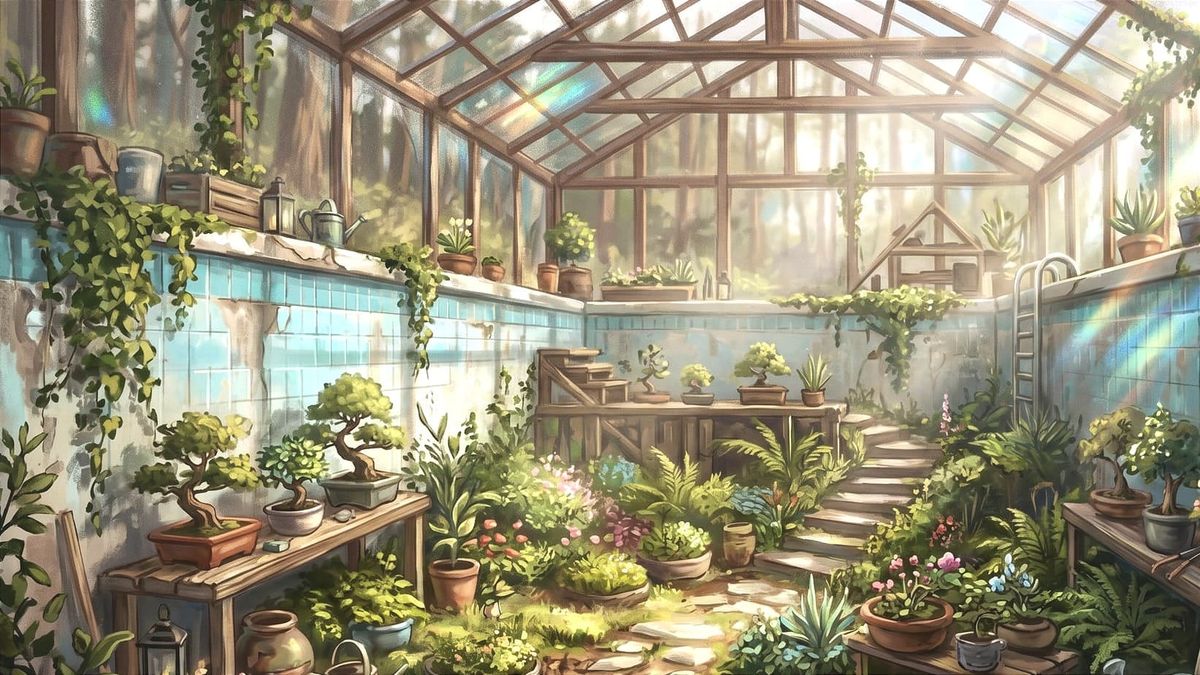
Soon, I found his space by accident—the community greenhouse that used to be a swimming pool.
The door creaked open into warmth and humidity that felt like stepping into a held breath.
Trees—tiny, curated, and shapely—lined every surface.
“Don’t touch that.”
I jumped on cue and saw that he was behind me.
“I wasn’t—”
“You were about to or thinking about it.”
He stepped past me, adjusting a branch I hadn’t even noticed was wrong.
“These things, you shape them slowly,” he said. “You don’t ever rush them.”
“I don’t rush things,” I replied defensively.
He glanced at me.
“From what I’ve seen so far, you do.”
The terrible truth came out in one of those moments.
“I flooded a wedding,” I said.
He didn’t react, so I kept going.
“Like… actually flooded it. There was chocolate everywhere. It happened right after the first dance. It was—” I laughed, but it sounded wrong. “It was really freakin’ bad.”
He waited.
“I knew something was off,” I added quietly. “I could feel it before the bride stepped onto the dance floor.”
“I’m guessing you quit right after. Am I wrong?” he asked.
I swallowed.
“If I stayed, I thought I’d make it worse. I’m already banned from the venue.”
“So you did nothing,” he said.
He showed me an imperfect tree, one where a branch bent the wrong way. There was also a scar where something had been cut too harshly.
“You see all that? Yet, it’s still here in all its glory,” he said.
“Is that supposed to make me feel better?” I asked.
He almost smiled.
“You don’t fix a situation by running away from it,” he said. “You grow around it.”
Weeks passed, and I slowly got used to life at Tranquility Cove.
The community eventually wanted a gathering of some kind to celebrate Earth Day.
“No,” I said immediately.
“But you’re literally an event planner,” Leo pointed out.
“Former,” I corrected.
Foster didn’t say anything, which was worse.
That night, I stared at the empty spaces of the park.
“Fine,” I whispered.
When Saturday night came around, lights draped across structures like quiet constellations. Music drifted in and out depending on where you stood. People moved instead of gathering, forming and reforming small pockets of conversation.
Of course, as if expected, the music cut out and someone spilled a drink. Glass clinked against concrete. I moved fast, with the instincts of a true event planner.
“Hey,” I said, grabbing a towel, laughing lightly. “We’re not letting gravity win tonight.”
The music came back. No one panicked, and no one left.
Halfway through the evening, I caught him watching me.
When the party wound down quietly, Foster sat beside me on a sagging beanbag.
“It didn’t fall apart,” he said.
And Foster’s hand found my waist like it had always known where to go.
You’ve reached the end of this story.
But not the end of the world it belongs to.
New stories appear regularly.
Stay curious.
If you want more stories like this, explore the full Petalstorm Press library → HERE
© Petalstorm Press — Original Fiction
This story is part of the Petalstorm Press library.
Redistribution or reproduction without permission is prohibited.
All stories shared through Petalstorm Press—and the channels linked here—are the official home of this work. Any versions found elsewhere are not authorized unless clearly noted.