Evenings at Aurora Station
A soft romance set on a frozen planet, where two station workers navigate isolation, survival, and a connection that has been building for years. Until a storm forces them to finally confront it.
A Short Story by Avia Nevoir
Mail wasn’t supposed to feel personal this far from Earth, but this one did.
The letter arrived inside a container humming with regulated warmth. Even paper required protection from the merciless temperament of Gelid-9.
It slid unceremoniously from the chute. The corners were rimmed with a lace of frost that dissipated the moment it crossed into the geothermal corridor of Aurora Station.
Celeste noticed it first. She paused mid-motion, one hand dusted in flour, the other still holding a copper spoon that smelled faintly of caramelized sugar and orange peel.
Mateo, kneeling beside a rack of nutrient trays where embryonic citrus hybrids stretched their tentative leaves toward artificial sunlight, did not look up immediately.
He was speaking softly to the plants in a cadence that might have sounded like nonsense to anyone else.
“There’s something for you,” she said, nudging the container open with her elbow.
“For me?” he asked, as though unexpected gifts were a statistical anomaly.
“It has your name on it,” she said. “And unless someone else here has been secretly living a double life as Mateo Algernon, I think it’s safe to assume it’s yours.”
He stood, brushing soil from his palms, and crossed the greenhouse kitchen with unhurried steps that suggested he was buying time to consider what this could mean.
Communication from Earth was infrequent and heavily filtered, and physical deliveries were rarer still, often reserved for essential components or experimental luxuries deemed worth the cost of interstellar transport.
The envelope was thick, textured, almost archaic in its insistence on being touched rather than scanned.
Mateo hesitated before opening it, his thumb tracing the seal as though it might contain something volatile.
“You’re staring at it like it’s going to bite,” Celeste observed, leaning against the counter.
“I’ve had worse experiences with envelopes,” he said. “Corporate contracts, for example.”
He smiled despite himself, then broke the seal.
Inside was a single sheet of paper, handwritten, the ink slightly uneven. A confirmation of its human origin. Mateo read silently at first, his expression shifting from curiosity to introspection.
“Well?” Celeste asked.
“It’s from Earth,” he said.
She rolled her eyes.
“No way... next thing you know, it's written on paper too.”
“Just messing with you. It’s actually from the training archive,” he continued.
“They’ve started sending… artifacts. Personal records. Things they think might help maintain psychological stability.”
Celeste raised an eyebrow. “So they’re mailing us nostalgia now.”
“It seems so.”
He handed her the letter.
It was a copy of an old evaluation report, annotated in the margins with casual notes from instructors long gone from their daily lives.
There were references to their early days of space training, to shared exercises, to moments that had seemed inconsequential at the time but now carried an unexpected weight.
One note, written in looping script, read:
“Subject Algernon demonstrates exceptional adaptability. Frequently collaborates with Subject Celeste Wayra. Their synergy is notable—efficiency improves when they are paired. Recommend continued joint assignments.”
Celeste’s lips curved upward. “We were efficient,” she said.
“We still are,” Mateo whispered.
The Warmest Place on a Frozen World
Years had passed since that letter’s arrival, though time on Gelid-9 had a peculiar elasticity, stretching and compressing itself.
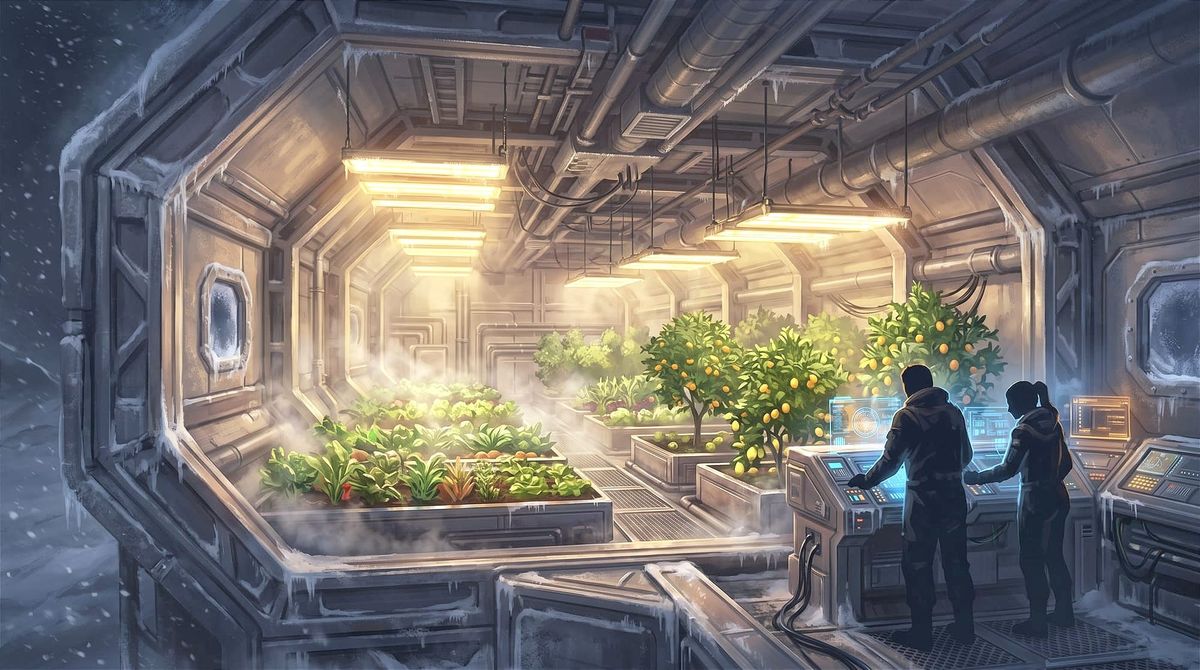
The thermal greenhouse kitchen remained the heart of Aurora Station, a sanctuary where heat gathered, where the air smelled of herbs and citrus and the sweetness of cultivated soil.
The Head Chef, Celeste, moved through the space with an intuitive grace. She orchestrated meals that were less about sustenance and more about remembrance.
She believed, with a conviction that bordered on the philosophical, that food was a language capable of translating the intangible into something immediate and tangible.
Mateo was the station's Pollination Technician. He ensured that life continued in defiance of an environment that seemed designed to extinguish it. His work was meticulous, requiring patience and a steady hand, but he approached it with an enthusiasm that made even the most repetitive tasks feel purposeful.
Their dynamic was effortless.
They moved around each other without collision, spoke in half-sentences that required no clarification, shared moments that were neither awkward nor empty.
To an outside observer, they might have appeared inseparable, their connection so seamless that it defied easy categorization.
Everyone assumed they were together.
They were not.
Small Worlds
Aurora Station was not the largest station on Gelid-9, but it was populated by individuals who had chosen this life with varying degrees of intention and understanding.
Astara Van, the Habitat Maintenance Technician, spent her days repairing microfractures in the station’s outer shell, her hands perpetually marked by the residue of sealants and thermal compounds. She possessed a dry humor that surfaced unexpectedly, often at moments when tension ran highest.
“If this place collapses,” she once remarked while tightening a bolt above the greenhouse entrance, “at least we’ll all die knowing we had excellent vegetables.”
“You’re a comforting presence,” Celeste replied.
“I try,” Astara said.
There was also Dr. Touma Rito, the Station Psychologist, whose calm demeanor masked an acute awareness of the psychological strain inherent in their isolation.
He said little, but never carelessly; when he spoke, it was with the confidence of someone who had already considered the outcome.
“You two,” he once said to Celeste and Mateo, “have constructed a very stable equilibrium.”
Finally, there was Lennox Rhodes, the Morale Officer, who approached his role with a theatrical enthusiasm. He organized events, celebrations, and parties designed to remind the colonists that they were more than their work.
“Tonight is themed,” he announced one evening, appearing in the greenhouse wearing a scarf that shimmered like captured aurora light. “We are celebrating ‘Summer Nostalgia.’ Please prepare outfits that remind you of summertime.”
Little Things
Surrounded by everyone’s rituals of remembrance, Celeste stopped trying to recreate anything.
The past, she realized, was nonsensical to hold onto out here.
She started paying attention to what was still here.
Small things, mostly.
The way the greenhouse lights reflected in Mateo's eyes when he looked up too quickly, startled by nothing in particular.
One evening, she slightly burned a batch of muffins.
Mateo glanced over from where he was kneeling beside a row of flowering vines.
“Is that salvageable?” he asked. “Or are we witnessing a tragedy?”
She rolled her eyes, but instead of discarding it, she adjusted—added cream, a hint of citrus, something sweet to round the bitterness.
Wasting food on Gelid-9 was its own kind of sin.
When she handed it to him, he tasted it anyway.
“It’s good,” he said.
“It’s so not,” she replied.
“It is,” he insisted. “It’s just… unexpected.”
“That’s a polite way of saying it sucks.”
They began staying a little longer after their shifts ended, sitting on overturned crates or leaning against warm metal surfaces, talking about things that didn’t matter and somehow mattered anyway.
Mateo started bringing her the first imperfect fruits from each new growth cycle, the ones that wouldn’t make it into official supply because they were slightly misshapen or too small.
“These are the best ones,” he said once, handing her a lopsided citrus with a grin.
“No one else gets them but us,” he added. “They’re exclusive.”
Later, she sliced it open, the scent bright against the warmth of the greenhouse, and handed half back to him without thinking.
On a planet where everything else felt vast and unyielding, that closeness became a place they returned to without naming.
The Realization
One night, beneath a sky shimmering with auroras so vivid they seemed almost sentient, they shared a bowl of potato soup neither of them had explicitly planned.
And yet, when Mateo tasted it, he paused.
“You’re doing that thing again,” she said.
Mateo glanced up, caught between distraction and awareness.
“What thing?” he asked.
“Your mind stops,” she said. “Like you’ve gone to a different world and forgotten to tell me.”
He let out a breath, looking back down at the dish as though the answer might still be there.
“Potato soup,” he said.
Celeste leaned slightly against the counter, watching him now.
“That’s right,” she replied. “Potatoes again.”
He shook his head once.
“No,” he said. “I don't mean that.”
He tried again, slower this time, letting the taste settle without forcing it into meaning.
“It feels like I’ve already been here,” he continued.
“About to say something I haven’t said yet.”
“Then say it,” she said, like she already knew what it was.
The auroras moved slowly above them, light bending across the reinforced glass in iridescent waves.
“Or maybe,” she said at last, her voice softer now, “you just haven’t let yourself get there yet.”
Mateo didn’t argue.
He picked up the spoon again, finishing the dish without further comment.
Celeste did the same.
The Storm
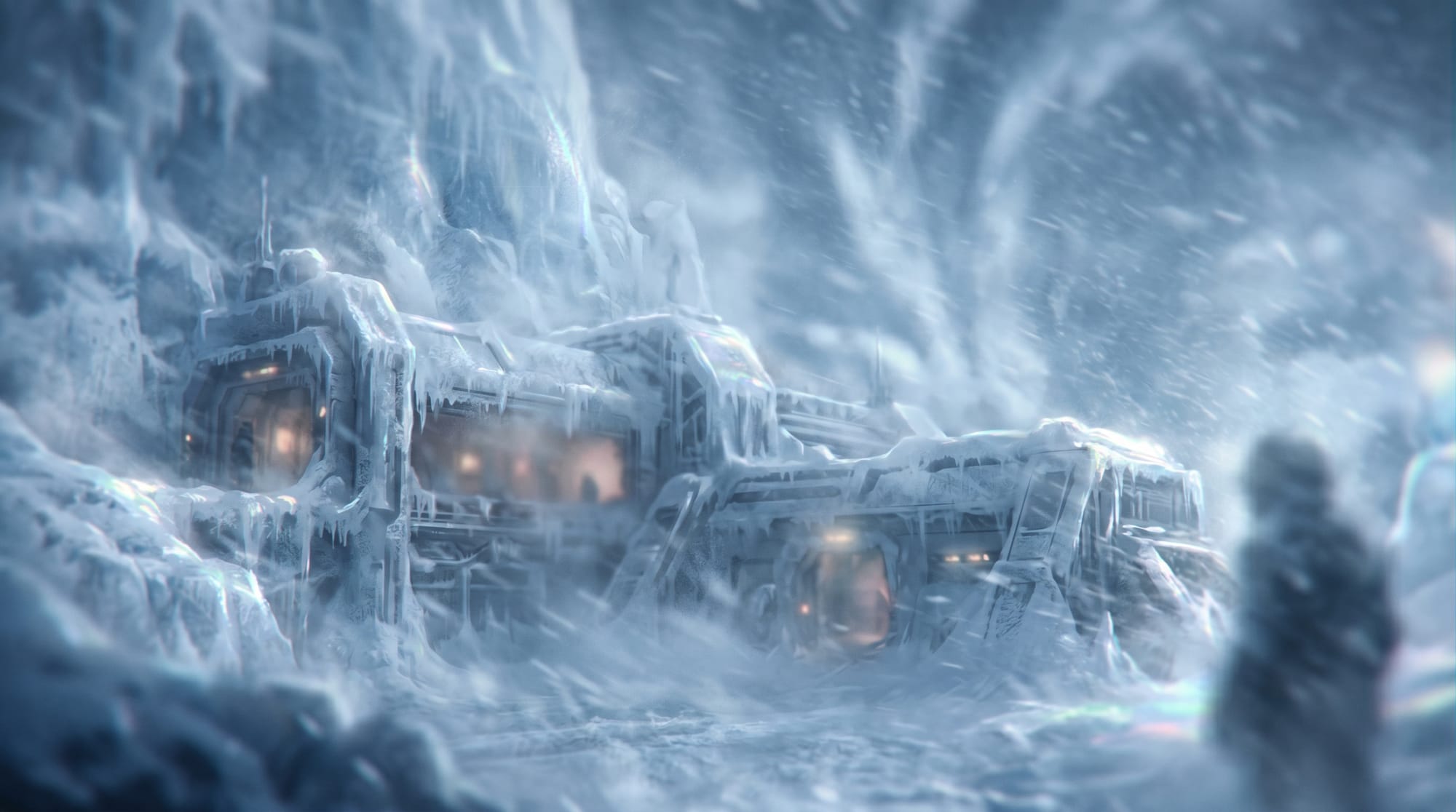
A once-a-decade ice storm cycle was approaching, its trajectory calculated with unsettling precision. Systems would be strained, contingencies activated, priorities reassessed.
Aurora Station shifted into a state of heightened awareness.
Astara worked tirelessly to reinforce structural weak points, her movements brisk and purposeful.
“This is going to be either unpleasant or excruciating,” she said, which was her way of acknowledging the severity of the situation.
Dr. Rito increased his rounds, monitoring stress levels, offering reassurances that felt both sincere and insufficient.
Lennox attempted to maintain morale, though his usual exuberance was tempered by the gravity of the circumstances.
And then the directive came. If systems failed, only core personnel would be moved to the inner geothermal shelter.
The shelter had been designed around personnel classifications, not relationships, and the storm had reduced capacity to the cruelest possible number.
The directive glowed on the panel between them, indifferent and final: GREENHOUSE DIVISION — ONE TRANSFER CLEARANCE AVAILABLE.
The Breaking Point
“You’re going,” Mateo said immediately.
“No,” Celeste said.
“You’re essential,” he continued. “The station needs you.”
“It needs you just as much. No one on the station has your skill set,” she said.
“It can be taught,” he argued.
“Your integrity is irreplaceable,” he added.
“No,” she said.
The argument was not loud, but it carried an intensity that neither of them had allowed themselves before.
“You should go,” he said again, softer this time.
“And leave you?” she asked.
“Yes,” he said.
“I’m not leaving,” she added.
Beneath their words, there was something deeper, something that had been accumulating for years, pressing against the boundaries of their restraint.
“I’m not losing you,” she said.
The Confession
The storm had not yet reached its peak, but Aurora Station had begun to feel it.
A low, constant tremor moved through the structure. The greenhouse lights dimmed intermittently. Beyond the glass, the sky had collapsed into a relentless white, the horizon erased completely.
Celeste stood near the thermal reserves, rerouting auxiliary heat into portable units. The process was manual, inefficient, and absolutely necessary if any part of the greenhouse lost power.
Mateo moved between stations, securing loose equipment, double-checking seals that had already been verified twice before.
“We should redistribute the smaller units,” he said, lifting one of the portable cores and setting it closer to the root trays. “If one section fails, at least it won’t take everything with it.”
Celeste nodded, already adjusting the output levels.
“That’s assuming we get partial failure,” she said. “If the grid goes entirely, these buy us minutes at best.”
“Minutes matter,” he replied.
“We’ve done what we can for now,” he said.
Another tremor passed through the station, stronger this time.
“If it fails,” he said, his voice less certain than she had ever heard it,
“they’ll call the evacuation before we can stabilize anything.”
Celeste exhaled slowly.
“I didn’t want it to come down to that,” he said.
Mateo reached for her hand without thinking.
“To what?” she asked.
“To choosing who gets left behind,” he said.
Celeste turned her hand slightly beneath his, and their palms aligned.
“That’s not the only choice we’ve been avoiding,” she said.
Mateo’s breath caught, subtle but unmistakable.
“No,” he admitted.
Another flicker of the lights.
The storm pressed harder against the glass, a distant, growing force.
“I kept telling myself it was better this way,” he continued. “That if we didn’t change anything, we wouldn’t risk losing it.”
“What we have?” she asked.
“Yes.”
Celeste tilted her head slightly, considering that.
The station groaned again, louder now.
“I don’t want to spend whatever time we have left pretending this isn’t real,” she said.
“It is real,” he said.
“Then say it,” she replied.
The storm surged outside, a rising crescendo.
Inside, everything stilled.
“I love you,” he said.
Celeste held his gaze, steady, unwavering.
“I know,” she said softly. “I love you too.”
Then the lights flickered again—harder this time.
A warning tone sounded somewhere deeper in the system.
Celeste glanced toward the control panel.
Mateo followed her gaze.
“We’re not done yet,” she said.
The Choice
When the shelter call came, it echoed through the station with mechanical indifference.
Instead of running towards the relocation route, they turned toward the greenhouse systems, their actions instinctive, coordinated.
“We don’t have enough output,” Mateo said, already scanning the control panel, his voice shifting into that focused register Celeste had heard a hundred times before.
“The vents can’t compensate if the external temperature drops any further.”
“Mateo,” she said. “How much heat are the lower trays retaining?”
“Not enough,” he said automatically—then paused.
“Wait a minute.”
He moved quickly, pulling up thermal readings, fingers flying with a precision born from repetition and necessity.
“The root beds,” he said. “They’re holding more than the air. The soil’s retaining heat longer than the system can circulate it.”
Celeste nodded once.
“Then we stop heating the air,” she said. “We heat the ground.”
He blinked. “That’s—”
“Backward?” she said. “Yes. So was cooking on open flame before someone figured out ovens.”
It was risky.
A crack and whoosh sounded somewhere above them.
“Structure’s starting to stress,” Mateo said.
“We don’t have time to do this clean,” Celeste replied. “We just have to do it right enough.”
Mateo rerouted the geothermal flow, bypassing the standard distribution system and forcing heat directly into the root network. It wasn’t designed for that kind of load, and the interface resisted him like it knew.
“Come on,” he muttered under his breath, fingers adjusting values that weren’t meant to be adjusted.
Celeste, meanwhile, began shutting down nonessential systems without waiting for clearance.
“Celeste,” he said, glancing over. “If you cut too much, we lose circulation entirely.”
“If we don’t,” she said, not looking up, “we lose everything evenly instead.”
The greenhouse shuddered again.
Frost spread faster now, creeping inward across the glass, turning transparency into opacity.
“Mateo,” she said.
“Don't worry, I got it.”
He adjusted one final parameter.
For a moment, nothing happened. Then the heat permeated inward, into the soil and into the roots.
The Aftermath
The storm passed and Aurora Station endured.
When the final all-clear came, it felt almost anticlimactic—just another announcement over the system, delivered in the same neutral tone as every other.
The greenhouse glowed once more, new growth pushing through the soil with determination.
Celeste and Mateo stood side by side, their hands brushing intentionally, their smiles lingering.
“That was a half-baked plan,” he said.
“It shouldn’t have worked,” he murmured.
Outside, the storm began to thin, the sky changing from opaque white to a luminous silver.
Inside, their hands didn’t drift apart.
You’ve reached the end of this story.
But not the end of the world it belongs to.
New stories appear regularly.
Stay curious.
✦ Related Reading & Themes
This story explored:
the inevitability of connection built over time
how small, shared moments can become something impossible to ignore
the tension between restraint and truth when time is no longer guaranteed
the way people choose each other—not all at once, but gradually, and then all at once
how survival can reveal what was already there beneath the surface
the idea that some confessions aren’t sudden, just delayed
Tags for similar stories:
sci-fi romance, space station setting, soft sci-fi, slow burn romance, friends to lovers, forced proximity, end of the world tension, survival romance, quiet love story, emotional restraint, character driven fiction, atmospheric fiction, introspective fiction, subtle romance, found connection, inevitability, soft dystopian, partnership under pressure, cinematic storytelling, reflective fiction
✦ If You Liked This Story
You might also enjoy:
The World Beneath the Skywall - A young scientist falls through the Arctic ice and discovers a hidden world beneath it—where a man who has never seen the sky is willing to risk everything to see it.
If you want more stories like this, explore the full Petalstorm Press library → HERE
© Petalstorm Press — Original Fiction
This story is part of the Petalstorm Press library.
Redistribution or reproduction without permission is prohibited.